Last reviewed: November 2026. We review this guide every year.
The short answer: an IQ test is a standardised set of reasoning, memory and problem-solving tasks. It compares a child’s performance with others the same age, with 100 set as average. A professional test takes about an hour with a psychologist. It measures key thinking skills well, but not creativity, effort or character.
Key takeaways
- There is no fixed number of questions. Each task gets harder until a child reaches the edge of their ability, so nobody is expected to answer everything.
- The WISC-V, the most widely used test for children, takes about 60 minutes of testing, according to its publisher Pearson.
- An American Psychological Association task force found IQ scores correlate about 0.5 with school grades. That is meaningful, but far from the whole picture.
- Most online IQ tests have no proper norms, so their scores cannot be trusted as a true IQ.
- An IQ score cannot measure effort, creativity or character, and scores from children under 7 can change a lot.
How does an IQ test work?
An IQ test works by comparison, not by counting right answers. A child’s results are measured against a large group of children the same age, called the norms. The score shows how far above or below that average they performed.
In years of teaching and tutoring, I have watched parents treat an IQ score as a verdict. It isn’t one. It is a snapshot of certain thinking skills, taken on one day. Understanding how the test works is the best protection against misreading it.
Where did IQ tests come from?
French psychologists Alfred Binet and Théodore Simon built the first practical intelligence test in 1905. France’s education ministry wanted a fair way to find children who needed extra help at school. In 1912, German psychologist William Stern proposed the “intelligence quotient”: mental age divided by real age, times 100.
Here is the detail I always share with parents. Binet believed intelligence could grow, and he warned that no single test could capture it (New World Encyclopedia). Today’s tests no longer use Stern’s formula, but Binet’s purpose still holds: the test exists to help children, not to rank them.
What happens in a professional IQ test?
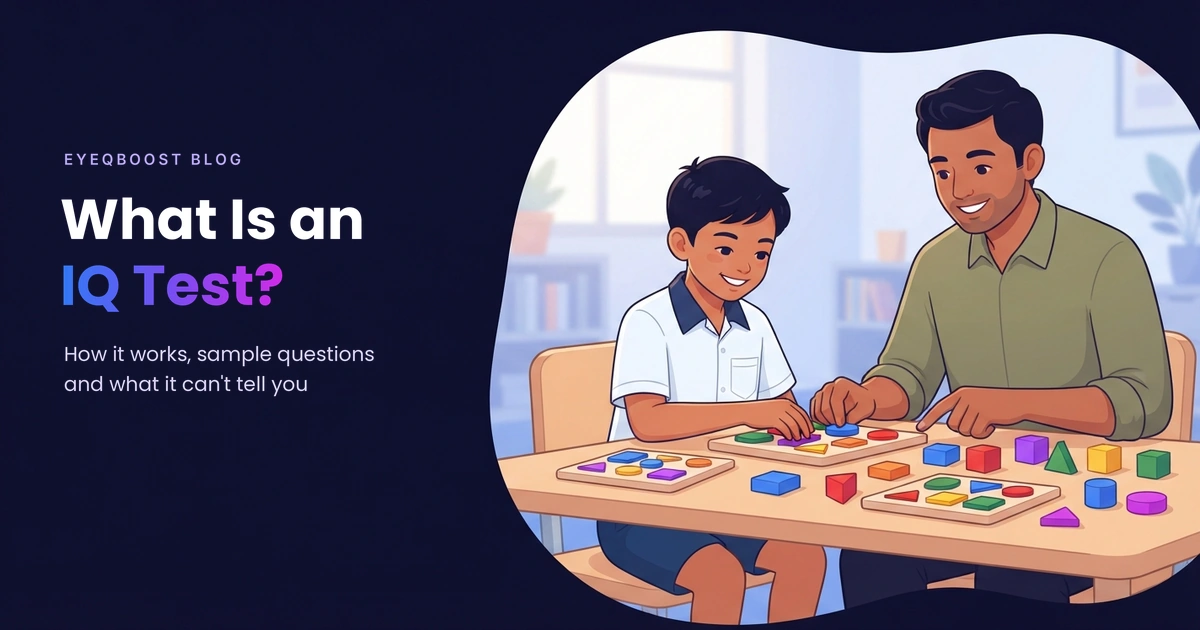
- It is one-to-one. A qualified psychologist sits with one child, reads scripted instructions and records every answer.
- It is adaptive. Tasks start at an age-suited level and get harder until they become too difficult.
- It mixes tasks. Some use words; others use pictures, blocks or puzzles, and some are timed.
- It produces a profile. The WISC-V gives a Full Scale IQ plus five index scores, as Riot IQ’s overview of the WISC explains.
Which thinking skills does an IQ test measure?
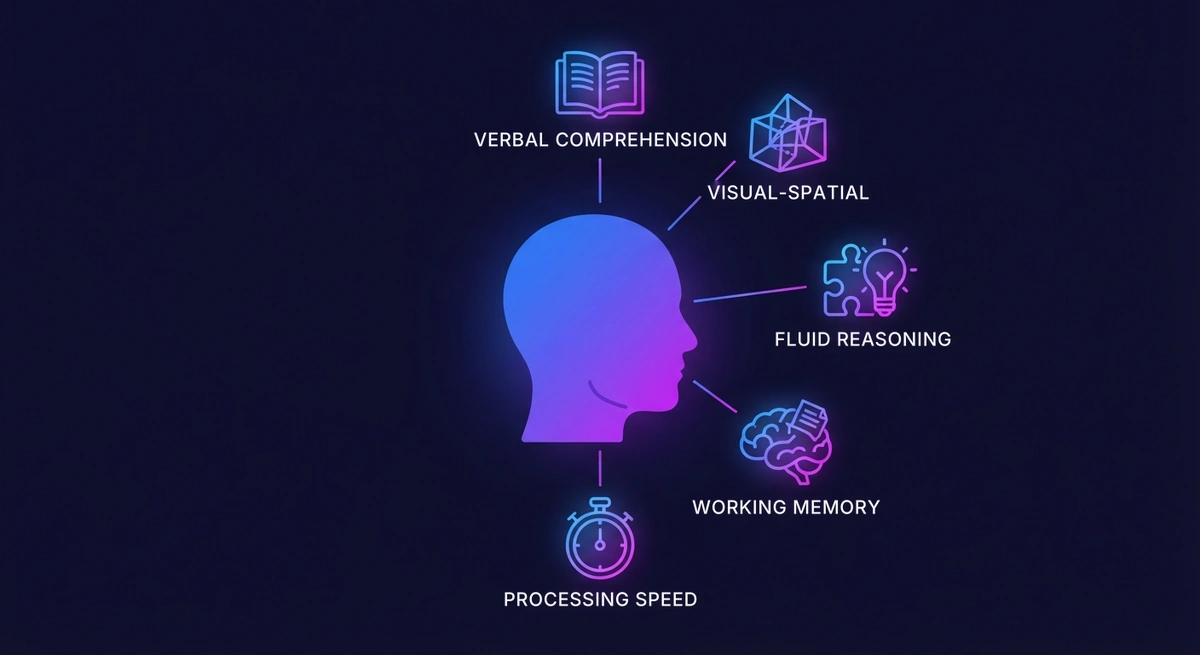
Most children’s IQ tests look at five areas:
- Verbal comprehension: understanding words, ideas and explanations.
- Visual-spatial skills: picturing shapes and how they fit together.
- Fluid reasoning: solving a brand-new problem by spotting the rule.
- Working memory: holding information in mind while using it.
- Processing speed: doing simple visual tasks quickly and accurately.
The pattern across these areas often tells a teacher more than the overall score. What the overall numbers mean, and the ranges psychologists use, is covered in IQ Scores Explained.
How long does an IQ test take?
Most professional IQ tests for children take 45 to 65 minutes of actual testing. The appointment itself usually runs longer, with a parent chat at the start and breaks for younger children.
Pearson lists the WISC-V core subtests at about 60 minutes. The Education Endowment Foundation’s entry for the UK edition gives 48 minutes for the Full Scale IQ and 65 for all five index scores. The Stanford-Binet takes about 5 minutes for each of its 10 subtests, according to its publisher PAR.
How many questions are on an IQ test?
There is no fixed number. Each subtest stops once a child misses several items in a row, so two children the same age may answer very different numbers. A few tests are fixed-length: Raven’s Standard Progressive Matrices has 60 puzzles that grow steadily harder.
Teacher’s tip: Tell your child it is a morning of puzzles and games, not an exam. Children who arrive rested, fed and relaxed show what they can genuinely do.
How many IQ tests are there?
There are dozens of IQ tests, but psychologists rely on a handful of well-researched ones. These are the names you are most likely to see on a report.
| Test | Ages | Format | Best known for |
|---|---|---|---|
| WPPSI-IV | 2.5yrs – 7.5yrs | One-to-one, verbal and non-verbal | Young children around school entry |
| WISC-V | 6yrs – 17yrs | One-to-one, about 60 minutes | The most common test for school-age children |
| WAIS | 16yrs – 90yrs | One-to-one | Older teenagers and adults |
| Stanford-Binet 5 | 2yrs – 85yrs+ | One-to-one, 10 subtests | One kit for every age; strong at the very high and very low ends |
| Raven’s Progressive Matrices | 6yrs+ | Pattern puzzles, no language needed | Children tested in a second language |
Sources: Pearson, Annabelle Psychology, PAR, Lancaster University.
For Malaysian families, language matters. Many of our children learn in two or three languages, and a verbal test in a weaker language can understate ability. A UNIMAS study found that two non-verbal tests, Raven’s Coloured Progressive Matrices and the TONI-4, worked well with Malaysian primary school children.
Even so, “non-verbal” does not mean “culture-free”. A 2022 review in Cognitive Research shows pattern puzzles still lean on habits of thinking that schooling builds.
What do IQ test questions look like?
IQ test questions are short puzzles that test reasoning, memory and speed, not school knowledge. Real items are kept confidential by publishers, so the six below are our own, written in the style of common IQ test questions. Try them with your child and talk about how they worked each one out.
Verbal reasoning: Bird is to nest as bee is to ___? (a) flower (b) hive (c) honey (d) wing
Answer: (b) hive. It checks whether a child can spot a relationship (an animal and its home) and apply it again.
Number patterns: 2, 5, 11, 23, ___?
Answer: 47. Each number is doubled, then 1 is added. This is fluid reasoning: finding a rule nobody has explained.
Odd one out: Carrot, potato, apple, onion. Which one does not belong?
Answer: apple, the only fruit. Children must group by meaning, not by look or sound.
Visual matrix: A 3 × 3 grid has circles in the top row, squares in the middle and triangles at the bottom. Across each row, the shapes gain one dot: one, two, then three. The last box is empty. What goes there?
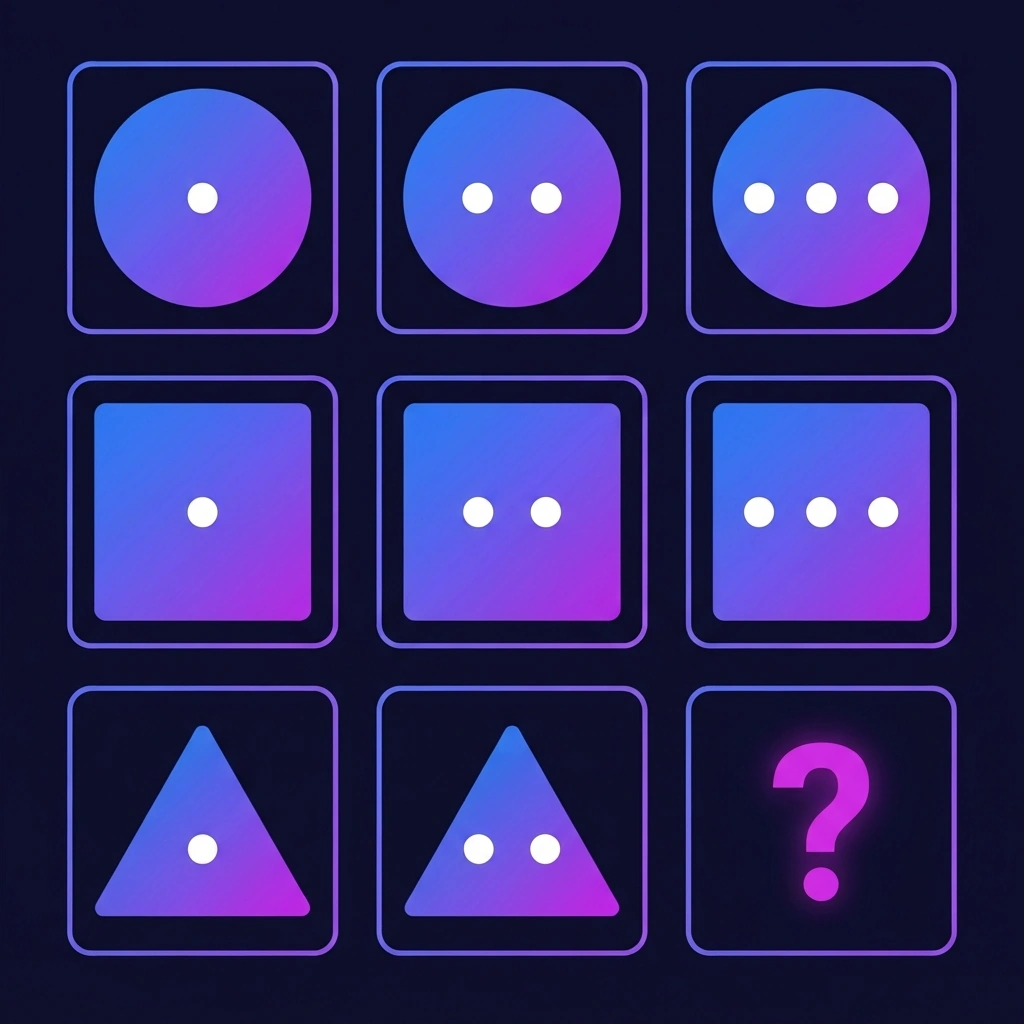
Answer: a triangle with three dots. This is the classic matrix format that Raven’s tests use.
Working memory (said aloud): “Listen: 7, 2, 9, 4. Now say the numbers backwards.”
Answer: 4, 9, 2, 7. Holding a list in mind while reversing it is a working-memory task.
Processing speed: A child sees rows of symbols and has two minutes to tick every one that matches a target.
There is no trick. It measures how quickly and accurately a child scans and decides.
Want more puzzles like these? Our free brain games let children practise pattern spotting, memory and focus in short, playful rounds. Try Code Cracker for rules and patterns, or Span Ladder for working memory.
Do IQ tests really measure intelligence?
Yes, IQ tests are real and they work, but they measure part of intelligence, not all of it. A professional IQ test is one of the most carefully studied tools in psychology. The real question is what exactly it captures.
What does the research support?
- They are consistent. The Stanford-Binet’s technical data shows reliabilities of .95 to .98 for its main scores. A child tested twice in good conditions gets very similar results.
- They predict school learning. A 1996 American Psychological Association task force led by Ulric Neisser found IQ scores correlate about 0.5 with school grades. That is meaningful but far from the whole story, as newer research on IQ and school grades shows.
- They measure skills that matter. Reasoning, memory and verbal understanding are used in every school subject.
Why do IQ scores keep rising?
This surprises most parents. Average scores on IQ tests rose by about 3 points every decade through the 20th century, so tests must be re-normed regularly. Researchers call this the Flynn effect, after James Flynn, a political scientist based in New Zealand.
Genes cannot change that quickly, so the rise points to schooling, nutrition and modern life. Flynn himself saw it as growth in abstract problem-solving rather than a jump in intelligence itself. In other words, IQ tests measure thinking skills that experience helps to shape, just as Binet believed over a century ago.
Is an online IQ test accurate?
Most online IQ tests are not accurate enough to give a true IQ score, though a well-made one can give a rough picture. The difference comes down to who built the test and who it compares your child with.
Many online tests compare you with whoever happened to take them online. Psychologist Russell Warne explains that such a self-selected group cannot produce accurate norms. And with no psychologist in the room, nobody notices if a child is tired, anxious or guessing.
How can you tell if an IQ test is legit?
Watch for these five red flags:
- No named author. Nobody qualified takes responsibility for the questions.
- No information on norms. It never says who your score is compared with.
- Very few questions. A handful of puzzles cannot measure several abilities reliably.
- One exact number. Real reports give a range, because every test has a margin of error.
- A paywall for your “result”. Flattering scores locked behind payment are a marketing tactic, not science.
Which IQ test is most accurate?
The most accurate IQ test is an individually given one, such as the WISC-V or Stanford-Binet, run by a qualified psychologist. Even so, there is no single “best” test for every child. A good psychologist picks the test that fits the child’s age, language and the question being asked.
What can’t an IQ test tell you?
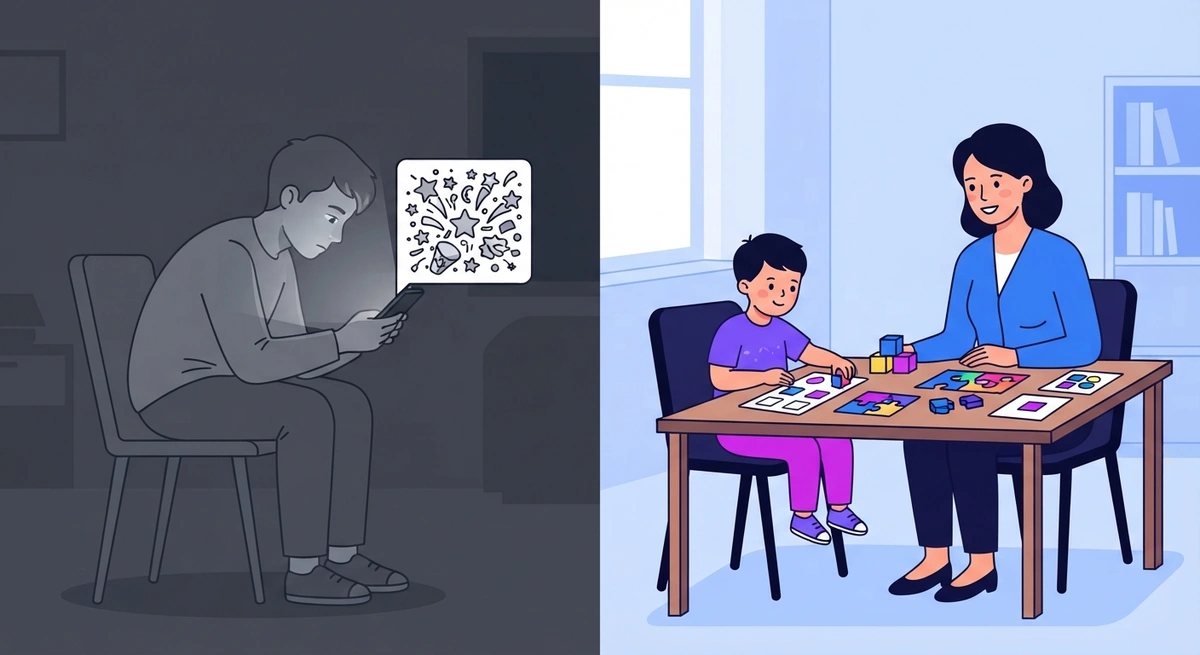
An IQ test cannot tell you how hard your child will work, how creative or kind they are, or what they will become. These are the limits I wish every parent heard before reading a report.
It can’t measure effort. In a 2005 study of 140 eighth-graders, Angela Duckworth and Martin Seligman found that self-discipline explained more than twice as much of the variation in final grades as IQ. But a 2022 study of 589 Czech pupils by Alexander Vazsonyi and colleagues found the reverse. The fair reading is that both matter, and habits are something families can build every day.
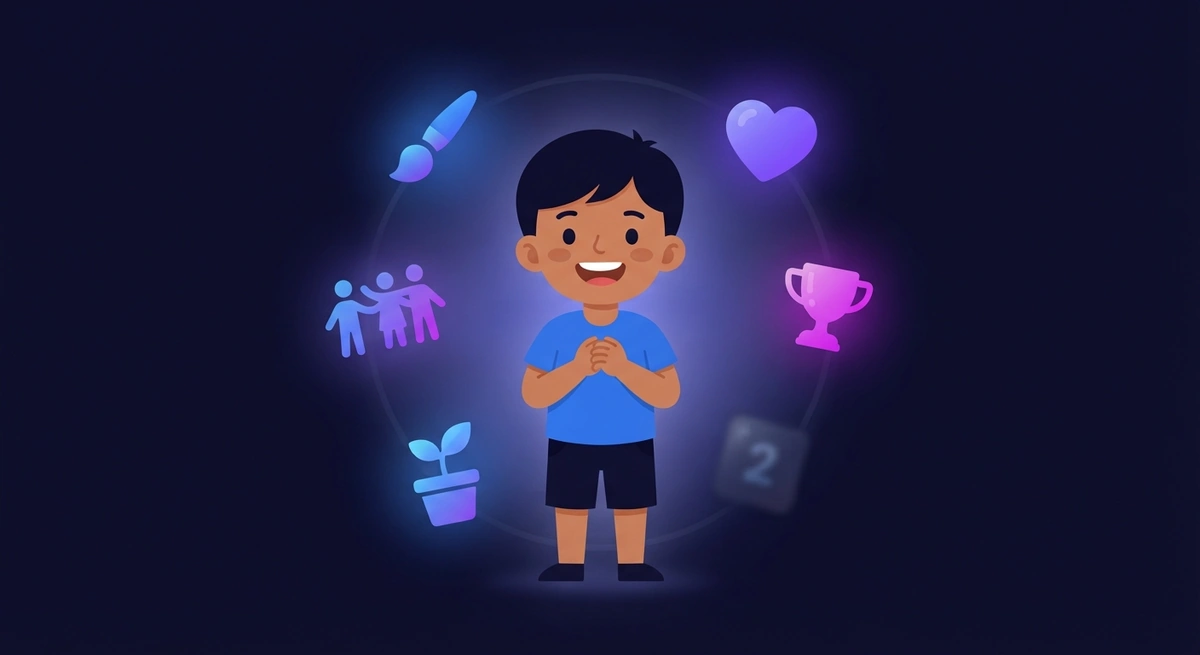
It can’t see creativity, character or resilience. No IQ task measures curiosity, kindness, courage or leadership. Yet these often carry a child through a hard term, and through life, which is why we believe in educating the whole child.
It can’t fix a young child’s future. Scores are a weak guide to later ability before about age 7, as we explain in how a child’s IQ score can change. A score at age 5 is a starting point, not a forecast.
What does this mean for your child?
Treat an IQ test as a tool for understanding your child, never as a label. Used for the right reason, it can open the right support. Used out of curiosity, it mostly creates worry.
When is an IQ test worth doing?
IQ tests are done to answer a real question about how a child learns. A psychologist may suggest one to:
- explain why a bright, chatty child is struggling to read or keep up
- help identify a learning difficulty, such as dyslexia, alongside other assessments
- identify giftedness, when a child is far ahead and needs more challenge
- support a placement, such as special needs schooling or extra exam time
Singapore practice Annabelle Psychology puts it plainly: wanting to know if a child is “intelligent enough” is not a reason to book an assessment.
Tips for parents
- Choose the right professional. In Malaysia, look for a clinical or educational psychologist trained in standardised testing. Clinical psychologists must be registered with the Malaysian Allied Health Professions Council under the Allied Health Professions Act 2016, and you can check a registration on the Ministry of Health’s practitioner directory, mhps.moh.gov.my (TherapyRoute). Educational psychologists have no official register, so ask about their training in testing instead.
- Ask about language. Check which language the test will use, and whether a non-verbal test would suit your child better.
- Ask for the profile, not just the number. Strengths and weaknesses across the five areas guide the next steps.
Tips for teachers
- Share what you see. Notes on how a pupil copes with reading, memory or timed work help a psychologist enormously.
- Use the report to plan support, such as extra time, shorter instructions or visual aids.
- Keep scores private. A child should never learn their “number” from a classroom conversation.
Where EyeQBoost fits in
We do not run IQ tests, and we make no IQ promises. What we do is work on the skills these tests touch, such as attention, working memory, visual processing and reasoning. We pair them with real reading practice and the emotional and character strengths no test can measure. Read more about our Academic Excellence programme.
Frequently asked questions
Is an IQ test free?
Online IQ quizzes are often free, but they are not professional tests. A proper assessment with a psychologist is a paid service, and fees vary by practice. When you ask for a quote, check whether it includes the parent interview, the written report and a feedback session. Those three parts are where most of the value lies.
Can an IQ test score be improved?
Partly. Schooling has the strongest evidence: each extra year of education adds about 1 to 5 IQ points. Brain games sharpen the skills they train, but there is no good evidence they raise IQ itself (see Does Brain Training Actually Work?). Our guide to IQ scores covers what else makes a score move.
Should my child practise for an IQ test?
No. Coaching on puzzle rules can lift scores sharply. Psychologist Russell Warne describes a study where a 15-minute video on matrix rules raised scores by 15 points. That sounds helpful, but it gives the psychologist a false picture of your child. The support that follows may then be wrong for them.
How soon can a child retake an IQ test?
Ask the psychologist, because retesting too soon inflates scores. Warne notes that simply taking a test a second time adds about 5 points, with no change in real ability. A good psychologist will also choose a different test, or wait long enough for familiarity to fade.
At what age can a child take an IQ test?
The WISC-V, the most common children’s test, is used from age 6 to 16, and the WPPSI covers younger children from about 2½. Young children can be tested, but their scores are a rough guide until about age 7.
Can a child fail an IQ test?
No. There is no pass mark. Every child meets questions they cannot answer, because the test keeps going until it finds the edge of their ability. Getting items wrong is part of how the test works, so it is worth telling your child this beforehand.
Is an IQ test the same as a school exam?
No. A school exam checks what a child has been taught. An IQ test looks at how a child reasons, remembers and solves new problems. That is why revision does not prepare for it, and why a child can do well in one and not the other.
Should I tell my child their IQ score?
In my experience, rarely. A number easily becomes a label, either “I’m smart, so I don’t need to try” or “I’m not clever”. Talk instead about what they do well and what they are working on. That keeps the focus on effort and growth.
Wondering where your child’s strengths really lie?
Book a free 30-minute assessment. It is not an IQ test, but a friendly online look at how your child learns, with you joining at the start and for the feedback chat at the end.
References
Studies
- Breit, M., Scherrer, V., Tucker-Drob, E. M., & Preckel, F. (2024). The stability of cognitive abilities: A meta-analytic review of longitudinal studies. Psychological Bulletin, 150(4). Author PDF
- Duckworth, A. L., & Seligman, M. E. P. (2005). Self-discipline outdoes IQ in predicting academic performance of adolescents. Psychological Science, 16(12), 939–944. https://doi.org/10.1111/j.1467-9280.2005.01641.x
- Neisser, U., et al. (1996). Intelligence: Knowns and unknowns. American Psychologist, 51(2), 77–101. https://doi.org/10.1037/0003-066X.51.2.77
- Ritchie, S. J., & Tucker-Drob, E. M. (2018). How much does education improve intelligence? A meta-analysis. Psychological Science, 29(8), 1358–1369. https://doi.org/10.1177/0956797618774253
- Vazsonyi, A. T., Javakhishvili, M., & Blatny, M. (2022). Does self-control outdo IQ in predicting academic performance? Journal of Youth and Adolescence, 51(3), 499–508. https://doi.org/10.1007/s10964-021-01539-4
- Gonthier, C. (2022). Cross-cultural differences in visuo-spatial processing and the culture-fairness of visuo-spatial intelligence tests: An integrative review and a model for matrices tasks. Cognitive Research: Principles and Implications, 7, Article 11. https://doi.org/10.1186/s41235-021-00350-w
- UNIMAS. Validity and reliability of the RCPM and TONI-4 with Malaysian primary school children. Universiti Malaysia Sarawak repository
Test publishers and reference pages
- Pearson. Wechsler Intelligence Scale for Children, Fifth Edition (WISC-V)
- Education Endowment Foundation. WISC-V UK measure entry
- PAR. Stanford-Binet Intelligence Scales, Fifth Edition; Mind Resources, SB5 reliability
- Lancaster University psychology glossary. Flynn effect; Raven’s Progressive Matrices
- Warne, R. T. Riot IQ articles on online IQ tests, test accuracy, the WISC and increasing IQ
- Annabelle Psychology. Psychometric and IQ testing
- New World Encyclopedia. Alfred Binet
- TherapyRoute. (2026). Mental health licensing and regulation in Malaysia.
About the author: Reuben Bykersma is the Catalyst and co-founder of EyeQBoost, a holistic education company helping children thrive in school and beyond, not just in exams. He has been teaching since the age of 15. He co-built a tutoring academy that taught more than 200 students over five years, and has taught English at a private school. Today he is building EyeQBoost to bring research-informed learning to more students, and to give parents and teachers honest, practical tools to support them. His aim is to make a lasting difference in education for students, teachers and parents alike. Connect on LinkedIn