
Last reviewed: November 2026. We review this guide every year.
The short answer: Reading in English is hard for many children because English spelling is irregular, and many children rarely hear English at home. Gaps in phonics, focus or a learning difficulty such as dyslexia can add to it. To help, read aloud together every day, teach letter sounds, build spoken vocabulary and practise with short passages. Get help early if it isn’t improving.
Key takeaways
- Struggling with reading does not mean a child is less intelligent. The skills underneath reading can be taught and trained.
- English is harder to learn to read than Malay, because the same letters can make different sounds (think of “though”, “through” and “tough”).
- Several signs that last for weeks, such as slow word-by-word reading or reading aloud without understanding, are worth a closer look. One bad day is not.
- If reading hasn’t improved after a term of steady practice at home, talk to the teacher and consider an assessment.
Reading, the core strand of literacy, is the skill every other subject depends on. In 2024, a World Bank report on Malaysian education found that 42% of Malaysian pupils were not reading proficiently by the end of Standard 5. When reading in English is a struggle, it soon shows up in science, maths word problems and writing too. The good news is that most reading difficulties respond well to the right help, especially when it starts early. For the full picture of where Malaysian children stand, see our guide to literacy in Malaysia.
Why is reading in English hard for so many children?
Most reading difficulties come from one or more of these causes: English spelling, the language spoken at home, phonics gaps, visual and listening skills, focus, a learning difficulty such as dyslexia, or help that came too late. Usually it is a mix, which is why the same tip doesn’t work for every child.
English spelling doesn’t follow its own rules
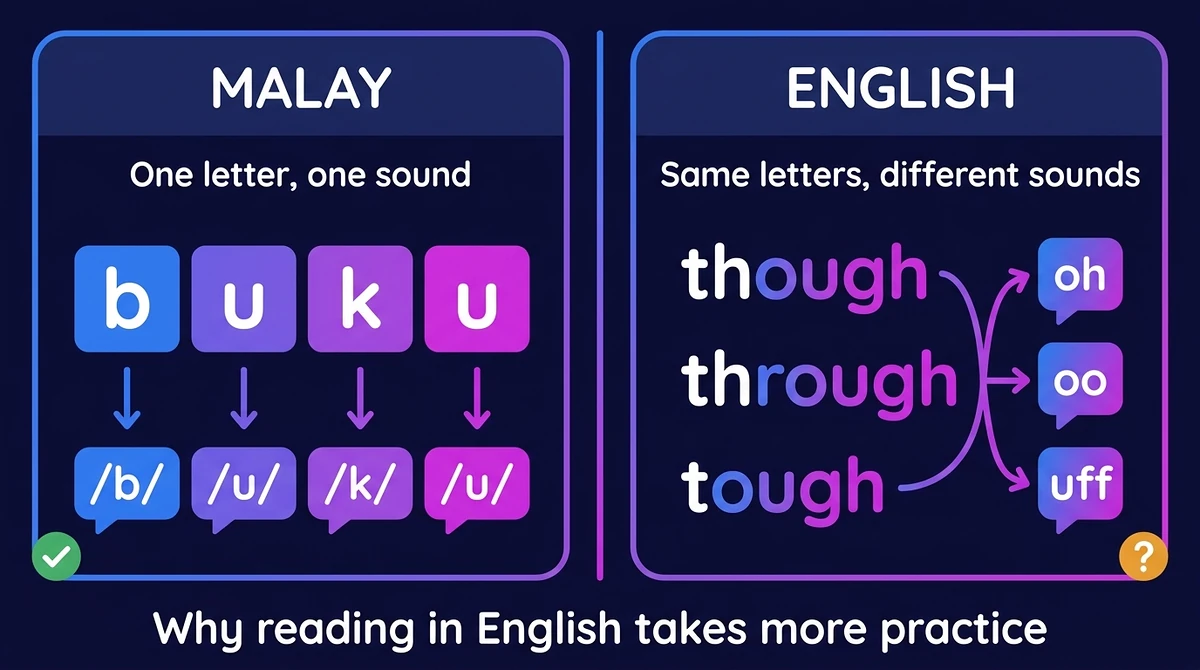
In Malay, each letter almost always makes the same sound, so once a child knows the sounds they can read most words. Researchers call this a “transparent” spelling system. English is the opposite. The letters “ough” sound different in “though”, “through” and “tough”, so children need more practice to read English words fluently.
English isn’t the language spoken at home
Children understand what they read only when they already know the words. A child who speaks Malay, Mandarin or Tamil at home may sound out an English sentence correctly and still not know what it means. A University of Reading study of Malaysian children aged four to seven found that home reading habits predicted how well children read in English, but not in Malay.
I saw this often when I taught upper-primary English at a private school in Malaysia, to children from Malay, Chinese and Tamil-speaking homes. Many of my Malay-speaking pupils knew their letter sounds well enough to read English words aloud almost correctly, yet had no idea what those words meant. To close the gap, I went back to much simpler picture books to build their everyday English vocabulary and strengthen the link between letters and sounds.
Within a term, many were reading with understanding. They were still below their age level, but with that foundation in place, reading was no longer such a struggle.
Gaps in phonics and decoding
Phonics is how children link letters to sounds and blend them into words. If those early lessons were missed or rushed, every new word becomes a guess. Reading slows down, and spelling usually suffers too.
Weak visual and listening skills
Reading asks the eyes to track along a line and jump to the next one, and the ears to hear the separate sounds inside a word. Some children lose their place, mix up similar letters such as b and d, or can’t hear that “cat” has three sounds. A basic sight test checks how clearly a child sees, not how well their eyes track text. Both skills can be trained.
Trouble focusing
Some children read every word on the page and still can’t tell you what happened. Their attention drifts mid-paragraph, so the meaning never builds up. Attention difficulties such as ADHD can make this more likely, and only a doctor or psychologist can assess for them. For what’s typical at each age, see our guide to attention span by age.
A learning difficulty such as dyslexia
The International Dyslexia Association estimates that as many as 15–20% of people have some symptoms of dyslexia, such as slow or inaccurate reading and poor spelling. Dyslexia has nothing to do with intelligence. If progress stays slow despite good support, or reading causes real anxiety, ask a qualified specialist for an assessment.
Not enough support, early enough
Children learn to read at different speeds. The trouble starts when a child who needs more time doesn’t get it. By upper primary, lessons assume children can read to learn, so a small gap in Standard 1 can become a wide one by Standard 4.
What are the signs a child is struggling with reading?
Look for patterns that last for weeks, not one bad day. Every child has off days. Several of the signs below, showing up again and again, are worth a closer look.
| Sign | What it might point to | What to try first |
|---|---|---|
| Reads slowly, word by word | Phonics | Short daily practice blending letter sounds |
| Guesses words from the first letter or the picture | Phonics gaps | Ask them to sound out the whole word before guessing |
| Skips lines or loses their place | Visual tracking | Use a finger or ruler under the line; consider an eye check |
| Reads aloud well but can’t say what it meant | Vocabulary or focus | Stop after each paragraph and talk about it |
| Spells the same word differently each time | Phonics gaps; possible dyslexia | Practise common spelling patterns; keep notes for the teacher |
| Says a lot but writes very little | Spelling or reading confidence | Let them say it first, then write it together |
| Rubs eyes, gets headaches or tires quickly | Visual strain | Book an optometrist check |
| Avoids reading or gets upset reading aloud | Confidence | Lower the pressure: read together, praise effort |
How can I improve my child’s English reading skills at home?
Read with your child every day, keep it short and calm, and make English something they hear and talk in, not just read. You don’t need to be a teacher or a fluent English speaker to make a real difference.
Read together, out loud, every day
Take turns reading a page each. Hearing you read shows them how fluent English sounds, with the pauses and expression that punctuation asks for. Pick books at their level or just above it.
Teach the sounds, not just the words
When your child gets stuck, help them sound the word out rather than telling them straight away. Point out spelling patterns as you go, such as “ai” in “rain” and “train”. Over time they will work out new words on their own.
Build English vocabulary through talk and listening
Children can only understand words they already know. Audiobooks, bedtime stories and everyday chats in English all grow vocabulary. Ask open questions such as “Why do you think she did that?” instead of yes-or-no ones.

Let them choose what to read
Comics, football magazines, recipes and game instructions all count as reading. A child who chooses their own material reads more of it, and reading more is what builds fluency. For ideas by age, see our reading list for kids aged 7 to 17.
Practise with short, focused passages
Ten focused minutes with a short passage and a few questions is usually more useful than a long, tiring session. Our free reading comprehension worksheets are graded by level, so you can start where your child is comfortable and build up.
Celebrate effort, not just results
Children who struggle often decide they are “bad at reading” and stop trying. Praise the effort and the small wins: a hard word sounded out, a chapter finished. Confidence keeps them coming back to the page.
What this means for your child
If home practice is helping, keep going. If you have tried for a term and reading still isn’t improving, it is time to find out what is holding your child back.
Talk to your child’s teacher
Share what you notice at home and ask what they see in class. Together you can agree on goals and on support, such as extra reading time or an individual education plan. If you or the school suspect dyslexia or ADHD, ask for an assessment by an educational psychologist or doctor, as only they can diagnose it.
Strengthen the skills underneath reading
Many struggling readers need work on the skills underneath reading: visual tracking, focus and listening, alongside real reading practice. Skills practice on its own won’t fix reading, as our look at whether brain training works explains. That is what our Academic Excellence programme works on, in small online groups or one to one. We start with a free assessment, so you know where your child’s reading gets stuck before you spend anything. Between sessions, our free brain games are a fun way to practise focus and visual attention.
Frequently asked questions
Why does my child read well in Malay but struggle in English?
Malay spelling is very regular, so once a child knows the letter sounds they can read most Malay words. English spelling is irregular, and many words have to be learned by sight. Children who hear little English at home also know fewer English words, so they can sound a sentence out without understanding it. More daily English reading and conversation usually narrows the gap.
How can I help my child with reading in English if we don’t speak English at home?
You don’t need to be fluent. Play English audiobooks and read-aloud videos, read picture books together and talk about the pictures in any language, and keep using your home language too. Strong talk in any language builds the thinking skills children need for reading. Short daily English practice matters more than perfect pronunciation.
At what age should I worry about my child’s reading?
Children learn at different speeds, so a slow start in Standard 1 is common. If your child still reads word by word, avoids books or can’t follow a simple story by Standard 2 or 3, it is worth looking into. Getting help early makes a big difference, because gaps widen once lessons expect children to read to learn.
Does struggling with reading mean my child is not intelligent?
No. Many bright children struggle with reading because one underlying skill, such as phonics, visual tracking or focus, is weaker than the rest. Those skills can be taught and trained. What children do need is to hear that clearly, because struggling readers often decide they are “not clever”, and that belief holds them back more than the reading itself.
Is my child’s reading problem dyslexia?
It might be, but many children who struggle with reading are not dyslexic. Common signs include persistent trouble with letter sounds, very inconsistent spelling and slow reading despite good teaching. Only a qualified specialist, such as an educational psychologist, can diagnose dyslexia. Keep notes on what you see at home to share with them and with the school.
How long does it take to improve a child’s reading skills?
It depends on the cause and how often your child practises. With short daily reading at home, many parents notice more confidence within a few weeks, while fluency and comprehension usually take a term or more to improve. If you see no change after a term of steady practice, ask for an assessment to find what is holding your child back.
Not sure where your child’s reading is getting stuck? Book a free assessment, and we’ll show you which skills to work on first.
References
- World Bank (2024). Bending Bamboo Shoots: Strengthening Foundational Skills. Malaysia Economic Monitor, April 2024. Washington, DC: World Bank.
- University of Reading, Institute of Education. Reading and reading-related skills in Malay and English in Malaysian children.
- International Dyslexia Association. Dyslexia Basics.
About the author: Reuben Bykersma is the Catalyst and co-founder of EyeQBoost, a holistic education company helping children thrive in school and beyond, not just in exams. He has been teaching since the age of 15. He co-built a tutoring academy that taught more than 200 students over five years, and has taught English at a private school. Today he is building EyeQBoost to bring research-informed learning to more students, and to give parents and teachers honest, practical tools to support them. His aim is to make a lasting difference in education for students, teachers and parents alike. Connect on LinkedIn