Last reviewed: November 2026. We review this guide every year.
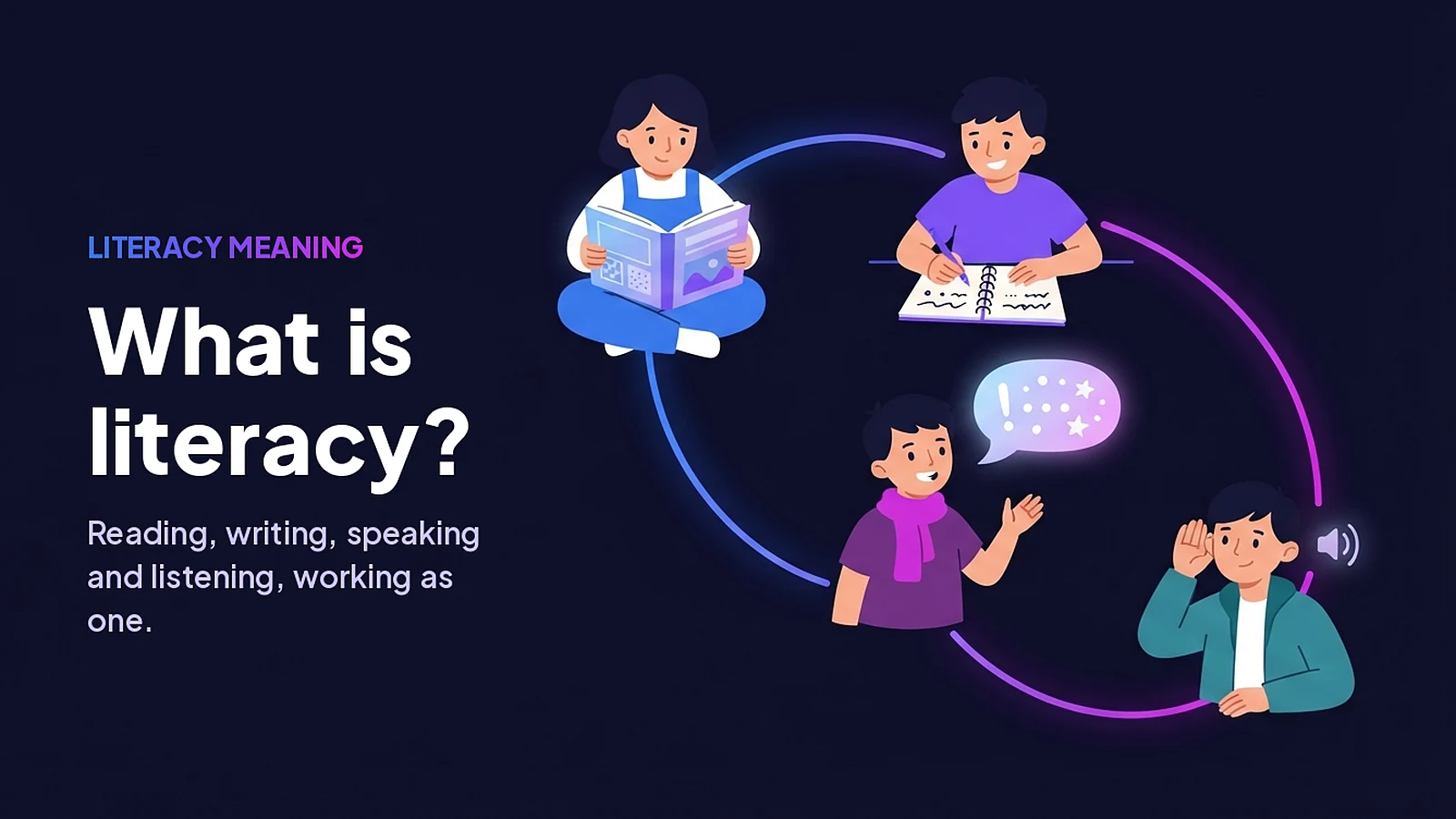
The short answer: The everyday literacy meaning is simply the ability to read and write. Educators use a wider definition: reading, writing, speaking and listening well enough to understand the world and be understood in it, on paper and on screens. Literacy grows out of spoken language and starts long before school, and small gaps are easiest to close when they’re spotted early.
Key takeaways
- In school, literacy means four strands: reading, writing, speaking and listening.
- Reading needs two things at once: recognising the words and understanding the language. Strong in one can’t make up for zero in the other.
- Talk is the foundation. Children learn to read and write on top of the language they already speak.
- Digital, media and financial literacy are newer kinds, but all of them rest on the same base.
- Worldwide, 739 million adults still can’t read and write, and almost 1 in 3 adults in OECD countries has weak literacy or numeracy.
What does literacy mean?
In everyday English, literacy means being able to read and write. That’s the first sense in the Oxford dictionary. Its second sense is knowledge or skill in a particular area, as in financial or health literacy (Oxford Learner’s Dictionaries; Merriam-Webster).
The word goes back to the Latin littera, a letter of the alphabet. In English, literate first meant learned or well-educated, and only settled on “able to read and write” in the early 1600s (Grammarphobia, citing the Oxford English Dictionary). Literacy itself is a young word, first recorded in 1883, long after illiteracy, which dates from the 1600s (Online Etymology Dictionary). The “skilled in a field” sense, as in computer literate, came in the 20th century.
When I ask a class what literacy means, almost every answer is “reading”. Hardly anyone says talking. Yet talking is where literacy begins, as you’ll see below.
How has the definition of literacy changed?
It has grown from reading one simple sentence to using written language to learn, think and take part in society. International bodies have widened the definition of literacy several times:
| Year | Who | Their definition, in short | What it adds |
|---|---|---|---|
| 1958 | UNESCO | Reading and writing, with understanding, a short simple sentence about everyday life | The basic bar still behind most literacy counts |
| 1978 | UNESCO | Functional literacy: using reading, writing and calculation to take part in your community and keep developing | Literacy as something you use, not just have |
| 2018 | UNESCO Institute for Statistics | Identifying, understanding, interpreting, creating, communicating and computing with printed and written materials, in different contexts | Creating texts, and numeracy |
| 2023 | OECD adult skills survey | Accessing, understanding, evaluating and reflecting on written texts to reach your goals and take part in society | Judging what you read, in print or online |
| Today | National Literacy Trust (UK) | Reading, writing, speaking and listening so we can communicate and make sense of the world | Speaking & listening count too |
Sources: UNESCO (1958, 1978); UIS glossary; NCES on the OECD survey; National Literacy Trust.
The pattern is that literacy isn’t a yes-or-no skill. UNESCO now calls it a continuum of learning that carries on through life (UNESCO). Someone can read a menu with ease and still struggle with a tenancy agreement. For children, that means the question isn’t “Can my child read?” but “What can my child do with what they read?” Our post on literacy in Malaysia shows how far apart those two questions can be.
What are the core literacy skills?
There are four, and they grow together: a weakness in one soon shows up in the others.
| Strand | What it involves | What it looks like at home |
|---|---|---|
| Reading | Turning print into meaning | Your child reads a recipe and can tell you what to do first |
| Writing | Spelling, sentence building, organising ideas for a reader | They write a birthday message someone else can follow |
| Speaking | Explaining, retelling, giving reasons, using new words | They retell a film so you’d understand it without seeing it |
| Listening | Following instructions, stories and discussions | They follow three-step directions without reminders |
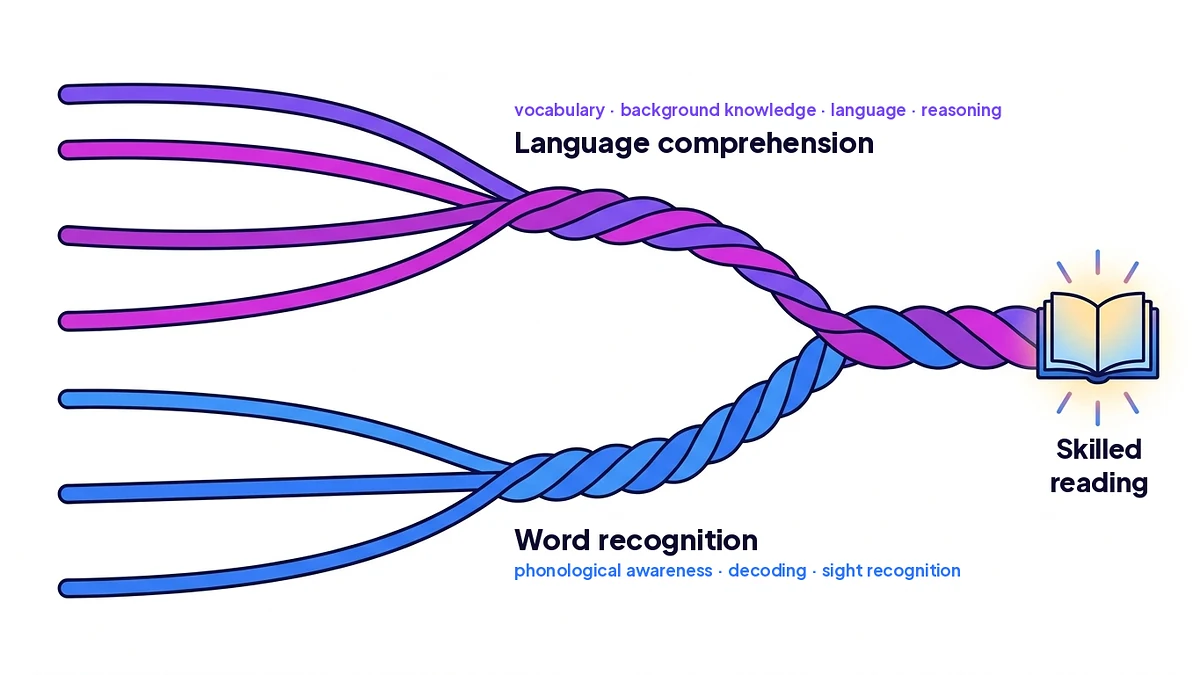
Reading is the strand parents worry about most, so it’s worth knowing how researchers break it down. The Simple View of Reading treats it as a multiplication: word recognition × language comprehension = reading comprehension (Reading Universe). Because it multiplies, a zero on either side gives zero. A child who sounds out every word but doesn’t know what they mean won’t understand the page, and nor will a child with a big vocabulary who can’t decode.
Hollis Scarborough’s reading rope splits each half into strands. Word recognition is phonological awareness, decoding and sight recognition. Language comprehension is background knowledge, vocabulary, language structures, verbal reasoning and knowledge of how books and texts work (NSW Department of Education). Our guide to improving your child’s English reading skills covers the phonics side in more detail.
How does language turn into literacy?
Language turns into literacy step by step: children learn to read and write on top of the language they already speak. The groundwork is laid well before school, in conversation, songs, stories and scribbles. Researchers call this emergent literacy: the skills, knowledge and attitudes that come before reading and writing (Whitehurst & Lonigan, 1998). They split it into two kinds:
- Inside-out skills: hearing the sounds in words and knowing the letters.
- Outside-in skills: vocabulary and knowledge of the world, which give the words meaning.
That’s why spoken language matters so much. The Education Endowment Foundation rates oral language approaches as high impact for very low cost, adding about six months’ progress over a year, with the biggest effects in the early years (EEF).
Writing pushes reading forward too. A meta-analysis for the Carnegie Corporation found that writing about texts, being taught to write and simply writing more all improve reading, and that teaching spelling improves word reading (Graham & Hebert, 2010).
Why early gaps can widen
Children who read well tend to read more and pull ahead; those who struggle read less and fall further behind. Psychologist Keith Stanovich called this the Matthew effect, after the saying “the rich get richer” (Reading Rockets). A later study found the effect is mostly one-sided: children most at risk fell further behind, while strong readers didn’t race further ahead (Morgan et al., 2008). Either way, the lesson for parents holds: a gap is easiest to close while it’s small.
In my tutoring years, the children who arrived furthest behind in reading were rarely short of intelligence. They were short of words. A child who has already said enormous, reluctant and suddenly out loud recognises them far faster on the page.
What are the different types of literacy?
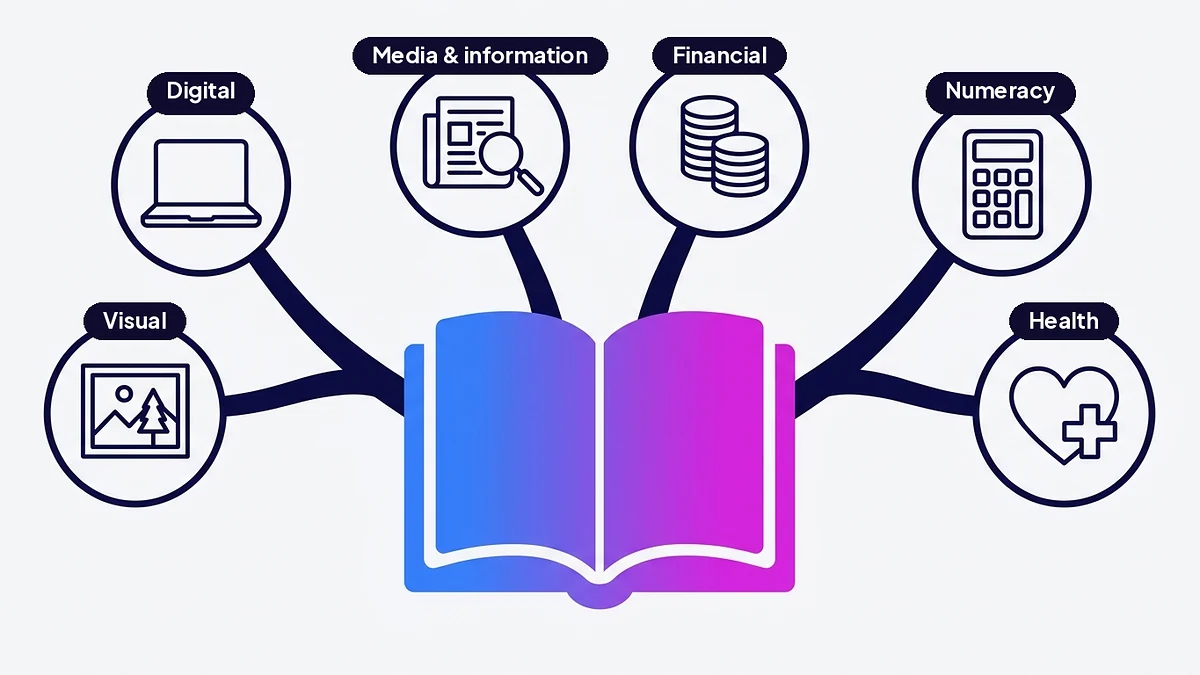
Beyond reading and writing, “literacy” now also means being competent in a particular field. These are the ones parents hear most:
| Type | What it means |
|---|---|
| Digital literacy | Using digital tools to find, evaluate, create and share information, safely and critically (European Commission) |
| Media and information literacy | Engaging critically with information and staying safe online, including spotting false content (UNESCO). Closely tied to critical thinking |
| Financial literacy | The knowledge and habits to make informed choices about money. See how we teach financial literacy. |
| Numeracy (numerical literacy) | Using numbers and reasoning with maths in everyday life |
| Health literacy | Understanding health information well enough to act on it |
| Visual literacy | Reading meaning from images, maps, charts and video |
Each one rests on the same base. A child who can’t read a paragraph closely can’t judge whether a viral post is true, however good they are with a phone.
Why does literacy matter?
Because almost everything else is learned, and lived, through it. Worldwide, at least 739 million adults can’t read and write, and two-thirds of them are women. The global adult literacy rate has climbed from 65% in 1975 to 88% in 2024 (UNESCO). For Malaysia’s figure, see our literacy in Malaysia post.
Being able to read isn’t the same as reading well, though. In the OECD’s 2023 adult skills survey across 31 countries, almost 1 in 3 adults had low literacy or numeracy (OECD). Those adults were less likely to be in work, tended to earn less and reported lower life satisfaction than adults with stronger skills. UNESCO links literacy to lower poverty, better health and more girls in school.
For your child, the payoff comes much sooner. Every subject, from science to Sejarah, arrives as text to read and answers to write, so literacy quietly sets the ceiling on all of them.
What’s another word for literacy?
For the reading-and-writing sense, the closest synonyms are literateness and reading and writing ability. Thesauruses also offer education, learning, knowledge and scholarship (Merriam-Webster), but those fit the older “well-educated” sense better. The opposite is illiteracy.
In Bahasa Melayu, schools use literasi, and celik huruf means able to read and write. The same celik gives celik IT and celik kewangan. In Mandarin, literacy is 读写能力 (dúxiě nénglì). For a school essay, “literacy skills” is usually the clearest swap.
How can parents and teachers build literacy skills?
Work all four strands a little every day. Here’s what I’d suggest:
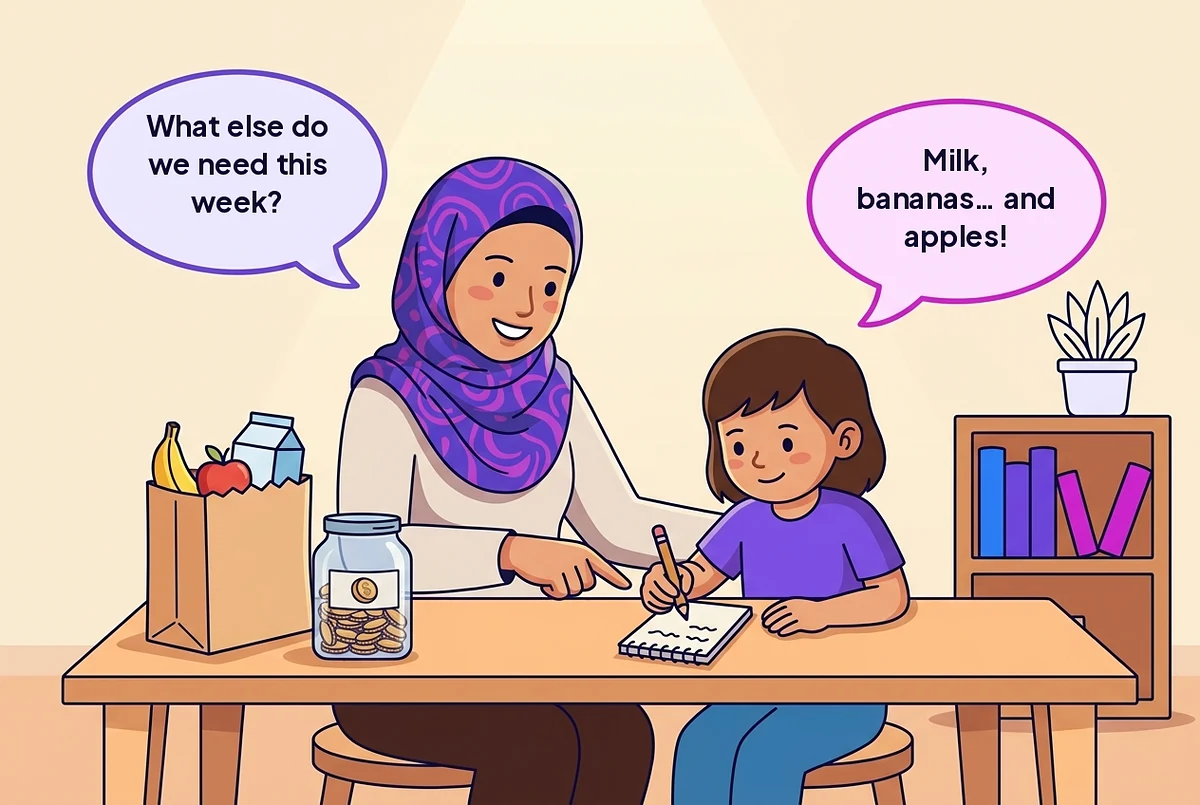
- Talk more, and stretch the words. Ask open questions such as “How did you work that out?” and use one new word on purpose each day. Children learn words best by hearing them and then using them.
- Make writing a daily habit. Shopping lists, a holiday diary, a note to a grandparent, three lines on the chapter they’ve just read. Short and often beats long and rare.
- Play with sounds (for younger children). Rhymes, I spy with first sounds, clapping out syllables. These build the inside-out skills that decoding needs.
- Build background knowledge. Documentaries, museum trips and non-fiction about whatever they love. You can’t understand a passage about volcanoes if you know nothing about volcanoes. Our reading list by age is a good place to start.
- Teach them to question what they read online. Three questions go a long way: Who made this? Why? How do they know?
- Notice which strand lags, and give it the extra time. A chatty child who writes very little, or a fluent reader with a narrow vocabulary, needs a different kind of practice.
Where EyeQBoost fits: Our free assessment looks at the skills underneath literacy, such as comprehension, vocabulary, attention and visual processing, and shows you which strand to work on next. For practice at home, our free graded reading comprehension PDFs cover every level, and our free Brain Games give quick practice in focus and visual skills. Read more on our Academic Excellence programme.
Frequently asked questions
What is the difference between literacy and reading?
Reading is one part of literacy. Literacy also covers writing, speaking and listening, and using all of them to get something done. A child can read every word of a science question and still not manage to write a clear answer to it. That’s a literacy gap, not a reading one, and it needs writing practice rather than more reading.
Is numeracy part of literacy?
It depends on who’s defining it. UNESCO’s definition includes computing, so numeracy sits inside literacy. The OECD’s adult skills survey tests literacy and numeracy separately, and most schools teach them side by side, as in Malaysia’s 3M (membaca, menulis, mengira). In practice they’re partners: a maths word problem is a reading task first.
What’s the difference between literacy, literature and literary?
They share a root but mean different things. All three come from the Latin littera, a letter. Literacy is a skill: reading, writing, speaking and listening. Literature is a body of written works, such as novels, poems and plays. Literary describes anything to do with literature, such as literary devices like metaphor and foreshadowing.
What are the five components of reading?
Phonemic awareness, phonics, fluency, vocabulary and comprehension. The US National Reading Panel named these in 2000 after reviewing the research on how children learn to read, and they’re often called the Big Five. Some educators add oral language as a sixth. Remember these describe reading, which is one strand of literacy, so writing and talk still need their own practice.
Is digital literacy replacing traditional literacy?
No. It builds on it. The UK’s National Literacy Trust argues that reading and writing remain the foundations for using AI well and thinking critically about what it creates. The OECD’s adult skills survey now tests reading on digital texts as well as print. Close reading and clear writing come first; judging sources and staying safe online are added on top.
Can literacy still improve in the teenage years?
Yes, and secondary schools have a clear playbook. The Education Endowment Foundation’s guidance for secondary schools recommends teaching vocabulary in every subject, helping students read complex academic texts, breaking down writing tasks and making time for structured talk. Struggling readers also need targeted support. At home, ask teenagers to explain an article or argue a point aloud; talking an idea through is good rehearsal for writing it.
What is disciplinary literacy?
(for teachers) It’s the reading, writing and talk that belong to each subject. The Education Endowment Foundation describes literacy skills as both general and subject-specific, so every teacher is also a literacy teacher. A science report, a history argument and a maths proof each have their own vocabulary and structure. Teaching those explicitly, rather than leaving literacy to the English department, helps students in every subject.
Is your child reading, writing, speaking and listening at the level they should be?
We’ll show you which literacy skills are strong, which need work, and what to do next.
References
- Education Endowment Foundation. (n.d.). Oral language interventions: Teaching and Learning Toolkit.
- Education Endowment Foundation. (2019). What do we mean by disciplinary literacy?
- European Commission, EPALE. (n.d.). Basic concepts: digital inclusion, digital literacy, life skill, digital skills.
- Graham, S., & Hebert, M. A. (2010). Writing to read: Evidence for how writing can improve reading. Carnegie Corporation of New York / Alliance for Excellent Education.
- Grammarphobia. (2026, March). ‘A hundred literate children’.
- Merriam-Webster. (n.d.). Literacy: simple definition and Literacy: thesaurus.
- Morgan, P. L., Farkas, G., & Hibel, J. (2008). Matthew effects for whom? Learning Disability Quarterly, 31(4), 187–198.
- National Center for Education Statistics. (n.d.). What PIAAC measures.
- National Literacy Trust. (n.d.). What is literacy?
- National Literacy Trust / Edge Foundation. (2025). What does it mean to be literate today?
- NSW Department of Education. (n.d.). Effective reading in the early years of school: comprehension.
- OECD. (2026). Navigating life with low literacy and numeracy: New results from the 2023 Survey of Adult Skills.
- Online Etymology Dictionary. (n.d.). Literacy.
- Oxford Learner’s Dictionaries. (n.d.). Literacy.
- Quigley, A., & Coleman, R. (2019). Improving literacy in secondary schools. Education Endowment Foundation.
- Reading Rockets. (n.d.). What every educator and parent should know about reading (National Reading Panel components).
- Reading Universe. (n.d.). Understanding the Simple View of Reading and Scarborough’s Rope.
- Stanovich, K. E. (1986). Matthew effects in reading: Some consequences of individual differences in the acquisition of literacy. Reading Research Quarterly, 21(4), 360–407. Summary via Reading Rockets.
- UNESCO. (n.d.). Literacy and non-formal education: Technical note (1958 and 1978 definitions).
- UNESCO. (n.d.). Media and information literacy.
- UNESCO. (2025). What you need to know about literacy.
- UNESCO Institute for Statistics. (n.d.). Glossary: Literacy.
- Whitehurst, G. J., & Lonigan, C. J. (1998). Child development and emergent literacy. Child Development, 69(3), 848–872. https://doi.org/10.1111/j.1467-8624.1998.tb06247.x
About the author: Reuben Bykersma is the Catalyst and co-founder of EyeQBoost, a holistic education company helping children thrive in school and beyond, not just in exams. He has been teaching since the age of 15. He co-built a tutoring academy that taught more than 200 students over five years, and has taught English at a private school. Today he is building EyeQBoost to bring research-informed learning to more students, and to give parents and teachers honest, practical tools to support them. His aim is to make a lasting difference in education for students, teachers and parents alike. Connect on LinkedIn