
Last reviewed: November 2026. We review this guide every year.
The short answer: Co-curricular activities are the planned activities outside lessons that are part of the national curriculum in Malaysian government schools. Every pupil takes part in one uniformed body, one club or society, and one sport or game. Teachers mark that involvement through PAJSK, the marks go on your child’s co-curricular record, and they make up 10% of the merit score for public university entry after SPM.
Key takeaways
- Co-curricular means “alongside the curriculum”. In Malaysian government schools, it is a required part of the national curriculum, not an optional extra.
- Every pupil joins three activities: a uniformed body, a club or society, and a sport or game.
- Teachers assess them through PAJSK. Attendance carries the most marks, followed by level of involvement and achievement.
- Your child’s co-curricular record and certificates are evidence. Keep copies, and check the record every year.
- After SPM, co-curricular marks make up 10% of the UPU merit score, which can separate two students with the same grades.
Every January, Malaysian parents hear the same question at the dinner table: “Which uniform unit should I join?” It sounds like a small decision. In fact, it is the start of a five-year record that follows your child to SPM and into their university application.
Yet many parents aren’t sure how co-curricular activities are marked, what counts, or where the marks go. This guide answers all three, then shows how to help your child make the most of it.
What does co-curricular mean?
Co-curricular means “alongside the curriculum”. The prefix co- means “together with”, so a co-curricular activity runs with classroom learning rather than outside it. Dictionaries describe it as an activity that complements the official curriculum (Dictionary.com).
In Malaysia, the meaning of co-curricular is also set in law. The Education (National Curriculum) Regulations 1997 define a co-curricular activity as any planned activity that extends the teaching and learning in the classroom, giving pupils the chance to add to, strengthen and practise the knowledge, skills and values they learnt there (Jurnal Kepimpinan Pendidikan, UM). Under the Education Act 1996, the national curriculum includes both lessons and co-curricular activities, so schools must run them and pupils must take part.
From the classroom: this is why I encourage parents to stop thinking of kokurikulum as “the activity after school”. The law treats it as the second half of your child’s education. The skills in it, such as leading a team, keeping a commitment and losing gracefully, are the ones no exam can test, and they sit at the heart of an all-round education.
Co-curricular vs extracurricular: what’s the difference?
The two words are often used as if they mean the same thing. In Malaysian schools, they don’t.
| Co-curricular (kokurikulum) | Extracurricular (ekstra kurikulum) | |
|---|---|---|
| Required? | Yes, for every pupil in government and government-aided schools | No, chosen by the child and family |
| Organised by | The school, with an advisor teacher for each unit | The school, a club, an academy, or the community |
| Examples | Scouts, Science and Maths Society, school football team | Piano lessons, a weekend coding class, a community swim squad |
| Marked in PAJSK? | Yes, under the co-curricular component | Partly: PAJSK has an extra-curricular component, but the activity must be recorded with proof |
Overseas, especially in universities and international schools, co-curricular usually describes voluntary activities that are not graded for academic credit (Advance HE). That is the opposite of the Malaysian school meaning, so it’s worth knowing which one a school or university means. For the wider meaning of extracurricular, examples by type and how much is too much, see our guide to extracurricular activities.
What co-curricular activities do Malaysian schools offer?
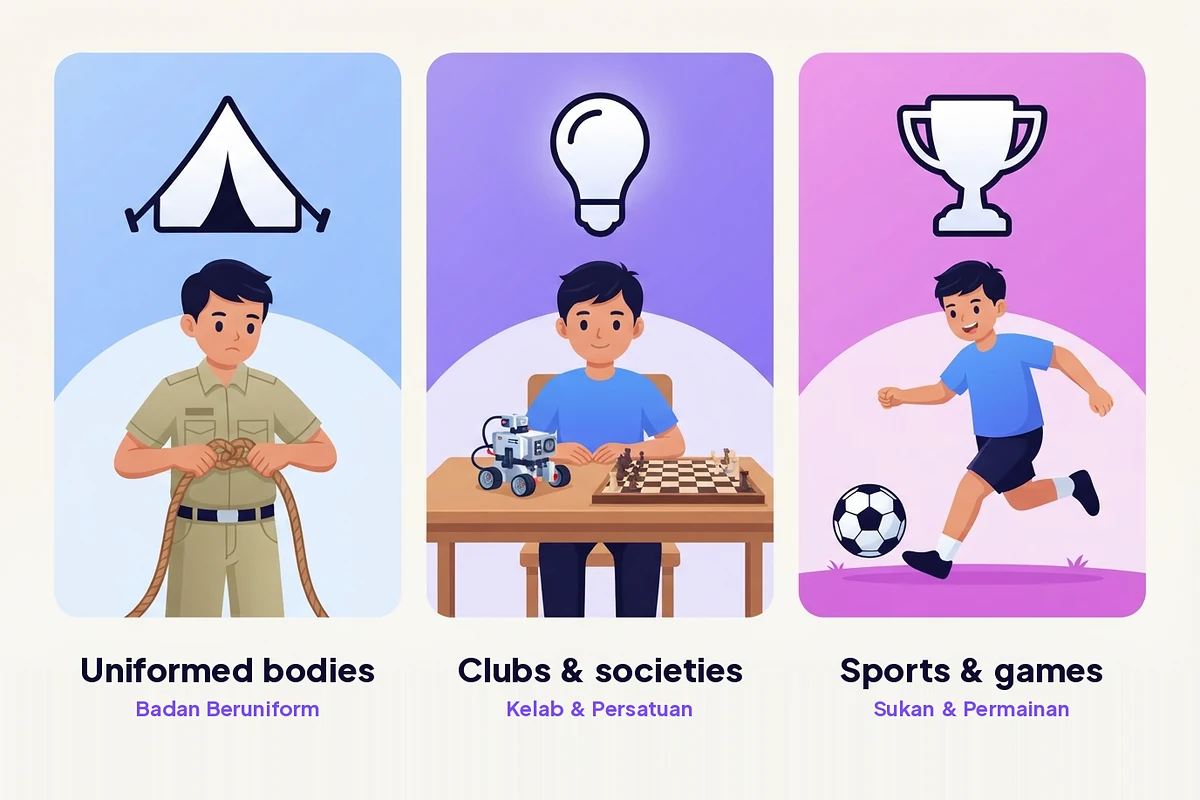
Malaysian schools group co-curricular activities into three types, and every pupil joins one of each. The Cabinet made this a requirement on 4 May 2005 (KPM PAJSK guideline). The Malaysia Education Blueprint 2013–2025 then reinforced it as 1 Sport, 1 Club and 1 Uniformed Body (UNESCO archive).
| Type | Common examples | What it builds best |
|---|---|---|
| Uniformed bodies | Scouts, Girl Guides, Red Crescent, School Cadets | Discipline, first aid and survival skills, leading a team |
| Clubs and societies | Science & Maths, language societies, robotics, chess, debate, ICT, environmental | Subject interest, planning, speaking up |
| Sports and games | Football, netball, badminton, athletics | Fitness, teamwork, resilience after losing |
Sport has a policy of its own. Under 1Murid 1Sukan (1 Student 1 Sport), introduced for the 2011 school year, every pupil must take part in at least one sport at school (KPM 1M1S module).
Which clubs and units are on offer depends on the school, its teachers and its facilities. Ask for the list at the start of the year, because popular units fill quickly.
Do these activities actually build skills? Malaysian research suggests they can. In one study of 912 university students taking a uniformed-body co-curricular course, all seven soft-skill areas measured, including communication, leadership and teamwork, changed between the start and the end of the course (Ismail, 2021). How much your child gains depends on how actively they take part, which is also what PAJSK measures.
How are co-curricular activities assessed in Malaysia?
Co-curricular activities are assessed through PAJSK, Pentaksiran Aktiviti Jasmani, Sukan dan Kokurikulum (Physical Activity, Sports and Co-Curricular Assessment). It is one of the four parts of school-based assessment, alongside classroom assessment, end-of-year exams and psychometric assessment (MyGOV). PAJSK began in secondary schools in 2012 and in primary schools in 2014.
What does PAJSK cover?
PAJSK has three parts:
- SEGAK: the national physical fitness test, with height and weight.
- Co-curriculum: your child’s uniformed body, club or society, and sport or game.
- Extra-curricular: recognised activities your child takes part in voluntarily, in or outside school.
The marks are not only for SPM leavers. MyGOV notes that PAJSK also contributes to the merit score for entry to fully residential schools (SBP) and MARA Junior Science Colleges (MRSM), which makes the primary years count too.
How are co-curricular marks given?
Each of your child’s three activities is scored out of 110 marks across six elements (KPM PAJSK guideline):
| Element | Marks | What earns them |
|---|---|---|
| Attendance (kehadiran) | 40 | Turning up to every scheduled meeting and practice |
| Level of involvement (Peringkat) | 20 | Taking part beyond school: district or zone, state, national or international |
| Achievement (Pencapaian) | 20 | Placings and results in competitions at each level |
| Position held (Jawatan) | 10 | Roles such as chairperson, captain, secretary or treasurer, held for at least seven months in a row |
| Commitment (Komitmen) | 10 | What the advisor teacher sees: leadership, managing activities, helping others, punctuality, interest |
| Service (Khidmat Sumbangan) | 10 | Registering as a participant or athlete in school programmes, or a technical role such as referee or coach |
Two things stand out. Attendance is worth more than any other element, so steady weekly effort beats one big win. And a pupil in two clubs doesn’t get double credit: in each category, only the highest-scoring activity counts. In secondary school, only the best two of the three categories then go into the final co-curricular score (KPM PAJSK guideline).
From the classroom: the pupils with the strongest co-curricular marks are rarely the stars. They are the ones who never miss a Wednesday afternoon, offer to set out the equipment, and are trusted with a role by Form 3. Teachers notice reliability, and PAJSK rewards it.
Guidelines are updated from time to time, so treat the figures above as a guide and check your school’s current version with the senior assistant for co-curriculum (PK Kokurikulum).
What is a co-curricular record?
A co-curricular record is the official history of your child’s involvement outside lessons: which activities they joined, the roles they held, and what they achieved. What it looks like depends on where your child is studying.
The co-curricular record in Malaysian schools
In a Malaysian school, the co-curricular record is your child’s PAJSK record. Advisor teachers mark each activity during the year, and the school enters the marks into the Ministry’s online system. Many schools also keep a PAJSK card or file for each pupil.
The record matters most when it goes wrong. In 2024, some 2023 SPM leavers found their sports and co-curriculum marks missing from their university applications. Reports said some missed out on a place or their first-choice course, and the Ministry had to re-assess the affected data (FMT; The Star). Ask to see your child’s record at the end of every school year, not just in Form 5.
The co-curricular record at university and overseas
Many universities, especially in Canada and the United States, issue a Co-Curricular Record (CCR). It is an official document that sits beside the academic transcript and lists verified activities such as leadership roles and volunteering (University of Toronto). Malaysian public universities take a different route: co-curricular courses are part of the degree and carry credit (UTeM). Either way, the habits your child builds at school carry straight on.
Which co-curricular certificates should you keep?
Keep every co-curricular certificate and appointment letter, because they are your child’s proof. To correct a previous year’s PAJSK marks, the school has to make a written request with a copy of the certificate or letter as evidence, by April at the latest (KPM PAJSK guideline). No paper, no correction.
The ones worth keeping:
- Participation certificates (sijil penyertaan) for camps, courses, carnivals and competitions
- Achievement certificates (sijil pencapaian) for placings at district, state, national or international level
- Appointment letters for roles such as captain, chairperson or secretary
- Certificates of appreciation (sijil penghargaan) for service to the school
- The school’s co-curricular certificate, if your child’s school issues one at the end of secondary school
The same papers help later with scholarship forms, private university applications and a first CV.

A simple system that works: one A4 folder with a plastic sleeve for each school year, plus a phone scan of each certificate saved to a cloud folder named by year. It takes five minutes a term and can save a very stressful week in Form 5.
How much do co-curricular marks count after SPM?
Co-curricular marks make up 10% of the merit score used for public university entry through UPU. The other 90% comes from academic results. The co-curricular marks are supplied by the Ministry of Education’s Sports, Co-curriculum and Arts Division, and simply added to the academic score (UPU circular for SPM leavers).
This isn’t new. Co-curricular marks have counted in public university selection since the 2002/2003 intake (Parliamentary reply, 2019). In 2025 the Deputy Higher Education Minister confirmed the same 90:10 split for STPM, matriculation and foundation students (Utusan Malaysia).
Why does 10% matter so much? Because academic scores at the top cluster tightly. Imagine two students who both score 85.5 out of 90 on academics. One brings 9.5 co-curricular marks, the other 6. Their merit scores are 95.0 and 91.5, and for a competitive course that gap can decide who gets the place.
One exception is worth knowing: students who apply for a degree with a diploma are ranked on academic results only, with no co-curricular marks (same Parliamentary reply).
From the classroom: it’s common for strong academic students to treat co-curriculum as a box to tick, then find in Form 5 that they’re competing with classmates who held a role and represented the district. Starting well in Form 1 is far easier than catching up in Form 5.
How can parents help their child make the most of co-curricular activities?
Your support matters more than you might think. In a study of 492 secondary pupils in Sabah, parental support was linked far more strongly to how involved pupils were in co-curricular activities than either their own interest or their teachers’ skill (Micheal, 2023). Here is where that support makes the biggest difference.
Choose for interest, then stick with it
Help your child pick units they will want to attend for years, not the ones a friend chose. Switching every year resets the chance to earn a role, and a role must be held for at least seven months in a row to count.
Protect the weekly session
Attendance is the biggest single element in PAJSK. Avoid booking tuition, appointments or family errands on co-curricular afternoons, and treat those sessions like any other school lesson.
Go deeper, not wider
Because only the best activity in each category counts, joining a fourth or fifth club adds little to the marks. Encourage your child to aim for a role by Form 3 or 4 in one unit they care about.
Say yes to going beyond school
Level of involvement and achievement together are worth 40 marks, and both reward taking part at district, state or national level. When the advisor teacher asks for volunteers for a competition or camp, help your child say yes, even if they don’t expect to win.
Keep the evidence and check the record
Use the folder system above, and ask the class teacher or advisor teacher to show you the PAJSK marks at the end of each year. Small errors are much easier to fix in Form 2 than in Form 5.

If your child’s week is already full of tuition and classes, it may be the optional activities that need trimming, not the compulsory ones. Our guide to extracurricular activities covers how to spot when a child is doing too much.
What does this mean for your child?
Co-curricular activities are compulsory, marked and counted, so a little planning goes a long way. Choose units your child enjoys, protect the weekly session, aim for one meaningful role, and keep every certificate. Do that from Standard 1 or Form 1, and the 10% takes care of itself.
The bigger prize isn’t the marks. A pupil who has organised a club event, kept a team going after a loss or led a patrol at camp walks into university interviews and first jobs with real stories to tell. Those are the leadership and character skills we build at EyeQBoost, alongside academic learning. For schools, our partnership programmes can support co-curricular and leadership activities in person or online.

Frequently asked questions
Are co-curricular activities compulsory in Malaysian schools?
Yes. In government and government-aided schools, co-curriculum is part of the national curriculum under the Education Act 1996, so every pupil takes part in a uniformed body, a club or society, and a sport. If your child has a health condition that limits physical activity, speak to the school early. They can usually suggest a suitable unit or role rather than leaving your child out.
Can my child change their co-curricular activity?
Usually yes, at registration at the start of the school year. Before switching, weigh what your child would lose. A role must be held for at least seven months in a row to earn marks, and teachers tend to give responsibility to pupils who have stayed with a unit. A switch makes sense when your child is genuinely unhappy or a better fit becomes available.
Do private and international schools use PAJSK?
PAJSK is the Ministry of Education’s assessment for schools that follow the national curriculum. International schools run their own co-curricular programmes, often called CCAs, and record them in their own way. If your child will apply to a Malaysian public university from a private or international school, check the UPU guidance early on how co-curricular marks are handled for their route.
Do activities outside school count towards co-curricular marks?
They can, through the extra-curricular part of PAJSK. Representing the state in swimming or performing in a national music competition, for example, may be recognised if the school has proof. Tell the class teacher about any outside achievement and hand in a copy of the certificate in the same term.
What should I do if my child’s co-curricular marks are wrong or missing?
Start with the class teacher or the advisor teacher for that unit, and bring copies of the relevant certificates or appointment letters. If it isn’t resolved, ask to speak to the senior assistant for co-curriculum (PK Kokurikulum). Do this as soon as you spot the problem. Corrections to last year’s marks need a written request with evidence by April, and they are much harder once your child has left school.
Do co-curricular marks matter in primary school?
Yes. PAJSK runs in primary school too, and the marks count towards the merit score for entry to fully residential schools (SBP) and MARA Junior Science Colleges (MRSM). Just as important, the primary years are when children learn to turn up, take part and stick with something. Those habits are what earn strong marks in secondary school.
How can teachers keep co-curricular records fair and accurate?
Take attendance at every session, since it carries the most marks. Record each pupil’s role with its start date, file copies of certificates as they come in, and note commitment as you see it rather than from memory at the end of the year. Showing pupils their marks once a term catches mistakes early and gives them a clear reason to keep improving.
Want to know which skills your child is ready to build next, in class and beyond it?
References
- Advance HE. Co-curricular activities (glossary). advance-he.ac.uk
- Bahagian Pendidikan Tinggi, Kementerian Pendidikan Tinggi (KPT). Pekeliling kemasukan lepasan SPM ke UA, politeknik, KK dan MARA BPT, sesi akademik 2026/2027. upu.mohe.gov.my
- Dewan Rakyat (2019). Written parliamentary reply on co-curricular marks in public university admissions. pardocs.sinarproject.org
- Dictionary.com. Cocurricular. dictionary.com
- Free Malaysia Today (7 July 2024). Ministry to reevaluate sports, co-curriculum data for 2023 SPM students. freemalaysiatoday.com
- Ismail, F. (2021). Mastery of soft skills through co-curricular uniform body. Journal of Social Transformation and Regional Development, 2(3), 150–155. journal.uthm.edu.my
- Kementerian Pendidikan Malaysia. Garis panduan Pentaksiran Aktiviti Jasmani, Sukan dan Kokurikulum sekolah menengah, Tingkatan 1–5 & calon STAM (PAJSK SM). moe.gov.my
- Kementerian Pendidikan Malaysia. Pekeliling dan garis panduan: Kokurikulum dan Kesenian (PAJSK guidelines for primary and secondary schools). moe.gov.my
- Kementerian Pendidikan Malaysia. Modul latihan sukan: Dasar 1Murid 1Sukan. gurubesar.my
- Kementerian Pendidikan Malaysia (2013). Malaysia Education Blueprint 2013–2025: Executive summary. UNESCO archive
- Micheal, S. (2023). Pengaruh minat murid, sokongan ibu bapa dan kompetensi guru terhadap penglibatan murid dalam aktiviti kokurikulum. Jurnal Pemikir Pendidikan, 11(1), 36–49. jurcon.ums.edu.my
- MyGOV, Government of Malaysia. School-based assessment. malaysia.gov.my
- Jurnal Kepimpinan Pendidikan, Universiti Malaya. Article quoting the definition in the Education (National Curriculum) Regulations 1997, P.U.(A) 531/97. jupidi.um.edu.my
- The Star (7 July 2024). Ministry to review co-curriculum assessment data of 2023 SPM candidates. thestar.com.my
- University of Toronto. Co-Curricular Record. studentlife.utoronto.ca
- Utusan Malaysia (November 2025). Kemasukan IPTA sama rata kepada lepasan STPM, matrikulasi, asasi. utusan.com.my
- UTeM. Keberkesanan kursus kokurikulum berkredit dalam memperkasakan kemahiran insaniah. Journal of Human Capital Development. jhcd.utem.edu.my
About the author: Reuben Bykersma is the Catalyst and co-founder of EyeQBoost, a holistic education company helping children thrive in school and beyond, not just in exams. He has been teaching since the age of 15. He co-built a tutoring academy that taught more than 200 students over five years, and has taught English at a private school. Today he is building EyeQBoost to bring research-informed learning to more students, and to give parents and teachers honest, practical tools to support them. His aim is to make a lasting difference in education for students, teachers and parents alike. Connect on LinkedIn