Last reviewed: November 2026. We review this guide every year.
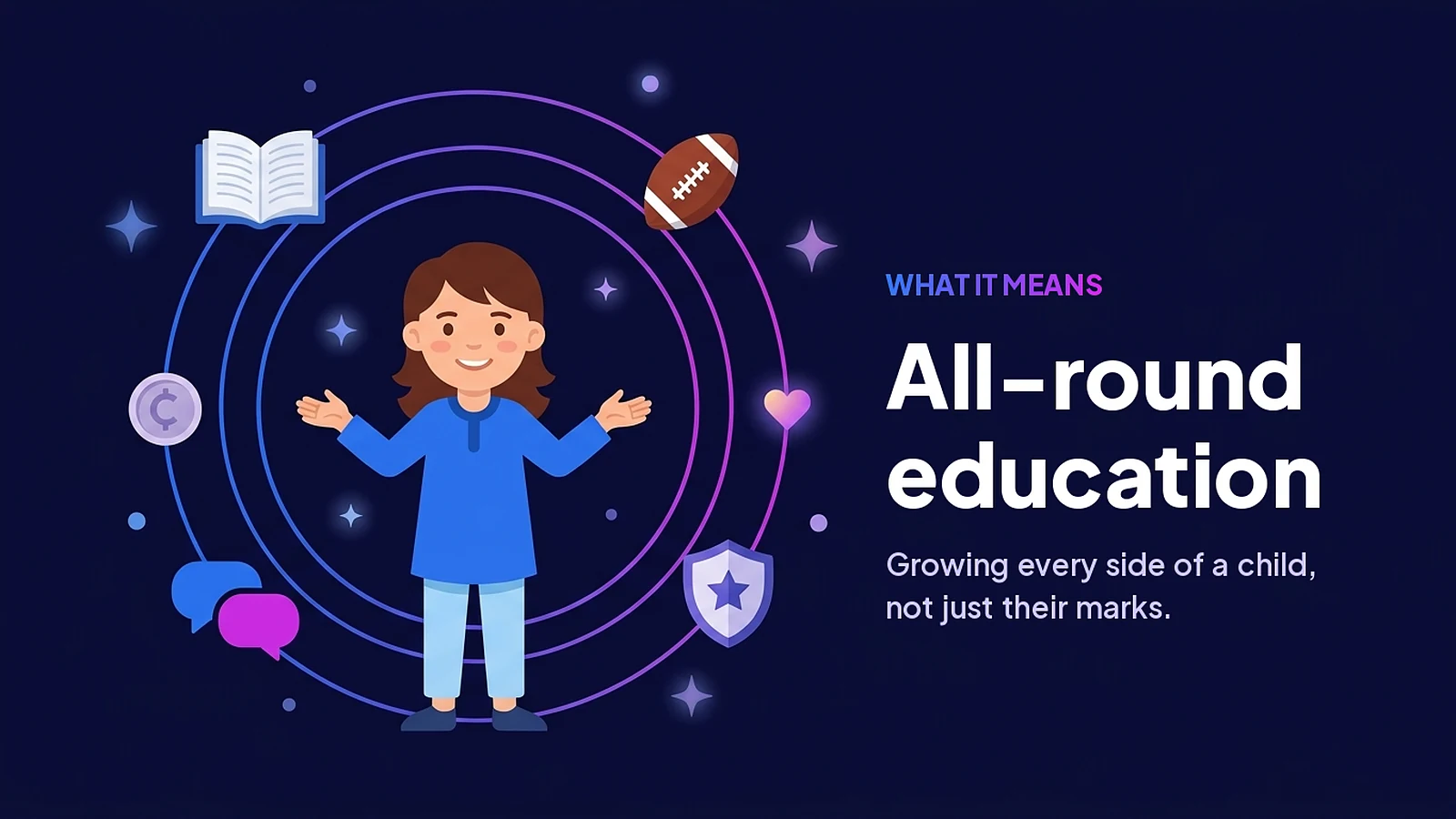
The short answer: All-round education is an approach to schooling and parenting that develops every side of a child, not just their marks: thinking, emotions, social skills, physical health, character and practical life skills. Holistic education shares that goal but goes one step further. It treats those areas as one connected whole, so each lesson builds several of them at once.
Key takeaways
- All-round education is about breadth: making sure no part of a child’s development is left out.
- Holistic education is about connection: the areas are taught together, because they shape each other.
- Skills like self-control and getting along with others predict adult health, wealth and wellbeing, even after IQ and family background are accounted for.
- Building those skills does not cost grades. Large reviews of school programmes found academic results rose when social and emotional skills were taught well.
- Malaysia’s own National Philosophy of Education has called for balanced, holistic development since 1988.
- Being all-rounded does not mean doing everything. A few well-chosen experiences, plenty of play and warm conversations at home do most of the work.
Almost every parent I have worked with wants the same thing, even if they say it in different ways: “I want my child to be an all-rounder.” What they rarely want is another report card. They want a child who can think, cope when things go wrong, get on with people, look after their body and do the right thing when nobody is watching.
The trouble is that all-round education sounds simple but gets used loosely, often in the same breath as holistic, well-rounded and whole-child. This guide untangles those terms, then shows what the research says and what it looks like at home, from Standard 1 to Form 5.
What is all-round education?
All-round education means developing the whole range of a child’s abilities, not only the ones that show up in exams. A child receiving an all-rounded education grows in how they think, how they feel, how they relate to others, how healthy and active they are, and what they value.
The term “well-rounded” carries the same meaning. A well-rounded education is simply one with no flat sides: a child who is strong in maths but has never learnt to handle disappointment, or who is confident on stage but cannot manage their own time, has a gap that grades will not reveal.
Who said education is all-round development?
The idea is centuries old, but the line most often quoted comes from Mahatma Gandhi. Writing in his weekly paper Harijan on 31 July 1937, he said: “By education I mean an all-round drawing out of the best in child and man — body, mind and spirit.” In the same passage he added that literacy is “not the end of education nor even the beginning.”
His point still holds. Literacy and exam results are tools. The purpose of education is the person those tools help to grow.
What are the areas of all-round development?
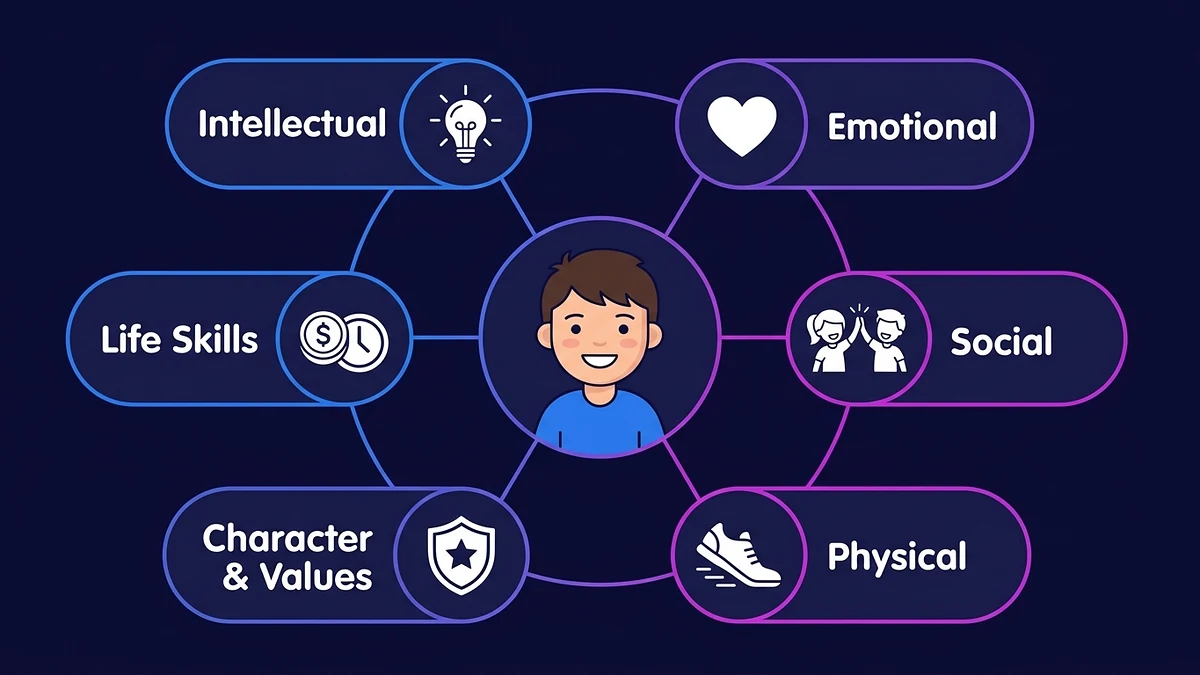
Researchers and education systems group them in slightly different ways, but most frameworks cover the same six areas. Malaysia’s National Philosophy of Education, for example, names four of them directly: intellectual, spiritual, emotional and physical balance, often shortened to JERI (jasmani, emosi, rohani, intelek).
| Area | What it covers | What you might notice at home |
|---|---|---|
| Intellectual | Thinking, reasoning, memory, attention, reading & numeracy | Asks “why?”, sticks with a puzzle, explains how they got an answer |
| Emotional | Naming feelings, coping with setbacks, self-control | Recovers after losing a game, can say “I’m frustrated” instead of shouting |
| Social | Communication, teamwork, empathy, resolving conflict | Takes turns, notices when a friend is upset, can disagree politely |
| Physical | Movement, fitness, coordination, sleep & healthy habits | Plays actively every day, has the energy to focus in class |
| Character & values | Honesty, responsibility, respect, a sense of right & wrong | Owns up to a mistake, keeps a promise, treats others fairly |
| Practical life skills | Managing time & money, independence, leadership | Packs their own bag, saves pocket money for something they want |
UNESCO made the same case on a global scale in its 1996 report Learning: The Treasure Within. It argued that schools tend to focus on knowledge at the expense of other kinds of learning, and that four “pillars” deserve equal attention: learning to know, learning to do, learning to live together and learning to be.
All-round education vs holistic education: what is the difference?
The two terms are often used as if they mean the same thing, and in everyday conversation that is fine. But the difference is worth knowing, because it changes what you look for in a school or programme.
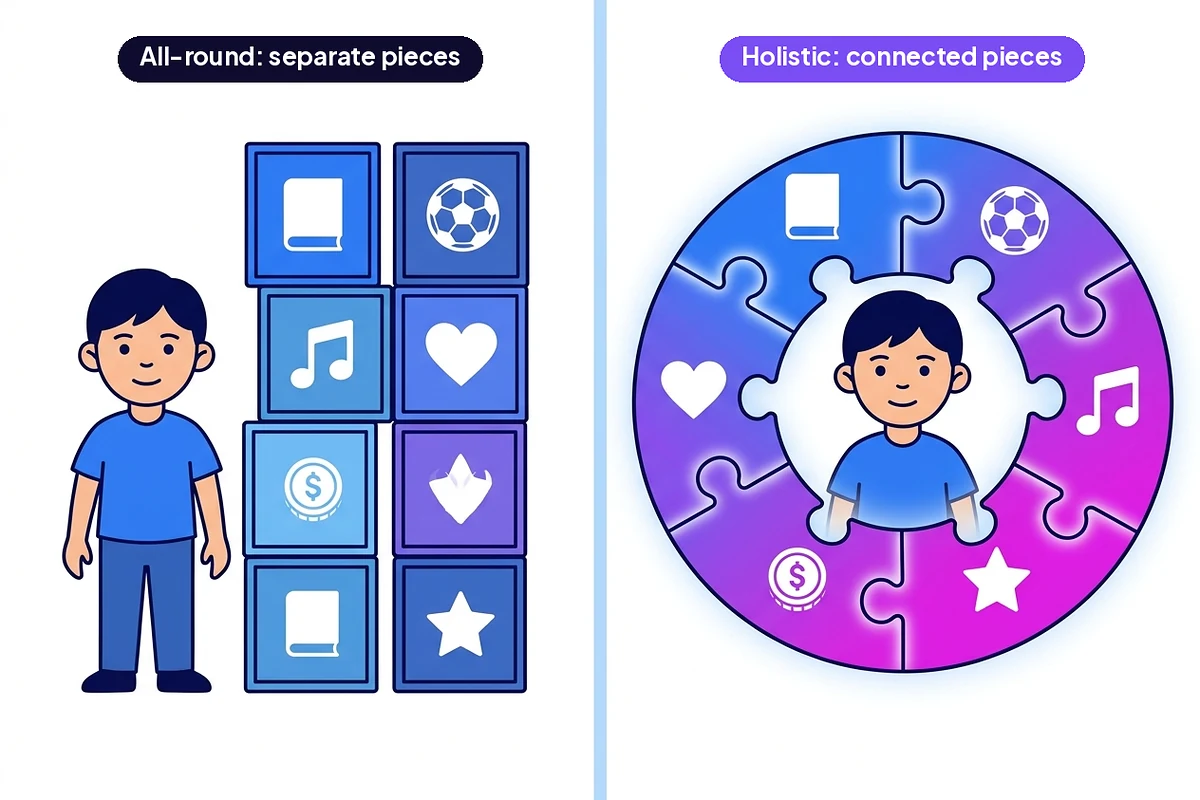
All-round education answers the question “What should a child develop?” Its answer is everything, so it is mainly about coverage. Holistic education answers a second question: “How do those areas fit together?” Its answer is that they cannot really be separated.
| All-round education | Holistic education | |
|---|---|---|
| Main idea | Breadth: cover every area of development | Integration: treat the child as one connected whole |
| Typical picture | Academics plus sport, music, clubs and values lessons | A single activity that builds thinking, feelings, teamwork and values at once |
| Risk if done badly | A packed timetable of disconnected activities | Vague goals that are hard to measure |
| Best question to ask | “Which areas does my child get to develop?” | “How does each activity help my child grow in more than one way?” |
What is the meaning of holistic education?
The best-known definition comes from historian of education Ron Miller, who founded the journal Holistic Education Review in 1988. He described holistic education as resting on the belief that people find their identity and purpose through their connections: to their community, to the natural world and to values such as compassion and peace.
In practice, the meaning most parents need is simpler: a child’s mind, emotions, body and character all affect one another, so good teaching works on them together. That is also why holistic programmes are often described as education with values. Character is not a separate subject added at the end of the week. It is built into how every lesson is run.
What does holistic development mean?
Holistic development describes the child’s growth, while holistic education describes the approach that supports it. It means a child grows as a whole person: a gain in one area tends to lift the others. A child who learns to calm down after a mistake, for example, is also better able to keep thinking through a hard maths problem.
Holistic learning, in turn, is the classroom version of the idea: lessons that join subjects together and connect them to real life, instead of teaching each skill in isolation.
Why does all-round education matter more than grades?
Grades matter. They open doors to the next stage of school and beyond. But on their own they tell us surprisingly little about how a child’s life will turn out, and the skills they leave out turn out to be some of the strongest predictors we have.
Self-control predicts adult life outcomes
The Dunedin study in New Zealand followed about 1,000 children from birth to age 32. Children with better self-control in their first decade grew up to have better physical health, fewer money problems and fewer criminal convictions, and this held even after the researchers accounted for IQ and family social class (Moffitt et al., 2011). Just as encouraging, children whose self-control improved during the study did better than their early scores predicted.
Social and emotional skills lift academic results
A common worry is that time spent on “soft skills” takes time away from learning. The evidence points the other way. A review of 213 school programmes involving more than 270,000 students found that teaching social and emotional skills improved behaviour, attitudes and academic performance, equivalent to an 11-percentile-point gain in achievement (Durlak et al., 2011).
A follow-up review of 82 programmes found the benefits lasted. Students were still doing better months and even years later, with academic gains of around 13 percentile points in the studies that measured them (Taylor et al., 2017). The authors are careful to note that only a small number of studies tracked grades over the long term, so this part of the evidence is promising rather than settled.
Movement and play support thinking
A major review for the American College of Sports Medicine found that physical activity and fitness benefit children’s thinking skills, such as attention and working memory (Donnelly et al., 2016). Its findings on test scores were more mixed, but it found no sign that time spent being active harms academic results. In other words, cutting PE to make room for more revision is unlikely to pay off.
The American Academy of Pediatrics goes further for younger children. Its 2018 report The Power of Play describes play as essential for building executive function, language and social skills, and for helping children cope with stress (Yogman et al., 2018).
Put together, the research says something reassuring: an all-round education does not compete with grades. Done well, it supports them.
Is all-round education part of the Malaysian school system?
Yes, at least on paper. Malaysia’s National Philosophy of Education (Falsafah Pendidikan Kebangsaan), first written in 1988, describes education as an ongoing effort to develop individuals “in a holistic and integrated manner” so that they are intellectually, spiritually, emotionally and physically balanced.
The Malaysia Education Blueprint 2013–2025 built on this with six student aspirations: knowledge, thinking skills, leadership skills, bilingual proficiency, ethics and spirituality, and national identity. On 20 January 2026 it was succeeded by the Malaysia Education Plan (RPM) 2026–2035, part of the wider National Education Plan, with the National Philosophy of Education still its foundation (RTM).
In the school week, the clearest example is compulsory co-curricular activities: every pupil joins a club, a uniformed body and a sport. The gap many parents notice is between policy and the rest of the week. With large classes and exam pressure, the areas that are hardest to measure are often the first to get squeezed. That is where families, and good programmes outside school, make the biggest difference.
What all-round education is not
- It is not doing everything. A child signed up for six activities a week is busy, not necessarily all-rounded. Depth in a few areas, plus free time, matters more. Our guide to extracurricular activities covers how many is too many.
- It is not lowering academic standards. Strong reading, maths and critical thinking skills are a core part of it.
- It is not being good at everything. An all-rounded child still has strengths and weaker spots. The aim is that no area is neglected, not that every area is excellent.
How can parents support holistic development at home?
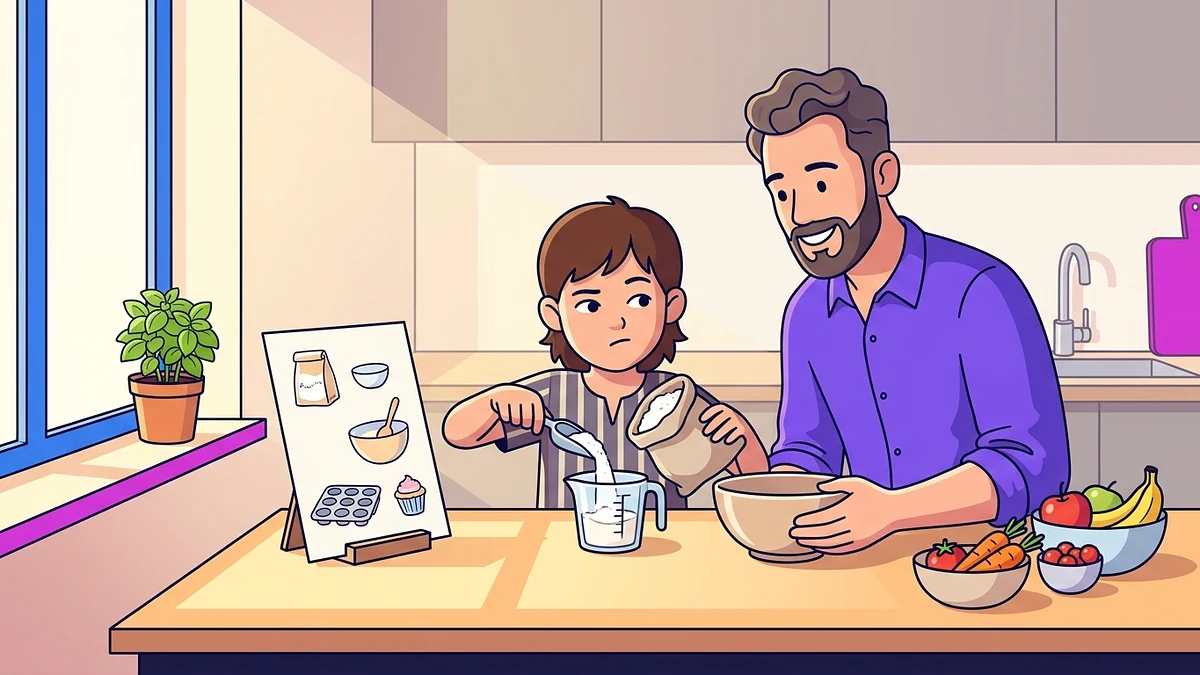
You do not need a special curriculum. Most holistic development activities fit into ordinary family life, and the best ones work on several areas at once.
| Activity | Areas it builds | How to make it count |
|---|---|---|
| Cooking a meal together | Numeracy, planning, teamwork, independence | Let your child read the recipe and measure the ingredients |
| Board and card games | Strategy, memory, turn-taking, coping with losing | Talk about the loss afterwards: “What would you try next time?” |
| Weekly family chat | Communication, empathy, values | Ask about a choice someone made at school and whether it was fair |
| Managing a small budget | Maths, self-control, money skills | Give a set amount for an outing and let your child plan how to spend it |
| Daily activity play | Fitness, focus, mood, social skills | Aim for outdoor time most days, with friends where possible |
| A household responsibility | Responsibility, independence, character | Pick one job they own fully, such as watering plants or setting the table |
Adjust by age. In Standard 1 to 3, keep it playful and short. By Standard 4 to 6, children can take on real responsibility, such as planning a family outing. In Form 1 to 5, give them ownership: a budget to manage, a younger sibling to coach, or a cause to organise around.
If you want ready-made activities, our free printable resources and brain games are built for exactly this kind of short, regular practice. For what brain games can and can’t do, see our guide to whether brain training works.
What does this mean for your child?
Look at your child through the six areas above and ask a simple question: which one gets the least attention right now? For most families it is not academics. It is usually emotional resilience, money skills or leadership, simply because school rarely has time for them.
At EyeQBoost, we build every programme around five pillars: helping children become academically excellent, emotionally resilient, financially intelligent, ethically grounded and equipped with leadership. Sessions are live and interactive, so children practise thinking, teamwork and confidence together rather than only completing worksheets. You can read more about our holistic education approach, or see how our programmes work.
Frequently asked questions
At what age should all-round development start?
From the very beginning. Babies are already building emotional, social and physical foundations through play and close relationships. Formal schooling adds structure, but the habits that matter most, such as curiosity, self-control and kindness, are shaped early and keep developing well into the teenage years. It is never too late to strengthen an area that has been neglected, because the brain keeps changing with practice.
My child gets good grades but is very shy. Should I be worried?
Not worried, but it is worth gently building their confidence. Shyness is a temperament, not a flaw, and many shy children become thoughtful leaders. Give them low-pressure chances to speak up: ordering food, explaining a game to a younger cousin, or joining a small group activity. Confidence grows through small successes repeated often.
How can I tell if my child’s school offers an all-round education?
Look beyond the brochure and ask specific questions. How much time is set aside each week for PE, the arts and free play? How does the school teach behaviour and resolve conflicts? Do students get real responsibilities, such as leading a club or a class project? How do teachers report on progress outside exams? Clear, concrete answers are a good sign.
How do you measure progress in areas that have no grades?
Through observation over time. Notice how your child handles frustration, works with others and manages their responsibilities, and compare it with a few months ago. In Malaysian schools, co-curricular involvement is recorded through the PAJSK assessment. A structured assessment from a programme can also give you a clear starting point to track against.
Can online learning support all-round development?
It depends on the format. Passive screen time, such as watching videos alone, does little for social or emotional growth. Live, interactive online sessions are different: children talk, solve problems in groups, take turns and get real-time feedback from a teacher. The key is balance, so online learning should sit alongside plenty of offline play, movement and family time.
How can teachers build all-round education into a packed syllabus?
By changing how topics are taught rather than adding new ones. Group tasks build teamwork, a two-minute reflection at the end of a lesson builds self-awareness, and giving students classroom roles builds responsibility. A history lesson can become a values discussion; a maths problem can be about planning a class budget. Small routines, used consistently, add up.
Not sure which areas your child needs most?
Book a free assessment. You’ll join the start and the feedback chat at the end, and we’ll show you where your child’s strengths and gaps are.
References
- Delors, J., et al. (1996). Learning: The treasure within. Report to UNESCO of the International Commission on Education for the Twenty-first Century. UNESCO. UNESCO-UNEVOC
- Donnelly, J. E., Hillman, C. H., Castelli, D., Etnier, J. L., Lee, S., Tomporowski, P., Lambourne, K., & Szabo-Reed, A. N. (2016). Physical activity, fitness, cognitive function, and academic achievement in children: A systematic review. Medicine & Science in Sports & Exercise, 48(6), 1197–1222. PubMed
- Durlak, J. A., Weissberg, R. P., Dymnicki, A. B., Taylor, R. D., & Schellinger, K. B. (2011). The impact of enhancing students’ social and emotional learning: A meta-analysis of school-based universal interventions. Child Development, 82(1), 405–432. PubMed
- Gandhi, M. K. (1937, 31 July). [Article on education]. Harijan. mkgandhi.org
- Kementerian Pendidikan Malaysia. (2013). Malaysia Education Blueprint 2013–2025 (Preschool to Post-Secondary Education). Ministry of Education Malaysia. Executive summary (UNESCO archive)
- Kementerian Pendidikan Malaysia. Falsafah Pendidikan Kebangsaan (National Philosophy of Education). Ministry of Education Malaysia
- Miller, R. (n.d.). A brief introduction to holistic education. infed. infed.org
- Moffitt, T. E., Arseneault, L., Belsky, D., et al. (2011). A gradient of childhood self-control predicts health, wealth, and public safety. Proceedings of the National Academy of Sciences, 108(7), 2693–2698. PubMed Central
- RTM (20 January 2026). Ibu bapa sambut baik RPN 2026–2035. berita.rtm.gov.my
- Taylor, R. D., Oberle, E., Durlak, J. A., & Weissberg, R. P. (2017). Promoting positive youth development through school-based social and emotional learning interventions: A meta-analysis of follow-up effects. Child Development, 88(4), 1156–1171. PubMed
- Yogman, M., Garner, A., Hutchinson, J., Hirsh-Pasek, K., Golinkoff, R. M., et al. (2018). The power of play: A pediatric role in enhancing development in young children. Pediatrics, 142(3), e20182058. https://doi.org/10.1542/peds.2018-2058
About the author: Reuben Bykersma is the Catalyst and co-founder of EyeQBoost, a holistic education company helping children thrive in school and beyond, not just in exams. He has been teaching since the age of 15. He co-built a tutoring academy that taught more than 200 students over five years, and has taught English at a private school. Today he is building EyeQBoost to bring research-informed learning to more students, and to give parents and teachers honest, practical tools to support them. His aim is to make a lasting difference in education for students, teachers and parents alike. Connect on LinkedIn