Last reviewed: November 2026. We review this guide every year.
The short answer: Brain training works for the skill being trained. A child who practises a memory game gets better at that game and at very similar tasks. Large research reviews find it does not raise IQ, or lift reading and maths scores, on its own. Those improve when children are taught and practise the skills themselves.
I’ve been teaching since I was 15. In that time, few questions from parents have come up as often as this one: “Will brain games make my child smarter?” It’s a fair question. The apps are everywhere, the promises are big, and every parent wants to give their child an edge.
So I went back to the research, not the marketing, and read what the major reviews actually found. This post is what I wish every parent could read before paying for a programme, including ours.
Key takeaways
- Brain training reliably improves the task being practised (near transfer), but the gains rarely carry over to IQ, reading or maths (far transfer).
- The best-designed studies show the smallest effects, which suggests many impressive results come from motivation and expectation, not a stronger brain.
- Brain games are still useful for practising specific skills and building focus, as long as you’re clear about what they do.
- Self-testing, spaced practice and daily reading have much stronger evidence for school results.
- Before you pay for any programme, ask five questions. The checklist is below.
What is brain training?
Brain training is repeated practice on games or exercises designed to strengthen a mental skill, such as working memory, attention or processing speed. It usually comes as an app, an online programme or a set of timed puzzles that get harder as your child improves.
The idea behind it is simple and appealing. If a skill like memory sits underneath everything your child does at school, then strengthening that skill should lift everything else too.
What do brain training programmes promise?
The promises tend to follow a pattern: sharper memory, better focus, higher grades and, in the boldest cases, a higher IQ.
Some of those promises have been tested in court as well as in the lab. In January 2016, the US Federal Trade Commission required Lumos Labs, the company behind Lumosity, to pay US$2 million to settle charges of deceptive advertising. The FTC said the company had claimed its games would improve performance at school, at work and in sport, without the science to back those claims (FTC).
That doesn’t mean every programme is a scam. It means the claims deserve a closer look.
Near transfer vs far transfer: the idea that explains everything
If you remember one idea from this post, make it this one.
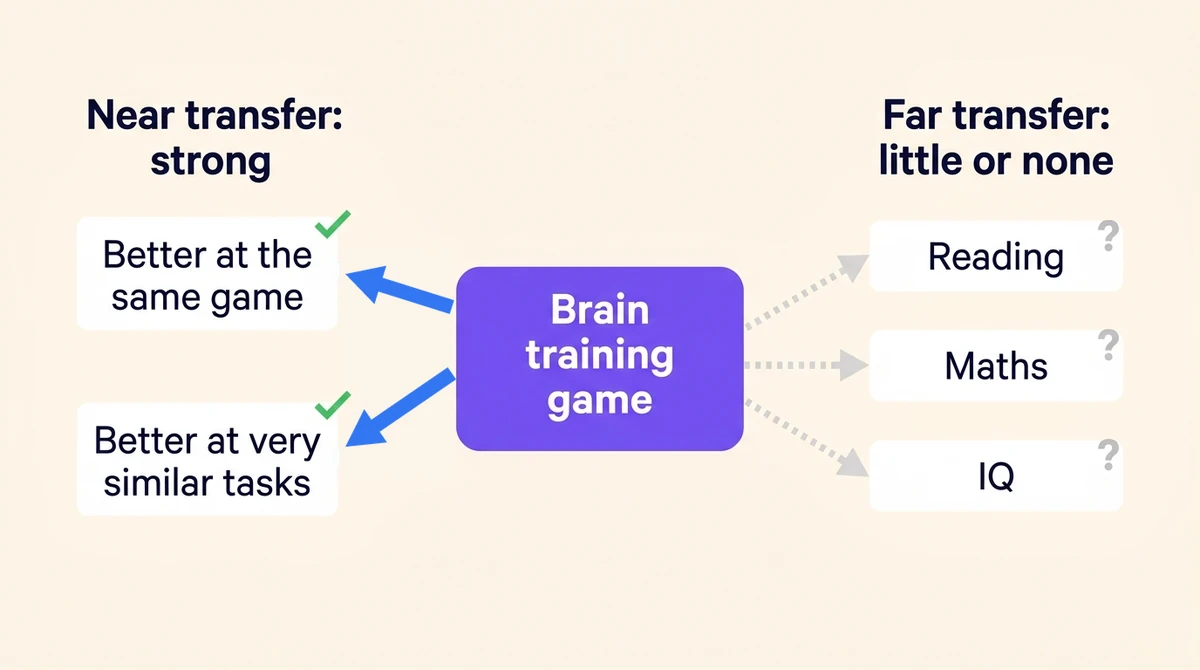
- Near transfer means getting better at the task you practised, or at tasks that are very like it. Practise remembering sequences of squares, and you get better at remembering sequences of squares.
- Far transfer means getting better at something different: reading, maths, problem-solving or IQ. This is what most parents are really hoping for.
What does the research say about brain training?
Brain training works for the skill being trained, and mostly not beyond it. The major reviews of the evidence since 2013 have reached broadly the same conclusion, whether they looked at adults, children or the companies’ own studies.
The review of the industry’s own evidence
In 2016, seven psychologists led by Daniel Simons published the most thorough review yet. They didn’t go looking for studies that would make brain training look bad. Instead, they examined the 130-plus studies that brain training companies and their supporters had cited as proof that their products work.
Their verdict was measured but clear. There was extensive evidence that training improves performance on the trained tasks. There was less evidence that it improves closely related tasks. And there was little evidence that it improves everyday thinking or real-world outcomes.
Working memory training in children
Working memory is the mental “desk space” your child uses to hold information while working with it, like remembering the start of a sentence while reading the end.
- A 2013 review by Monica Melby-Lervåg and Charles Hulme combined 23 studies of children and adults. Training produced reliable short-term gains in working memory. But there was no convincing evidence that those gains spread to other skills, including verbal ability, attention, word reading or arithmetic.
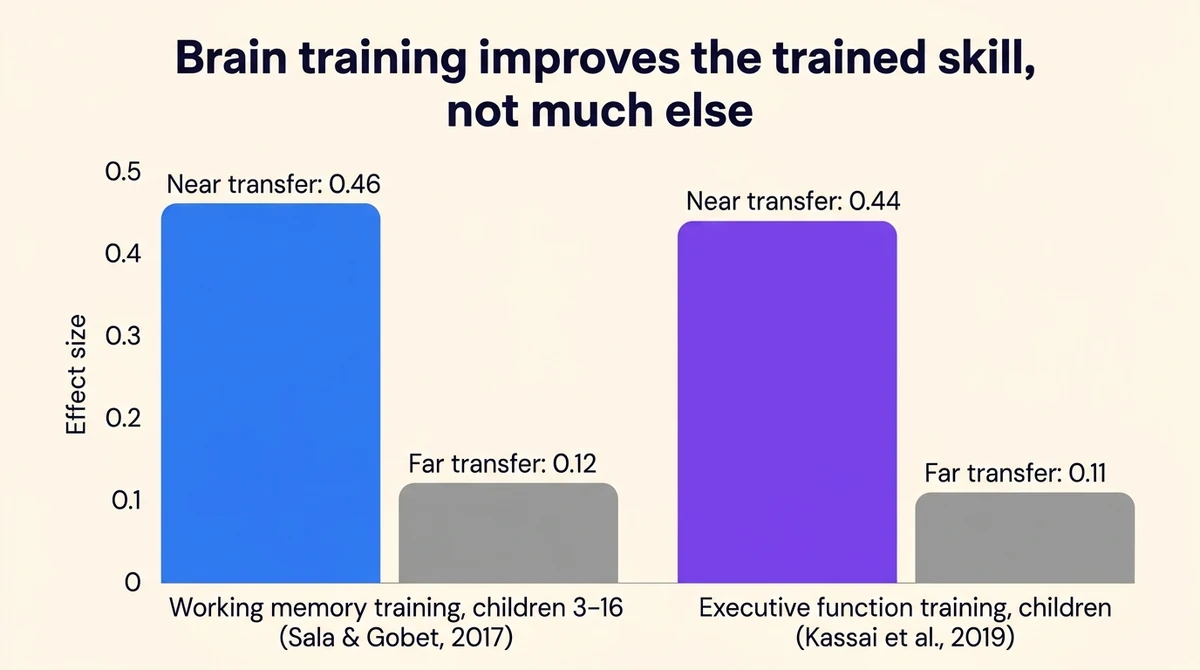
- A 2017 review by Giovanni Sala and Fernand Gobet focused on typically developing children aged 3 to 16. It found a moderate effect on memory tasks similar to the training, but only a small effect on anything further away, such as intelligence, maths or literacy.
- In 2020, Sala and Gobet returned with a larger review of 41 studies and 2,375 children. When studies compared trained children with children doing a different engaging activity, the effect on intelligence, maths and language was essentially zero.
Training focus and self-control
Some programmes target executive functions instead: the skills that help children plan, stay focused and resist distractions. A 2019 review by Reka Kassai and colleagues looked at this kind of training in children. Training one skill, such as working memory or self-control, improved that skill. It did not convincingly improve the others.
| Study | What it looked at | What it found |
|---|---|---|
| Simons et al. (2016) | The 130+ industry-cited studies | Trained tasks = strong Everyday life = weak |
| Melby-Lervåg & Hulme (2013) | 23 studies | Short-term gains; no transfer to reading or maths |
| Sala & Gobet (2017) | Children aged 3-16 | Near transfer = 0.46 Far transfer = 0.12 |
| Sala & Gobet (2020) | 41 studies, 2,375 children | No effect on intelligence, maths or language with active controls |
| Kassai et al. (2019) | Focus and self-control training | Trained skill = 0.44 Other skills = 0.11 |
The numbers in the table are effect sizes, a standard way of comparing results across studies. As a rough guide, 0.46 is a moderate effect that you’d notice. 0.12 is small enough that, in a classroom, you’d struggle to see it at all.
Why the best-designed studies show the smallest effects
This is the part most articles leave out, and it’s the most important.
Sala and Gobet noticed a pattern: the more carefully a study was designed, the smaller its results. Two design choices made the biggest difference.
- Random allocation. Children are split into groups by chance, not by who signed up first or which school took part. Otherwise, the trained group might simply have been more motivated to begin with.
- An active control group. The comparison children do a different engaging activity, not nothing. Children who know they’re getting special training often try harder on the tests afterwards. Comparing them with children who did nothing captures that extra effort, not a change in ability.
When studies had both, the far-transfer effects mostly disappeared. That tells us many of the impressive results in weaker studies were likely down to motivation, expectation and practice with test-like tasks, rather than a stronger brain.
Does brain training improve memory?
Brain training improves memory on the kind of task your child practises, and those gains tend to fade once the practice stops. It doesn’t reliably improve the everyday memory parents care about, like remembering homework instructions or what they read last night.
I see the same thing in tutoring. A student can become brilliant at a memory game within a fortnight and still forget their spelling words on Friday, because spelling words need their own practice.
Can brain training raise your child’s IQ?
No. Sala and Gobet’s 2020 review found that working memory training had no effect on intelligence once studies used a proper comparison group.
This matters because IQ is often the headline promise. A child’s score can rise when they retake a similar test, but that’s usually familiarity with the puzzles, not a change in how well they reason. Intelligence is shaped by many things over many years, and so far no game has been shown to shift it. Our guide to IQ scores explains what the numbers actually mean.
Do brain training games work for kids?
Brain training games work for practising the specific skill in the game, and they’re very good at getting children to practise willingly. They aren’t a shortcut to better grades.
That might sound like a let-down, but I don’t think it is. Some of the most valuable things in learning are the least glamorous: sitting with a task, staying with it when it gets harder, and coming back the next day. A well-made game makes that kind of practice something children ask for, not something they put up with.
What brain games are good for
- Practising one skill on purpose. A memory game gives focused practice at holding information in mind. A spot-the-difference game trains careful looking.
- Building attention to a task. Children learn to stay with one challenge for several minutes, which is harder for many of them than it sounds.
- Making practice enjoyable. Levels, scores and small wins keep children coming back.
- A better kind of screen time. If your child is going to be on a screen anyway, a game that asks them to think beats one that only asks them to scroll.
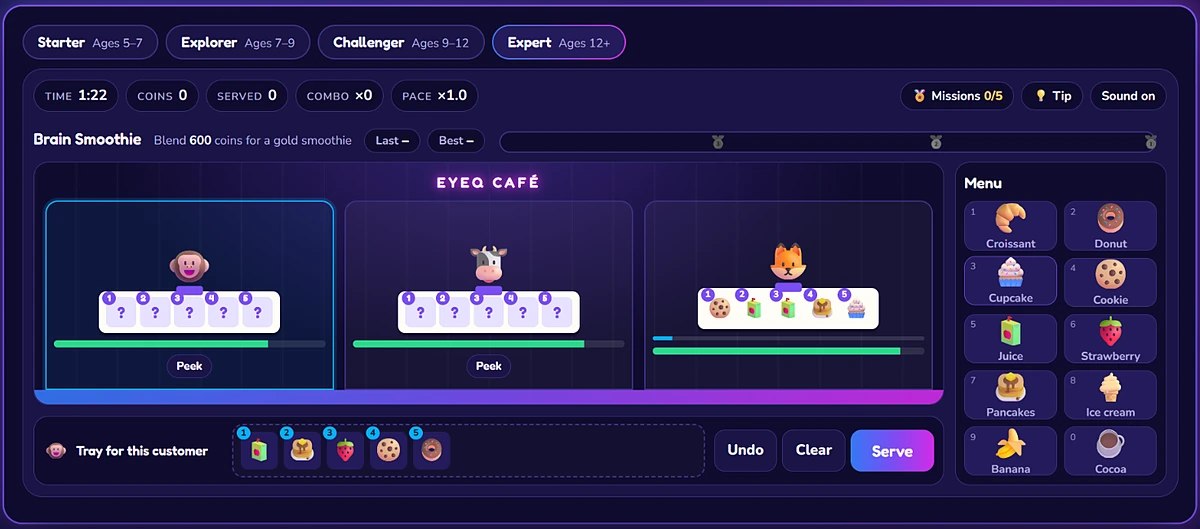
We built our own free brain games with exactly this in mind. In Café Rush, for example, children remember each customer’s order and serve it before their patience runs out. It’s honest memory practice, wrapped in a game they actually want to play.
Why do brain training claims sound so convincing?
Because part of the claim is true. The brain really does change with practice, a concept called neuroplasticity. Every time your child practises a skill, the connections involved in that skill get stronger.
The leap comes next. Getting better at one game does change the brain, but only in the ways that game uses. It doesn’t follow that the whole brain gets “fitter”, in the way a muscle does.
A few other things make the claims feel stronger than they are. Children often feel sharper after training and try harder on tests. Testimonials are easy to collect and hard to check. And when companies fund their own studies, the results don’t always hold up when independent researchers repeat them.
What actually helps children learn and remember?
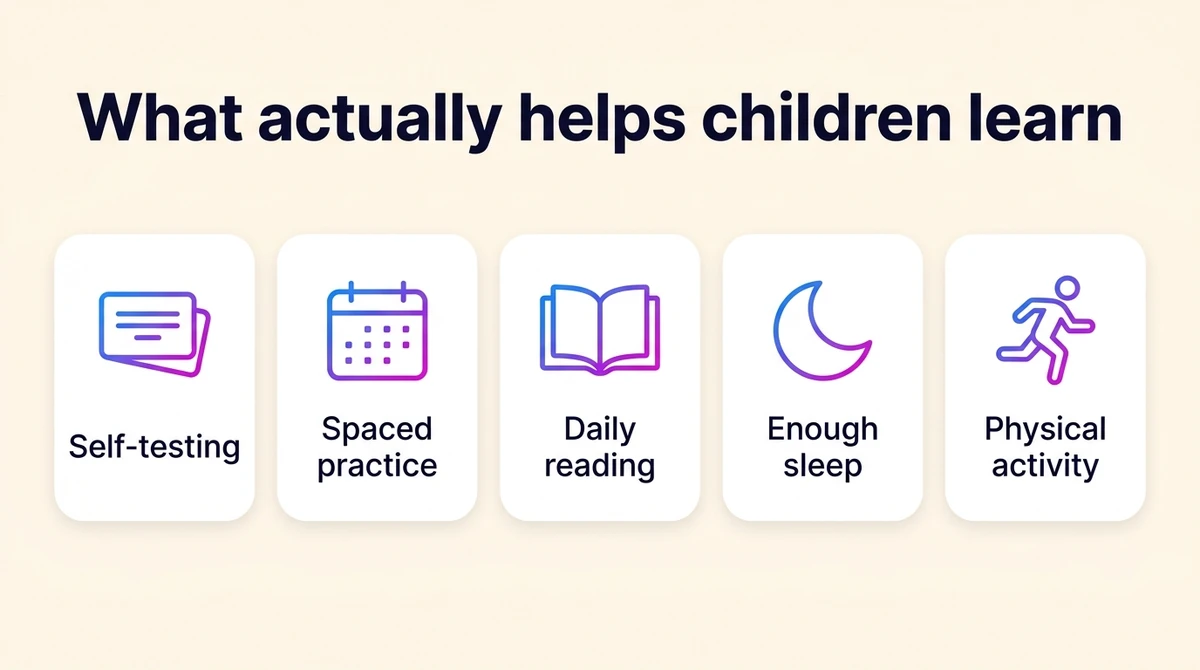
Practice testing and spaced practice are the two study techniques with the strongest evidence behind them. Add daily reading and the everyday basics, and you have a better plan than any app.
In a 2013 review of ten common study techniques, John Dunlosky and colleagues rated these two highest, while rereading and highlighting, the two techniques students use most, were rated low. For more home activities built on the same research, see our guide to neuroplasticity exercises for kids.
Practice testing
Practice testing means pulling information out of memory instead of reading it again. Flashcards, answering questions at the end of a chapter, or explaining a topic to a parent from memory all count. It feels harder than rereading, and that difficulty is the point. It’s what makes the learning stick.
Spaced practice
Spread practice over several short sessions across days or weeks instead of one long cram the night before. Ten minutes of spelling on Monday, Wednesday and Friday will usually beat thirty minutes on Thursday night.
Reading every day
Children get better at reading by reading. Every page builds vocabulary, background knowledge and stamina, which no memory game can do for them. If you need material, our free reading comprehension PDFs are graded by level and ready to print.
If reading itself is a struggle, our guide to improving your child’s English reading skills explains the common causes and what to try at home.
The basics
Sleep, physical activity and regular routines don’t feel like learning strategies, but every teacher sees their effect. A tired, restless child won’t get much out of the best lesson or the best game.
How to judge any brain training programme: 5-question checklist
Before you pay for a programme, ask what evidence sits behind its claims. These five questions come from the standards researchers use to judge brain training studies. They work just as well for parents choosing a programme and for principals choosing one for a school.
- Is there real research behind it? Look for studies published in a respected (peer-reviewed) journal, where other scientists checked the work. Glowing reviews and testimonials don’t count.
- Who did the research? Studies by independent researchers are far more trustworthy than a company testing its own product.
- Did they measure what you actually care about? Getting better at the game itself is expected. Look for improvements in things like reading, maths or school grades.
- Was it a fair comparison? The other group should have done a different activity, not nothing (see why above).
- Were the groups chosen by chance? Children should be put into groups at random, not by who signs up first.
Where EyeQBoost stands
We use cognitive and visual-skills training to build specific skills, we pair it with real reading and maths practice, and we don’t promise IQ gains.
I’m writing this post as someone who runs a programme that includes this kind of training, so you deserve to know where we stand. Here’s what we do:
- We train specific skills on purpose. Our sessions build skills like visual processing, attention and memory through structured, game-based activities, because practising a skill does improve that skill.
- We connect those skills to real learning. Training sits alongside reading, comprehension and problem-solving work, not in place of it.
- We start with an assessment. Every child begins with a free assessment, so we know where they are before we suggest anything. A parent joins at the start and for the feedback chat at the end.
What we can promise is focused practice, an honest picture of how your child is doing, and a programme built around the whole child: focus, confidence and character as well as marks. You can read more about our approach on our Academic Excellence page.
Frequently asked questions
How long does it take to see results from brain training?
Children usually improve on the trained games within a few weeks of regular practice. How long those gains last depends on whether the practice continues, as the memory section above explains.
How much time should my child spend on brain games?
In my experience, short and regular beats long and occasional. 10 to 15 minutes a few times a week is plenty for practising a skill, and that time is best taken from scrolling, not from reading or homework.
Are brain training apps a waste of money?
Not if you know what you’re paying for. A good app gives focused, enjoyable practice in a specific skill, and has real value. What isn’t worth paying extra for are promises of higher IQ or better grades, which the research doesn’t support. Free, well-designed games can give the same practice benefit as paid ones.
Does brain training help children with ADHD or dyslexia?
The evidence doesn’t support it as a treatment. Melby-Lervåg and Hulme’s 2013 review found that working memory training did not convincingly improve attention or word reading. If your child has, or may have, ADHD or dyslexia, speak to their doctor or a qualified specialist about evidence-based support.
At what age can children start brain games?
Simple memory and matching games suit children from about 4 to 5, in short sessions with an adult. What matters more than age is that the game is matched to their level and stays enjoyable. Our free brain games start at the Starter level, for Grades 2 to 4.
Should schools use brain training programmes?
Only as a supplement to teaching, not a replacement for lesson time. Use the 5-question checklist above, ask the provider for independent studies, and check that the programme connects its activities to reading and maths. We also run programmes with partner schools: see For schools.
Not sure which skills your child actually needs to work on?
We’ll show you where they are now, and won’t promise what the research can’t back up.
References
- Dunlosky, J., Rawson, K. A., Marsh, E. J., Nathan, M. J., & Willingham, D. T. (2013). Improving students’ learning with effective learning techniques. Psychological Science in the Public Interest, 14(1), 4–58. https://doi.org/10.1177/1529100612453266
- Federal Trade Commission. (2016, January 5). Lumosity to pay $2 million to settle FTC deceptive advertising charges for its “brain training” program. ftc.gov
- Kassai, R., Futo, J., Demetrovics, Z., & Takacs, Z. K. (2019). A meta-analysis of the experimental evidence on the near- and far-transfer effects among children’s executive function skills. Psychological Bulletin, 145(2), 165–188. https://doi.org/10.1037/bul0000180
- McCabe, J. A., Redick, T. S., & Engle, R. W. (2016). Brain-training pessimism, but applied-memory optimism. Psychological Science in the Public Interest, 17(3), 187–191. https://doi.org/10.1177/1529100616664716
- Melby-Lervåg, M., & Hulme, C. (2013). Is working memory training effective? A meta-analytic review. Developmental Psychology, 49(2), 270–291. https://doi.org/10.1037/a0028228
- Sala, G., & Gobet, F. (2017). Working memory training in typically developing children: A meta-analysis of the available evidence. Developmental Psychology, 53(4), 671–685. https://doi.org/10.1037/dev0000265
- Sala, G., & Gobet, F. (2020). Working memory training in typically developing children: A multilevel meta-analysis. Psychonomic Bulletin & Review, 27(3), 423–434. https://doi.org/10.3758/s13423-019-01681-y
- Simons, D. J., Boot, W. R., Charness, N., Gathercole, S. E., Chabris, C. F., Hambrick, D. Z., & Stine-Morrow, E. A. L. (2016). Do “brain-training” programs work? Psychological Science in the Public Interest, 17(3), 103–186. https://doi.org/10.1177/1529100616661983
About the author: Reuben Bykersma is the Catalyst and co-founder of EyeQBoost, a holistic education company helping children thrive in school and beyond, not just in exams. He has been teaching since the age of 15. He co-built a tutoring academy that taught more than 200 students over five years, and has taught English at a private school. Today he is building EyeQBoost to bring research-informed learning to more students, and to give parents and teachers honest, practical tools to support them. His aim is to make a lasting difference in education for students, teachers and parents alike. Connect on LinkedIn