Last reviewed: November 2026. We review this guide every year.
The short answer: Neuroplasticity exercises are activities that change the brain by asking it to learn something new, a little difficult and often repeated. For kids, the best ones are ordinary: learning an instrument, daily reading practice, quizzing themselves on what they learnt, mastering a new physical skill and solving puzzles that get harder. Sleep and exercise lock the changes in.
Key takeaways
- Neuroplasticity, the brain’s ability to change with experience, is why everyday practice works. No special “brain” product is needed.
- The brain changes most in early childhood, but it keeps changing through the teenage years and into adulthood. It is never “too late”.
- The brain gets better at exactly what it practises. A memory game mostly improves that game, while reading practice improves reading.
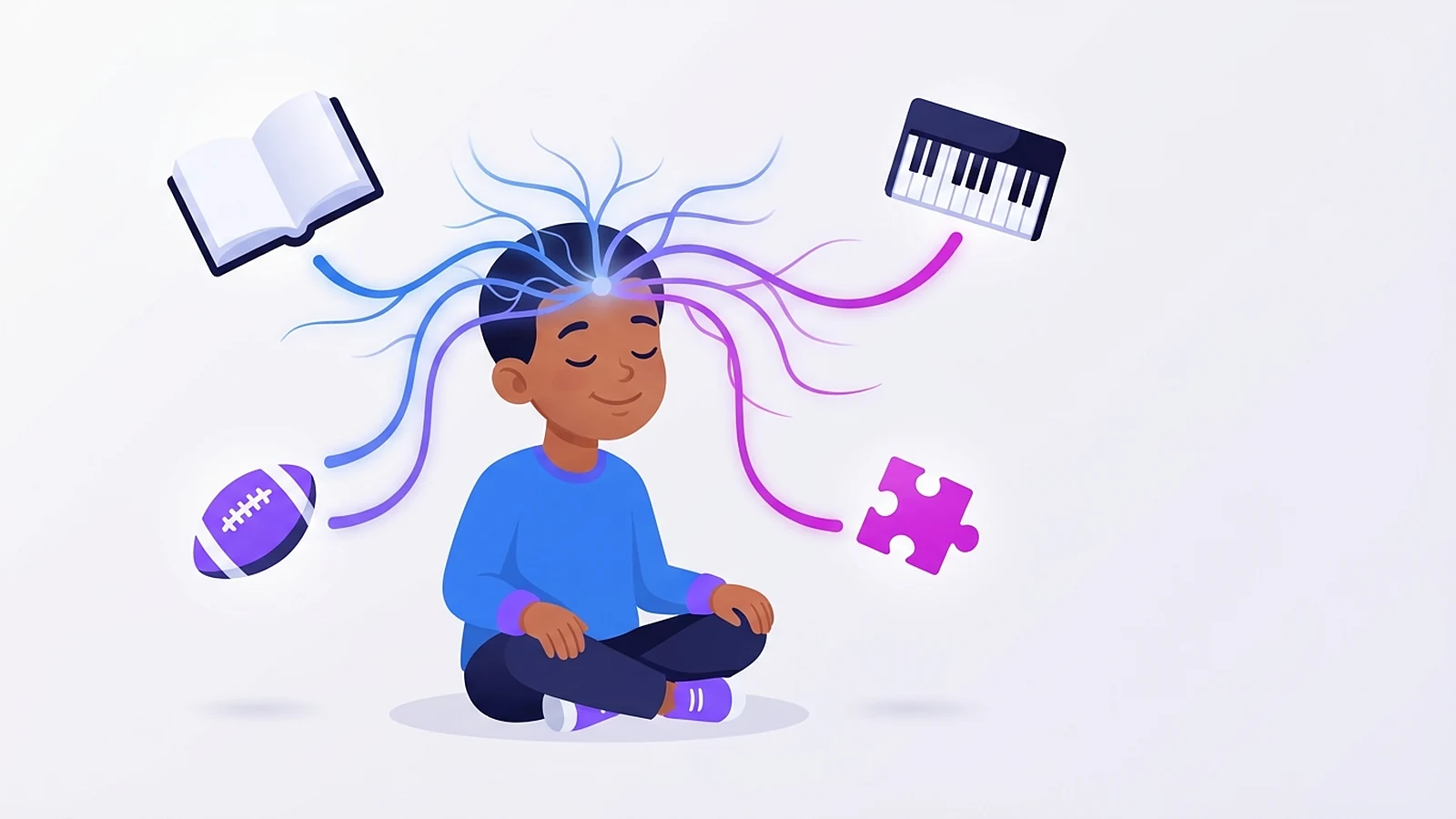
- The most effective neuroplasticity exercises for kids are new, slightly hard, repeated over weeks, and meaningful to the child.
- Sleep, movement and a calm, supportive adult are not extras. They are the conditions that let brain changes stick.
Most parents have heard the word neuroplasticity by now. It turns up in parenting posts, app adverts and school newsletters, usually next to a promise that a child’s brain can be “rewired”. The idea is real, and it is one of the most hopeful findings in modern science. But the useful part, what you actually do at home on a Tuesday evening, often gets lost.
What makes an activity a good neuroplasticity exercise?
An activity changes the brain when it is new, demanding, repeated and meaningful to your child. Those tests come from the ten principles of neuroplasticity set out by neuroscientists Jeffrey Kleim and Theresa Jones (Kleim & Jones, 2008). For the science behind them, from synapses to sensitive periods, see our guide to neuroplasticity explained. Here is how six of them look at home:
| Principle | What it looks like at home |
|---|---|
| Use it or lose it | Keep a little reading and times-table practice going through the school holidays |
| Use it and improve it | Ten minutes of piano most days beats one long session a week |
| Specificity | To improve reading, practise reading; a memory app mostly improves the app |
| Repetition matters | Expect progress over a school term, not a weekend |
| Intensity matters | Aim for just too hard: your child gets most of it right, but has to work for it |
| Salience matters | Let your child choose the instrument, the book or the sport |
Specificity is the principle most often ignored in marketing. It explains why large research reviews find that brain-training games improve the trained task far more than school results or IQ (Sala & Gobet, 2017). We cover that research in does brain training work?
What are the best neuroplasticity exercises for kids?
The best neuroplasticity exercises for kids are real skills practised often, not special “brain” activities. Each one below follows the principles above, and most are backed by studies that measured changes in children’s brains or learning.
1. Learn a musical instrument
In one study, six-year-olds who had weekly half-hour keyboard lessons for 15 months showed structural brain changes in motor and hearing areas that children without lessons did not (Hyde et al., 2009). Those changes tracked their gains in finger skill and musical listening. Notice what didn’t change: the children did not improve on non-musical tests. That is specificity in action.
- Try: short daily practice of a piece that is slightly beyond them, rather than replaying songs they already know.
2. Practise reading every day
When researchers gave struggling readers aged 8 to 12 about 100 hours of focused reading instruction over six months, the quality of a key white-matter pathway in their brains improved. The children whose brains changed most also improved most in reading (Keller & Just, 2009). Poor readers who stayed in normal lessons showed no such change.
- Try: 15 to 20 minutes of reading aloud together, then two or three questions about the story. Our reading list by age helps you pick the right book, and our guide to improving English reading skills covers phonics and vocabulary. Our free reading comprehension worksheets are graded by level to keep the challenge right.
3. Quiz instead of reread
A major review of ten study methods rated just two as high utility: practice testing and spacing practice out over time (Dunlosky et al., 2013). Rereading and highlighting, the methods most students use, were rated low. Pulling an answer out of memory strengthens the pathway far more than looking at it again.
- Try: after homework, ask your child to teach you three things they learnt, without notes. Revisit the same topic two days later, then a week later.
4. Master a new physical skill
In a classic experiment, adults who learnt to juggle for three months grew extra grey matter in areas that process visual motion. Three months after they stopped, much of that gain had shrunk (Draganski et al., 2004). That is use it or lose it, visible on a brain scan.
- Try: skipping-rope tricks, juggling, badminton footwork, a dance routine or riding a bike without stabilisers. The skill should be new, not one they have already mastered.
5. Solve puzzles that get harder
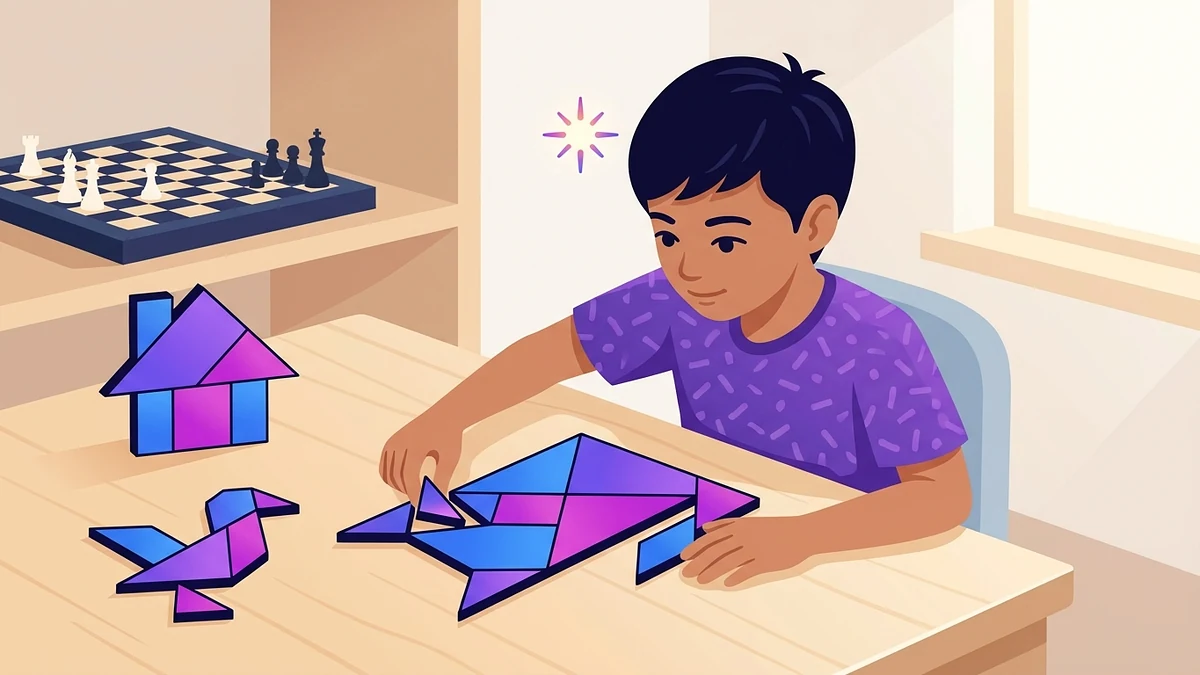
Puzzles and strategy games build planning, working memory and visual skills, as long as the difficulty keeps rising. In our free Span Ladder, each correct answer makes the next sequence one step longer, and Flash Grid asks children to recall and mirror visual patterns.
- Try: jigsaws, tangrams, chess or Sudoku, and move up a level once a puzzle feels easy. Treat games as practice for the skill they train, not a shortcut to better grades.
6. Let them find the way
London taxi drivers, who must memorise the city’s streets, have a larger rear hippocampus (a memory and navigation region) than non-drivers, and the difference grows with years on the job (Maguire et al., 2000). Planning and following routes trains that same system. You don’t need to memorise a city, but you can hand over the job of getting somewhere.
- Try: let your child navigate a shopping centre, read a map on a family walk, or draw a map of your neighbourhood from memory and then check it.
7. Talk through their thinking
Harvard’s researchers call responsive, back-and-forth conversation “serve and return”, and describe it as one of the most important influences on how children’s brain circuits are built. For older children, it looks like asking how they solved something, not just whether they got it right. It is also how critical thinking grows.
- Try: at dinner, ask “What was hard today, and what did you try?” Listen to the whole answer before offering a solution.
Which neuroplasticity exercises suit each age?
Match the exercise to your child’s stage, and keep raising the challenge as it gets easy.
| Stage | Good starting exercises | Practice that fits |
|---|---|---|
| Standard 1-3 (ages 7-9) | Reading aloud, a first instrument, skipping and ball skills, jigsaws | 10-15 minutes, most days, with an adult |
| Standard 4-6 (ages 10-12) | Teach-back quizzes, chess or tangrams, a new sport, map reading | 15-20 minutes, mostly independent |
| Form 1-3 (ages 13-15) | Spaced self-testing for school subjects, an instrument or language, strategy games | 20-30 minutes, planned by the student |
| Form 4-5 (ages 16-17) | Practice papers spaced across weeks, a demanding hobby or sport | Self-directed, with a weekly check-in |
The practice times are a starting guide from classroom experience, not research limits. Watch your child: frustration means the task is too hard, boredom means it is too easy.
What does a child’s brain need, to hold on to new learning?
Practice starts a brain change; sleep, movement and a calm home help it last. None of these is a “neuroplasticity exercise” in itself, but without them the exercises above work far less well.
Enough sleep
Sleep is when the brain sorts and strengthens the day’s learning. In one experiment, children aged 6 to 8 remembered newly learnt word pairs better after a night’s sleep than after the same time awake (Wilhelm, Diekelmann & Born, 2008). The American Academy of Sleep Medicine recommends 9 to 12 hours a night for ages 6 to 12 and 8 to 10 hours for teenagers (Paruthi et al., 2016).
From the classroom: the student who stayed up late revising is often the one who blanks in the test. An earlier night is usually worth more than an extra hour of study.
Daily movement
The World Health Organization recommends that children aged 5 to 17 average at least 60 minutes a day of moderate to vigorous activity, and rates the evidence as moderate that activity benefits thinking skills (WHO, 2020). A major review for the American College of Sports Medicine agreed that active, fit children tend to think better, but found the link to exam results less certain (Donnelly et al., 2016). So treat sport as good for the brain, not as a replacement for study.
A calm, responsive adult
Harvard’s Center on the Developing Child warns that long-lasting, severe stress without adult support can weaken developing brain circuits. The everyday stress of a hard spelling test is not the problem. What protects children is a steady relationship with an adult who notices, listens and helps, which is exactly what exercise 7 practises.
What can’t neuroplasticity exercises do?
Neuroplasticity explains how children learn, but it is not a shortcut around learning. Three honest limits are worth knowing:
- Changes are slow and specific. The studies above ran for three months to well over a year, and each changed the skill that was practised. Be wary of any product that promises fast, broad gains such as a higher IQ.
- Knowing about neuroplasticity helps only a little. In a national US study, two short online sessions teaching over 12,000 Grade 9 students (around Form 3 age) that the brain grows with effort raised lower achievers’ grades by about 0.1 on a 4-point scale (Yeager et al., 2019). A large review found the average effect of these mindset lessons was weak (Sisk et al., 2018). The message is worth sharing; the practice is what does the work.
- It is not a treatment on its own. If you are worried about your child’s reading, attention or development, speak to their teacher or a qualified professional. Targeted support, like the reading programme in exercise 2, is itself a way of using neuroplasticity well.
What does this mean for your child?
You don’t need a special programme to use neuroplasticity. You need a few good habits, kept up for months. A simple weekly rhythm covers most of this guide:
- One skill on the go: an instrument, sport or hobby that is still slightly hard.
- Reading most days, with a short chat about the book.
- Quiz, don’t reread, for schoolwork, spaced across the week.
- Protected sleep and time to move every day.
And tell your child what is happening. When they say “I’m just bad at maths”, you can answer, “Your brain hasn’t practised this enough yet.” It is true, and now they know why.
If you would like a clearer picture of which skills your child should practise first, our free assessment looks at the thinking, visual and learning skills behind schoolwork. A parent joins at the start and for the feedback chat at the end. We build these skills alongside real schoolwork through our Academic Excellence programmes, and we only promise what the research supports. For more on focus, see attention span by age.
Frequently asked questions
Can neuroplasticity exercises raise my child’s IQ?
Not directly. Practice changes the brain in the specific skill being trained, so piano improves piano and reading practice improves reading. Large reviews of brain-training games found little or no effect on IQ once studies were well designed. What reliably helps is building real skills and knowledge over time. Those make a child a stronger learner, even if an IQ score barely moves.
How long does it take to change a child’s brain?
Weeks to months, depending on the skill. In the research described here, measurable brain changes appeared after about three months of juggling, six months of reading instruction and 15 months of keyboard lessons. Your child will usually feel the skill getting easier long before any scan could show it. Plan in school terms, not days, and keep practice short and regular.
Is it too late if my child is already a teenager?
No. The teenage brain is still reorganising, especially the areas for planning and self-control, which keep maturing into the mid-20s. Teenagers can make big gains in a subject, an instrument or a sport. The difference is that they need more ownership: let them choose the goal and plan the practice, while you protect their sleep and check in weekly.
Can neuroplasticity help children with dyslexia, ADHD, or other learning difficulties?
The brain’s ability to change is the reason targeted teaching works. Struggling readers who had intensive reading instruction showed both brain and reading improvements in the Keller and Just study. Neuroplasticity is not a cure, though. If you suspect a learning difficulty, seek a proper assessment from a qualified professional, and use home practice to support the plan they recommend.
Is screen time bad for my child’s brain?
The brain gets better at whatever it does often, so it depends on what the screen time involves. A challenging puzzle game is very different from hours of fast scrolling. The bigger risks are usually indirect: screens pushing out sleep, reading, movement and conversation. Keep screens out of bedrooms at night and make sure the essentials come first.
How can teachers use neuroplasticity in the classroom?
Start with the two strategies rated highest for learning: short low-stakes quizzes and revisiting topics across weeks. Pitch tasks so students succeed with effort, and give feedback on strategy rather than talent. A brief lesson on how the brain changes with practice can help struggling students, but it works best inside a classroom culture that rewards effort and challenge.
How do I explain neuroplasticity to a child?
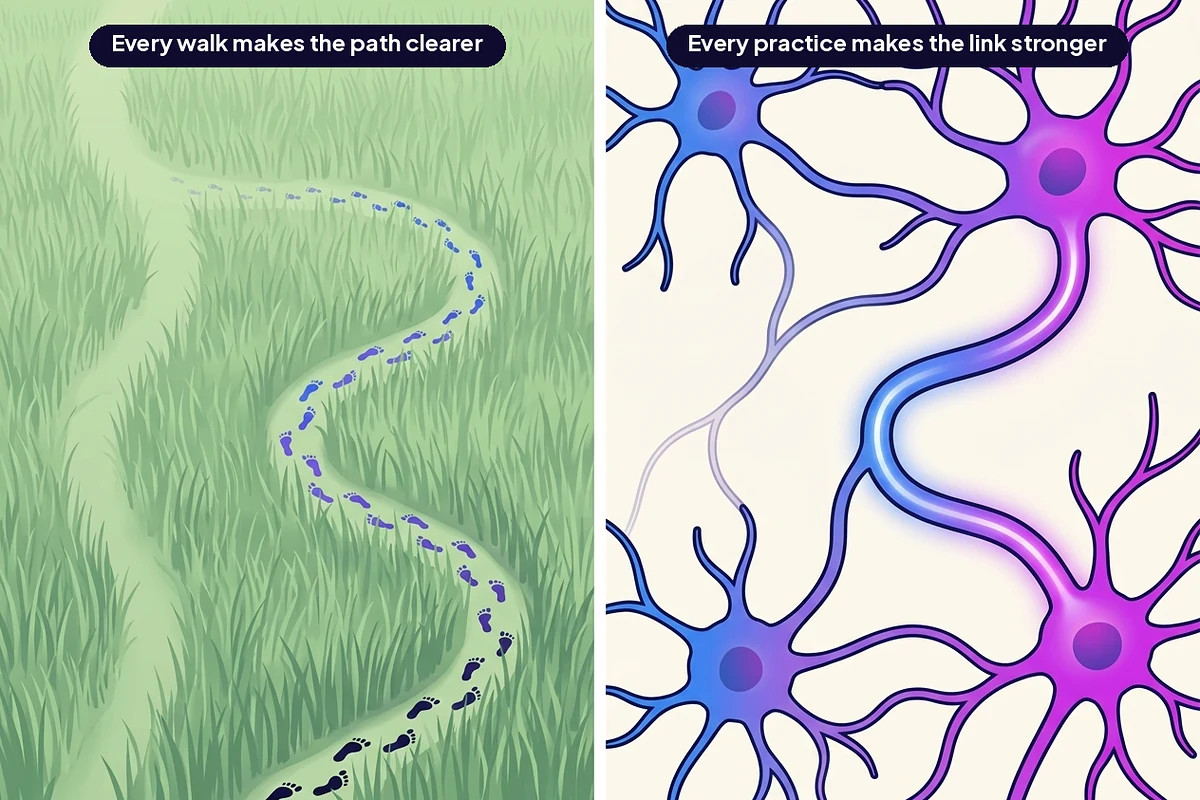
Use the grass path. The first time you walk across a field, you can hardly see where you went. Walk the same way every day, and a clear path appears that is easy to follow. Learning works the same way in the brain. Hard things feel hard because the path is new, and practice is how it becomes easy.
Want to know which skills your child’s brain is ready to build next?
References
- Center on the Developing Child, Harvard University. Brain architecture. developingchild.harvard.edu
- Dunlosky, J., Rawson, K. A., Marsh, E. J., Nathan, M. J., & Willingham, D. T. (2013). Improving students’ learning with effective learning techniques. Psychological Science in the Public Interest, 14(1), 4–58. https://doi.org/10.1177/1529100612453266
- Donnelly, J. E., et al. (2016). Physical activity, fitness, cognitive function, and academic achievement in children: A systematic review. Medicine & Science in Sports & Exercise, 48(6), 1197–1222. https://doi.org/10.1249/MSS.0000000000000901
- Draganski, B., et al. (2004). Neuroplasticity: Changes in grey matter induced by training. Nature, 427, 311–312. https://doi.org/10.1038/427311a
- Hyde, K. L., et al. (2009). Musical training shapes structural brain development. Journal of Neuroscience, 29(10), 3019–3025. https://doi.org/10.1523/JNEUROSCI.5118-08.2009
- Keller, T. A., & Just, M. A. (2009). Altering cortical connectivity: Remediation-induced changes in the white matter of poor readers. Neuron, 64(5), 624–631. https://doi.org/10.1016/j.neuron.2009.10.018
- Kleim, J. A., & Jones, T. A. (2008). Principles of experience-dependent neural plasticity. Journal of Speech, Language, and Hearing Research, 51(1), S225–S239. https://doi.org/10.1044/1092-4388(2008/018)
- Maguire, E. A., et al. (2000). Navigation-related structural change in the hippocampi of taxi drivers. PNAS, 97(8), 4398–4403. https://doi.org/10.1073/pnas.070039597
- National Institute of Mental Health. The teen brain: 7 things to know. nimh.nih.gov
- Paruthi, S., et al. (2016). Recommended amount of sleep for pediatric populations. Journal of Clinical Sleep Medicine, 12(6), 785–786. https://doi.org/10.5664/jcsm.5866
- Sala, G., & Gobet, F. (2017). Working memory training in typically developing children: A meta-analysis. Developmental Psychology, 53(4), 671–685. https://doi.org/10.1037/dev0000265
- Sisk, V. F., et al. (2018). To what extent and under which circumstances are growth mind-sets important to academic achievement? Psychological Science, 29(4), 549–571. https://doi.org/10.1177/0956797617739704
- Wilhelm, I., Diekelmann, S., & Born, J. (2008). Sleep in children improves memory performance on declarative but not procedural tasks. Learning & Memory, 15(5), 373–377. https://doi.org/10.1101/lm.803708
- World Health Organization (2020). WHO guidelines on physical activity and sedentary behaviour. ncbi.nlm.nih.gov
- Yeager, D. S., et al. (2019). A national experiment reveals where a growth mindset improves achievement. Nature, 573, 364–369. https://doi.org/10.1038/s41586-019-1466-y
About the author: Reuben Bykersma is the Catalyst and co-founder of EyeQBoost, a holistic education company helping children thrive in school and beyond, not just in exams. He has been teaching since the age of 15. He co-built a tutoring academy that taught more than 200 students over five years, and has taught English at a private school. Today he is building EyeQBoost to bring research-informed learning to more students, and to give parents and teachers honest, practical tools to support them. His aim is to make a lasting difference in education for students, teachers and parents alike. Connect on LinkedIn