Last reviewed: November 2026. We review this guide every year.
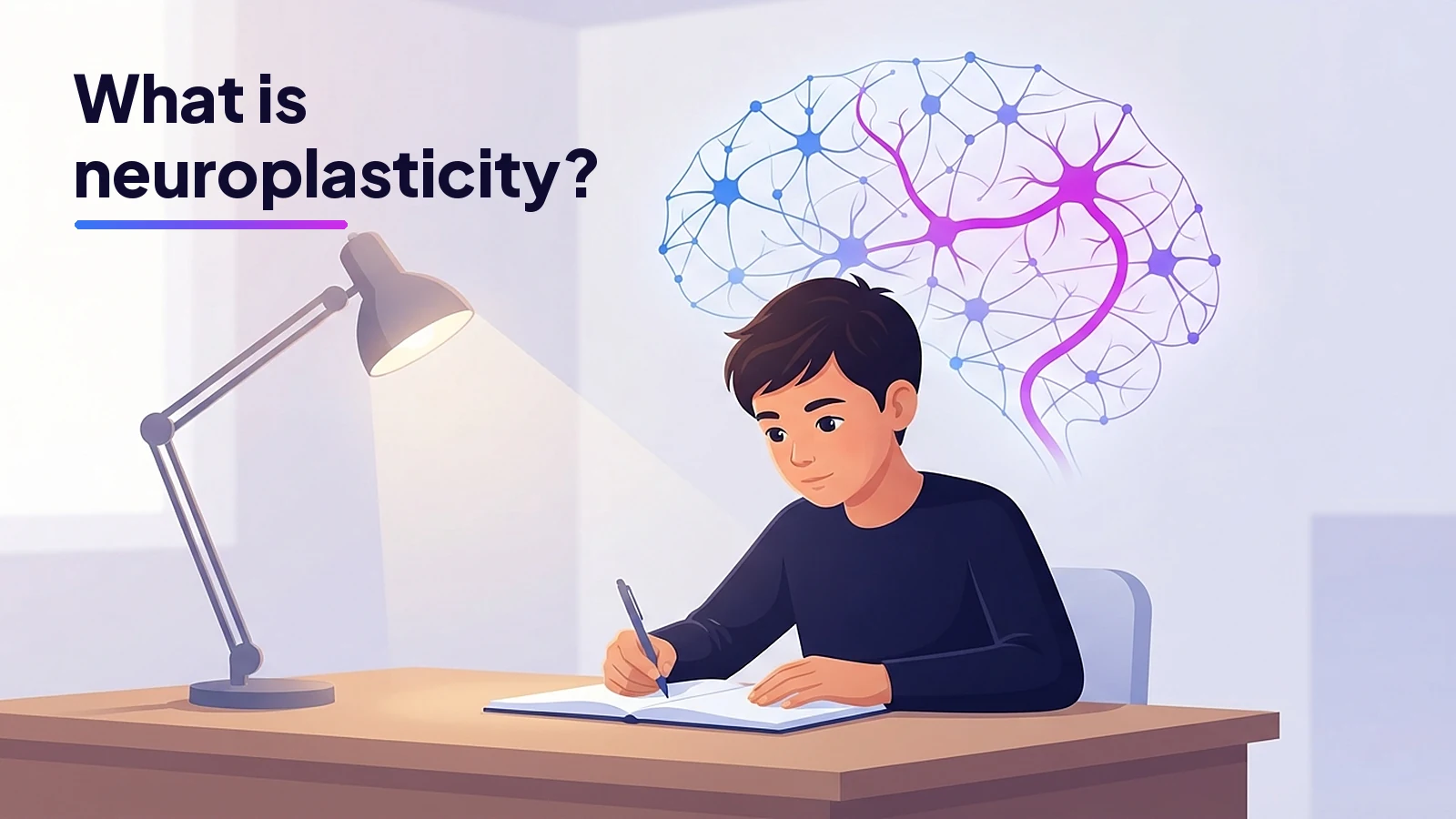
The short answer: Neuroplasticity, defined simply, is the brain’s ability to rewire itself through experience. Each time your child practises something, the connections between the brain cells involved grow stronger, faster and better organised, while unused connections fade. It is how all learning happens. It is strongest in childhood, but it never switches off.
Key takeaways
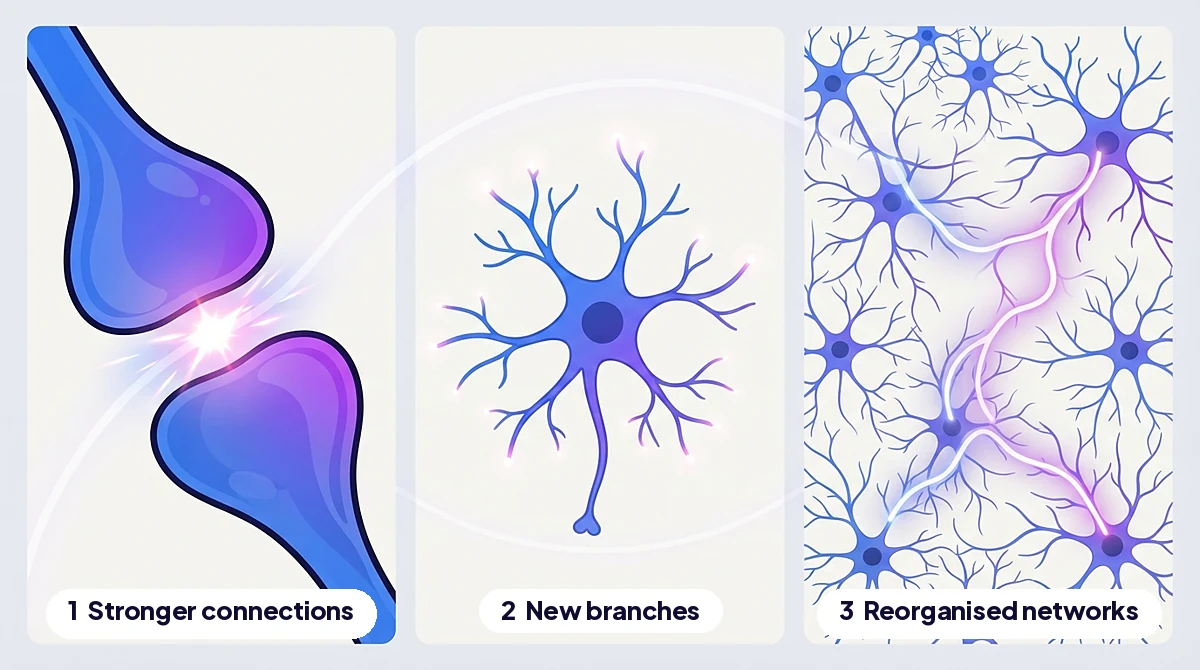
- Neuroplasticity (also called brain plasticity or neural plasticity) works at three levels: single connections get stronger, brain tissue physically changes and whole networks reorganise.
- Children’s brains run on two kinds of plasticity. One builds the basics every child needs, on a fixed timetable. The other builds your child’s own skills and knowledge, and it lasts a lifetime.
- Researchers have set out ten principles of neuroplasticity. Two that parents rarely hear about: gains transfer only to closely related skills, and bad habits get wired in just as firmly as good ones.
- Ignore the neuromyths. Nobody is “left-brained” or “right-brained”, and the learning window does not slam shut at age three.
Every term, a parent asks me some version of the same question: “Is my child just not a maths person?” Sometimes it is reading, or writing, or music. Behind the question sits a worry that ability is fixed, handed out at birth and settled by Standard 1.
Neuroscience gives a clear answer, and it is good news. The brain your child has today is, to a large degree, a record of what it has practised so far. This guide explains what neuroplasticity actually is, how it works inside the brain, why a child’s brain changes differently from an adult’s, and the principles researchers agree on. If you are looking for activities to try at home, our guide to neuroplasticity exercises for kids picks up where this one ends.
What is neuroplasticity?
Neuroplasticity is the brain’s ability to reorganise itself, both in structure and in how it works, as a result of experience and learning. That is the neuroplasticity definition most neuroscientists would sign up to. The word joins neuro (nerve cells) with plastic, from a Greek word meaning “able to be moulded”. Plastic here means mouldable, not flimsy.
The key idea is that learning is physical. When your child finally gets long division, something has changed inside their head that was not there last week. Neuroscientists Jeffrey Kleim and Theresa Jones put it plainly: plasticity is believed to be the basis of learning in a healthy brain, and of relearning after an injury (Kleim & Jones, 2008).
Where did the idea come from?
For much of the 20th century, textbooks taught that the adult brain was more or less fixed. The idea of a changeable brain is older than that, though. It was argued for, then tested, then measured, over about a century:
| When | Who | What they added |
|---|---|---|
| 1890 | William James, psychologist | Linked habits to the plasticity of the body’s materials, in The Principles of Psychology |
| Around 1900 | Santiago Ramón y Cajal, neuroscientist | Proposed that learning forms new connections between nerve cells |
| 1949 | Donald Hebb, psychologist | Proposed that when one cell repeatedly helps fire another, the link between them strengthens |
| 1966 to 1973 | Terje Lømo and Tim Bliss | First measured a connection staying strengthened for hours after repeated stimulation (long-term potentiation) |
| 1987 | William Greenough and colleagues | Showed that young brains use two different kinds of plasticity |
| 2000s onward | Brain imaging labs worldwide | Watched human brains change as people learnt, using MRI scans |
Hebb’s idea is now usually summed up in a line coined by neuroscientist Carla Shatz in 1992: cells that fire together, wire together. It is the single most useful sentence in this guide.
How does neuroplasticity work in the brain?
Neuroplasticity works at three levels at once: the single connection, the physical tissue and the whole network. A useful way to picture it is a city. Streets get busier, new roads get built, and the traffic system as a whole is redesigned.
Level 1: Connections get stronger
Brain cells (neurons) pass signals to each other across tiny gaps called synapses. When two neurons are active together again and again, the synapse between them becomes more efficient, so the next signal crosses more easily. This is long-term potentiation, the effect Bliss and Lømo first recorded (Bliss & Lømo, 1973).
In a child, this is the moment a times-table fact stops needing to be worked out and simply appears. The pathway has been used enough to become quick.
Level 2: The brain’s tissue physically changes
With longer practice, the change becomes visible on a brain scan. In one study, researchers scanned 38 medical students three months before a major exam, just after it, and three months later. During their revision, grey matter increased in areas at the back and sides of the brain involved in memory. One memory region, the rear hippocampus, kept growing in the three months after the exam (Draganski et al., 2006).
From the classroom: that is a useful thing to tell a Form 5 student facing SPM. Months of steady revision do not just fill a notebook. They change the brain doing the revising.
Level 3: Whole networks reorganise
The most striking changes are in how brain areas work together. A Stanford team gave primary-school children with significant maths difficulties eight weeks of one-to-one tutoring in number sense and counting strategies. Before tutoring, their brains solved sums in a noticeably different way from their classmates’. After tutoring, their maths caught up, and a computer analysis could no longer tell their brain activity apart from that of children without difficulties (Iuculano et al., 2015).
Read that again, because it matters for every parent who has been told their child is “weak” at a subject. Good teaching did not help these children work around their brains. It changed how their brains worked.
Does a child’s brain change differently from an adult’s?
Yes. A child’s brain uses two kinds of plasticity, and it builds and trims connections on a timetable that runs right through the teenage years. Understanding both explains a lot about why children learn the way they do.
Expected experiences and personal experiences
In a landmark paper, William Greenough and colleagues argued that genes only roughly outline the brain’s wiring, leaving the details to be filled in by experience (Greenough, Black & Wallace, 1987). They described two ways this happens:
| Experience-expectant plasticity | Experience-dependent plasticity | |
|---|---|---|
| What it builds | Abilities every child is expected to develop, such as seeing patterns and hearing speech sounds | Skills and knowledge unique to your child, such as their vocabulary, their route to school, chess, the piano |
| How it works | The brain makes extra connections in advance, then keeps the ones that ordinary experience uses | The brain forms new connections when something new is learnt |
| When | Mostly early, in set windows | Throughout life |
| What it needs | An ordinary, caring environment with light, sound, talk and touch | Practice, challenge and teaching |
This is reassuring. The first kind needs nothing special from parents; ordinary family life provides it. Almost everything your child learns at school runs on the second kind, and that kind does not expire.
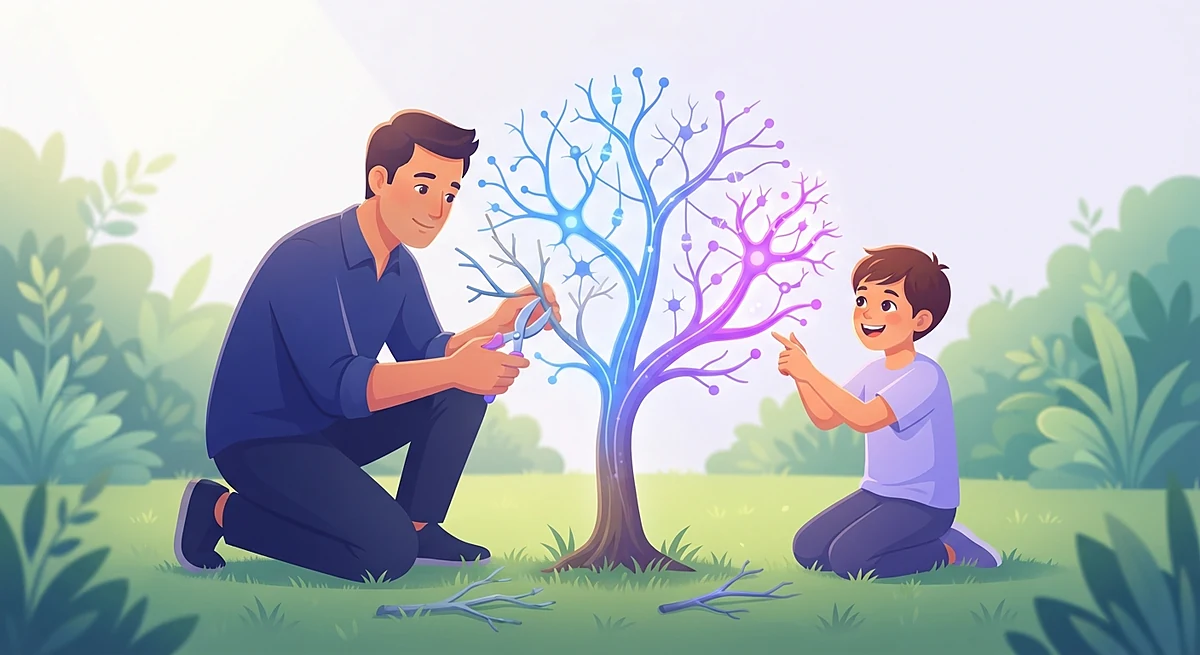
Blooming, then pruning
In early childhood the brain makes far more synapses than it will keep. It then trims back the unused ones, a process called synaptic pruning. Studies of brain tissue by neurologist Peter Huttenlocher found that different areas run on different timetables. Connections in a hearing area peaked within months of birth and had mostly finished thinning by about age 12. In the prefrontal cortex, the area behind the forehead that handles planning and self-control, the thinning ran on into mid-adolescence (Huttenlocher & Dabholkar, 1997).
Pruning sounds like loss, but it is how the brain becomes efficient. Think of a sculptor removing stone. What remains is the shape your child’s experiences have chosen.
Sensitive periods, not closed doors
Scientists now prefer the term sensitive period to “critical period”. In a sensitive period, a brain system is especially responsive to a certain kind of experience. Learning is still possible afterwards; it just takes more effort.
One sensitive period surprises many parents of secondary students. Psychologist Sarah-Jayne Blakemore and her colleagues have shown that the brain’s social network, the areas used to understand other people, reorganises substantially during the second decade of life. They suggest adolescence may be a sensitive period for adapting to the social world (Blakemore & Mills, 2014).
In practice: if your Form 2 child suddenly cares more about what their friends think than what you think, that is not just attitude. Their brain is tuned to learn from peers right now. A good study group, a club or a team can be a powerful place to learn.
What are the principles of neuroplasticity?
The principles of neuroplasticity are the ten rules that decide whether an experience actually changes the brain. Kleim and Jones drew them from decades of research on learning and recovery, and theirs is still the most widely cited list (Kleim & Jones, 2008):
| # | Principle | What the research shows | What it means for learning |
|---|---|---|---|
| 1 | Use it or lose it | Brain functions that are not used can weaken | Skills fade over long breaks |
| 2 | Use it and improve it | Training a function can strengthen it | Practice builds the circuit behind a skill |
| 3 | Specificity | The kind of training decides the kind of change | The brain improves at what it actually practises |
| 4 | Repetition matters | Lasting change needs enough repetition | Once is never enough |
| 5 | Intensity matters | Training must be demanding enough | Easy tasks change little |
| 6 | Time matters | Different changes happen at different stages of training | Progress comes in stages, not a straight line |
| 7 | Salience matters | The experience must matter to the learner | Interest and meaning switch learning on |
| 8 | Age matters | Training-induced change happens more readily in younger brains | Childhood is a head start, not a deadline |
| 9 | Transference | Training one skill can help similar skills | Gains spread to close neighbours, not across the board |
| 10 | Interference | Learning one thing can get in the way of learning another | Bad habits are wired in too |
How to turn the first eight into everyday practice is covered in our neuroplasticity exercises guide. The last two deserve a closer look, because they are the ones most often left out.
Transference: why gains stay close to home
Practice helps related skills, but the further the skill, the weaker the effect. A child who masters number bonds will find mental arithmetic easier; they will not suddenly spell better. This is why researchers are cautious about games that promise to raise general intelligence. We look at that evidence in does brain training work?
Interference: the principle every teacher knows
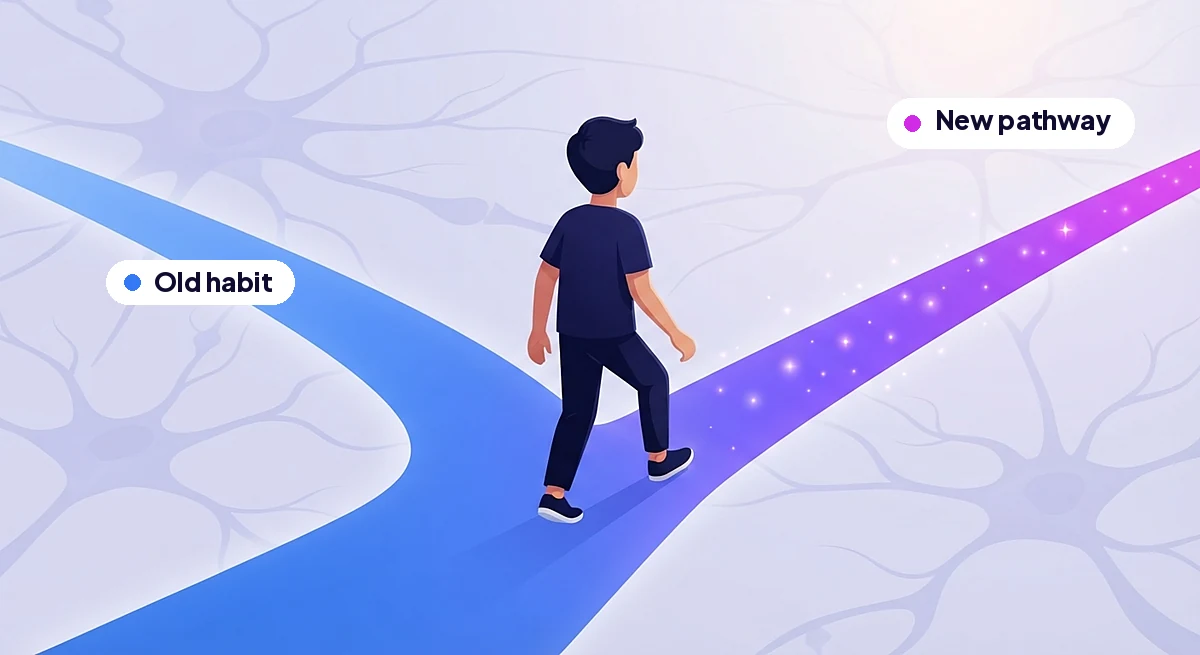
The brain does not judge whether a habit is helpful. It strengthens whatever is repeated. So a child who has guessed at unfamiliar words for two years has a well-worn “guessing” pathway that competes with the newer “sounding out” one. The old route fires first, because it is faster.
This is why unlearning usually takes longer than learning fresh. It is also the strongest argument for getting the basics right early: pencil grip, letter formation, number sense and phonics. Patience helps too. When a child slips back into an old habit, their brain is not refusing to change; the old pathway is simply still the stronger one.
Which brain myths does neuroplasticity disprove?
Real neuroplasticity research undoes several popular “brain facts” that still circulate in schools and parenting groups. These misunderstandings are called neuromyths. In a survey of 242 primary and secondary teachers in the UK and the Netherlands, teachers believed 49% of the neuromyths on average. Surprisingly, teachers who knew more about the brain in general were more likely to believe the myths, not less. The myths linked to commercial education programmes were the most widely believed (Dekker et al., 2012).
Myth 1: “My child is left-brained” (or right-brained)
Some functions do lean to one side, such as language to the left in most people. But a University of Utah team analysed brain scans of more than 1,000 people aged 7 to 29 and found no evidence that anyone has a stronger left-brain or right-brain network overall (Nielsen et al., 2013). Creative children and logical children use both halves of their brain. Labels like this can quietly become a reason not to practise.
Myth 2: “After age three, it’s too late”
The early years matter, and some sensitive periods do fall early. But the experience-dependent plasticity behind school learning continues for life. The medical students and tutored children above were all well past age three.
Myth 3: “If it mentions the brain, it must be proven”
Words like rewire, neural and brain-based sell. Dekker’s team notes research showing that people find explanations more convincing when brain images or neuroscience terms are attached, even when those explanations are wrong. Before paying for any programme, ask three questions:
- Was it tested on children like mine, against a comparison group?
- Did the children improve at real skills, such as reading or maths, or only at the programme’s own tasks?
- Do the claimed results fit the principles above, especially specificity and transference?
What does neuroplasticity mean for your child?
Neuroplasticity turns “Is my child good at this?” into a better question: “What has my child’s brain practised so far?” Three shifts follow from the science:
- Treat ability as a record, not a verdict. A weak subject usually means a pathway that has not been used enough yet, as the tutored children showed.
- Get the foundations right early. Because of interference, a habit is far easier to fix in Standard 2 than to unpick in Form 2.
- Use the teenage social brain. Secondary students learn powerfully from peers, so the right friends, clubs and study partners are part of their education.
If you would like to know which skills your child’s brain is ready to build next, our free 30-minute assessment looks at the thinking, visual and learning skills behind schoolwork. A parent joins at the start and for the feedback chat at the end. We then build those skills alongside real schoolwork in our Academic Excellence programmes. For a quick start at home, try our free Brain Games or the printable worksheets on our Resources page.
Frequently asked questions
Is neuroplasticity real, or just a buzzword?
It is real and well measured. Scientists have recorded single connections strengthening since the 1970s and have watched human brains change with learning on MRI scans since the 2000s. The word, though, is often stretched by marketing. The science supports steady, specific change through practice, not overnight transformation.
Does my child grow new brain cells when they learn?
Mostly, learning changes the connections between existing brain cells, not the number of cells. Whether humans keep making new neurons in the memory centre after childhood is still debated: two major 2018 studies reached opposite conclusions. Either way, the strengthening and pruning of connections is what drives day-to-day learning.
Is there such a thing as a “maths brain” or a “language brain”?
Children do start with different strengths, because genes shape the brain’s broad layout. But specific skills like algebra or essay writing are built through experience-dependent plasticity, which means through teaching and practice. A child who calls themselves “not a maths person” usually means “not a maths person yet“.
Does learning a second language change a child’s brain?
Yes. A study in Nature found that bilingual people had denser grey matter in a left-side brain area linked to language than people who spoke one language. The effect was stronger in those who learnt the second language earlier and spoke it better (Mechelli et al., 2004). Growing up with two or three languages at home is a real advantage worth keeping up.
Is neuroplasticity the same as a growth mindset?
No, though they are related. Neuroplasticity is the biology: the brain physically changes with practice. A growth mindset is a belief: that ability can grow with effort. The biology is what makes the belief accurate. Research suggests the belief helps a little on its own, but the practice is what changes the brain.
What is the difference between neuroplasticity and brain training?
Neuroplasticity is the brain’s natural ability to change. Brain training is one product built on that idea: games or apps meant to exercise particular skills. Because of the transference principle, training mostly improves the trained task and its close neighbours. See does brain training work? for what the research shows.
Curious how your child’s brain learns best?
References
- Blakemore, S.-J., & Mills, K. L. (2014). Is adolescence a sensitive period for sociocultural processing? Annual Review of Psychology, 65, 187–207. https://doi.org/10.1146/annurev-psych-010213-115202
- Bliss, T. V. P., & Lømo, T. (1973). Long-lasting potentiation of synaptic transmission in the dentate area of the anaesthetized rabbit following stimulation of the perforant path. The Journal of Physiology, 232(2), 331–356. https://doi.org/10.1113/jphysiol.1973.sp010273
- Dekker, S., Lee, N. C., Howard-Jones, P., & Jolles, J. (2012). Neuromyths in education: Prevalence and predictors of misconceptions among teachers. Frontiers in Psychology, 3, 429. https://doi.org/10.3389/fpsyg.2012.00429
- Draganski, B., et al. (2006). Temporal and spatial dynamics of brain structure changes during extensive learning. Journal of Neuroscience, 26(23), 6314–6317. https://doi.org/10.1523/JNEUROSCI.4628-05.2006
- Greenough, W. T., Black, J. E., & Wallace, C. S. (1987). Experience and brain development. Child Development, 58(3), 539–559. https://doi.org/10.2307/1130197
- Hebb, D. O. (1949). The Organization of Behavior: A Neuropsychological Theory. Wiley.
- Huttenlocher, P. R., & Dabholkar, A. S. (1997). Regional differences in synaptogenesis in human cerebral cortex. Journal of Comparative Neurology, 387(2), 167–178. https://doi.org/10.1002/(SICI)1096-9861(19971020)387:2<167::AID-CNE1>3.0.CO;2-Z
- Iuculano, T., et al. (2015). Cognitive tutoring induces widespread neuroplasticity and remediates brain function in children with mathematical learning disabilities. Nature Communications, 6, 8453. https://doi.org/10.1038/ncomms9453
- James, W. (1890). The Principles of Psychology. Henry Holt.
- Kleim, J. A., & Jones, T. A. (2008). Principles of experience-dependent neural plasticity: Implications for rehabilitation after brain damage. Journal of Speech, Language, and Hearing Research, 51(1), S225–S239. https://doi.org/10.1044/1092-4388(2008/018)
- Mechelli, A., et al. (2004). Structural plasticity in the bilingual brain. Nature, 431, 757. https://doi.org/10.1038/431757a
- Nielsen, J. A., Zielinski, B. A., Ferguson, M. A., Lainhart, J. E., & Anderson, J. S. (2013). An evaluation of the left-brain vs. right-brain hypothesis with resting state functional connectivity magnetic resonance imaging. PLOS ONE, 8(8), e71275. https://doi.org/10.1371/journal.pone.0071275
- Shatz, C. J. (1992). The developing brain. Scientific American, 267(3), 60–67. https://doi.org/10.1038/scientificamerican0992-60
About the author: Reuben Bykersma is the Catalyst and co-founder of EyeQBoost, a holistic education company helping children thrive in school and beyond, not just in exams. He has been teaching since the age of 15. He co-built a tutoring academy that taught more than 200 students over five years, and has taught English at a private school. Today he is building EyeQBoost to bring research-informed learning to more students, and to give parents and teachers honest, practical tools to support them. His aim is to make a lasting difference in education for students, teachers and parents alike. Connect on LinkedIn