Last reviewed: November 2026. We review this guide every year.
The short answer: Extracurricular activities are activities students choose to do outside their regular lessons, such as sport, music, drama, debate, coding or volunteering. Research links regular participation to better grades, stronger friendships and higher self-esteem, especially when a child enjoys the activity and sticks with it.
Key takeaways
- Try lots when young, go deeper later. Primary children do best sampling several activities. Teenagers do best focusing on one or two.
- Most of the benefit comes from staying with an activity, not from collecting as many as possible.
- Overscheduling is rarer than parents fear. Children who do nothing at all tend to fare worse than busy ones.
- Pressure matters more than hours. In one study, how critical a child felt their parents were mattered far more than how many hours they spent in activities.
- The best activities are structured and active, with a clear skill to learn and an adult who teaches it.
Every parent knows the after-school scramble: football on Tuesday, piano on Thursday, a robotics club someone recommended, and a child who just wants to lie on the sofa. It is fair to ask whether any of it is worth the time, the fees and the traffic.
The research gives a clear answer, though it is not quite the one most parents expect. Extracurricular activities do help children, but how a child takes part matters more than how much.
[Lucas: add a short real story here. One or two sentences about a student you taught whose confidence or schoolwork changed through an activity outside class, such as music. I haven’t invented one.]
What does extracurricular mean?
The extracurricular meaning is simple: “outside the curriculum”. The word joins the Latin extra (outside) with curriculum, the set course of study (Vocabulary.com). An extracurricular activity is anything a student does regularly that isn’t part of their required lessons.
So what is an extracurricular activity, exactly? In research, it usually has three features:
- Voluntary: the child chooses it, or at least agrees to it. It isn’t a required subject.
- Organised: it has a leader, a regular time and a skill to work on, like a swimming squad or a chess club.
- Outside lessons: it happens before school, after school, at weekends or in the holidays, at school or in the community.
That third point is why playing video games or chatting with friends doesn’t usually count. Both are fine, but researchers call them unstructured time. They don’t carry the same benefits, because nobody is teaching a skill or setting a goal.
A note for Malaysian parents: extracurricular activities are different from the compulsory co-curricular activities (kokurikulum) in government schools. The FAQ below explains the difference, and our guide to co-curricular activities in Malaysian schools covers records, marks and certificates.
What are some examples of extracurricular activities?
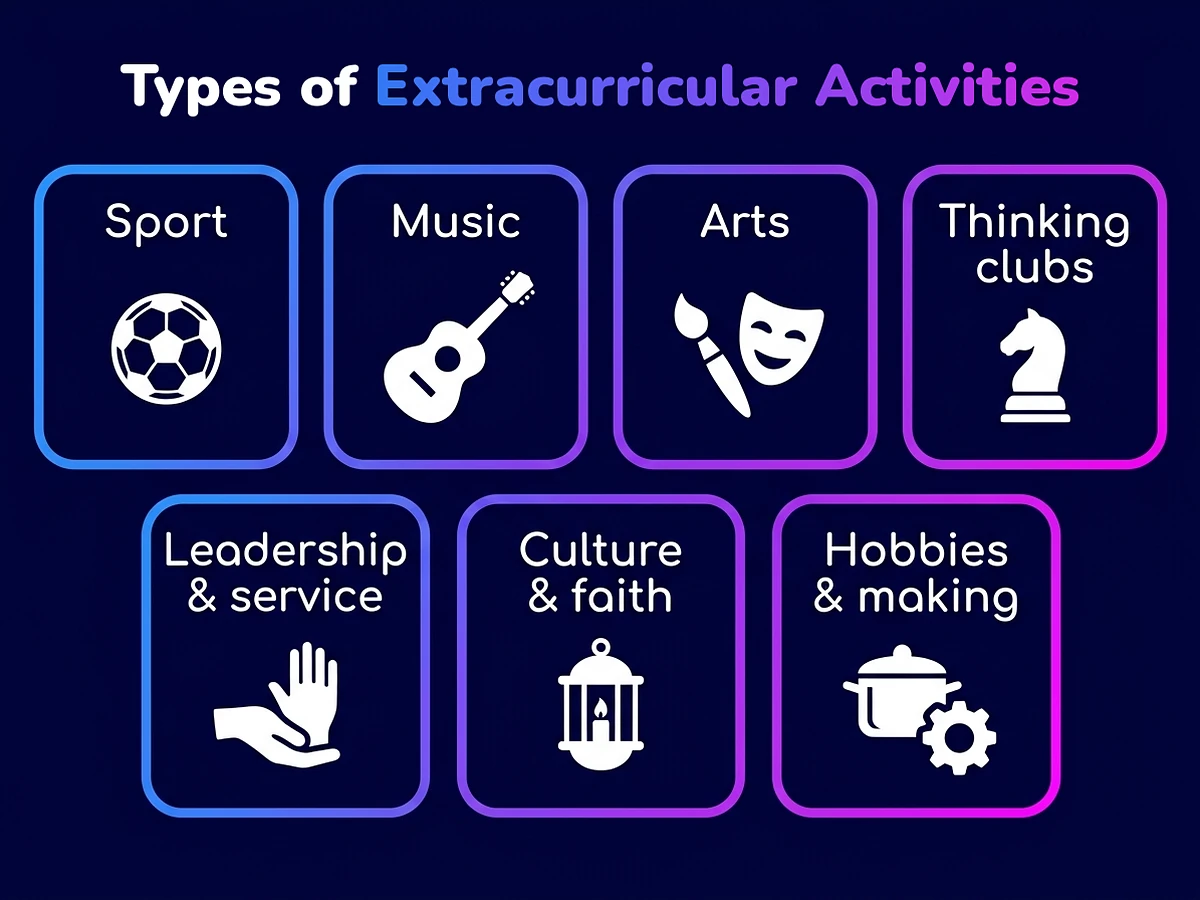
Extracurricular activities fall into seven broad groups. The table shows examples of each, and the skills each type tends to build.
| Type | Examples | Skills it tends to build |
|---|---|---|
| Sport and movement | Football, badminton, swimming, martial arts, gymnastics, dance | Persistence, teamwork, physical fitness |
| Music | Piano, violin, guitar, choir, school band or orchestra | Focus, memory, patient daily practice |
| Performing and visual arts | Drama, art club, photography, film-making | Self-expression, creativity, confidence in front of others |
| Thinking and academic clubs | Chess, debate, coding, robotics, spelling bees | Critical thinking, problem-solving, public speaking |
| Leadership and service | Student council, scouts, volunteering, peer mentoring | Responsibility, empathy, links with adults |
| Faith and cultural groups | Youth groups, cultural dance, language classes | Identity, emotional control, sense of belonging |
| Hobbies and making | Cooking, gardening, model building, sewing, a school newspaper | Planning, independence, finishing what you start |
The skills column isn’t guesswork. A survey of 2,280 American 16- and 17-year-olds found that each type of activity gave students different growth experiences (Larson, Hansen & Moneta, 2006). Sport and the arts built the most initiative, while faith-based and service groups built the most identity and emotional regulation.
Which extracurricular activities suit which age?
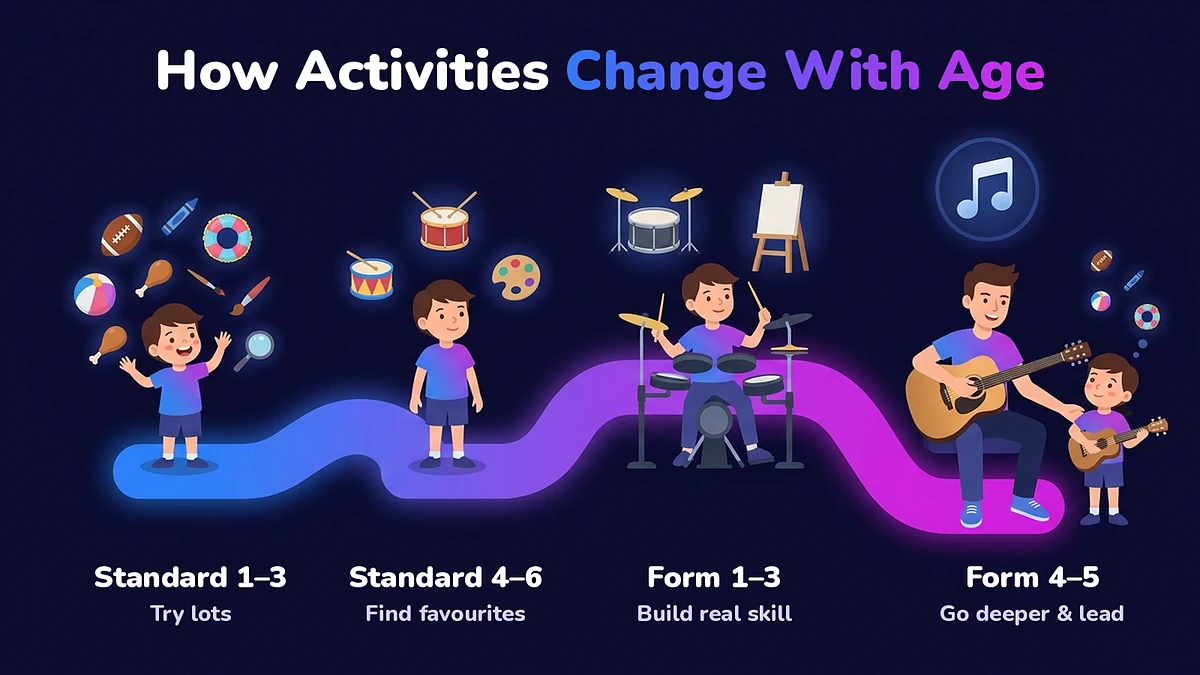
Younger children do best by trying several things. Teenagers do best by going deeper into one or two. Researchers describe this as moving from sampling in childhood to intensifying in mid-adolescence (Bohnert, Fredricks & Randall, 2010).
| Stage | Age | What tends to work |
|---|---|---|
| Standard 1 to 3 | 7 to 9 | Short, playful sessions. Swimming, simple team games, a first instrument, art. Let them try a few things over the year |
| Standard 4 to 6 | 10 to 12 | Clubs with a clear skill ladder, such as chess grades, music exams or a coding project. Encourage one physical and one creative or thinking activity |
| Form 1 to 3 | 13 to 15 | Activities with more responsibility, such as team captaincy, debate, robotics competitions or helping younger children |
| Form 4 to 5 | 16 to 17 | One or two activities they care about, done well, with a leadership or service role where possible. Protect sleep and exam time |
How do extracurricular activities help students?
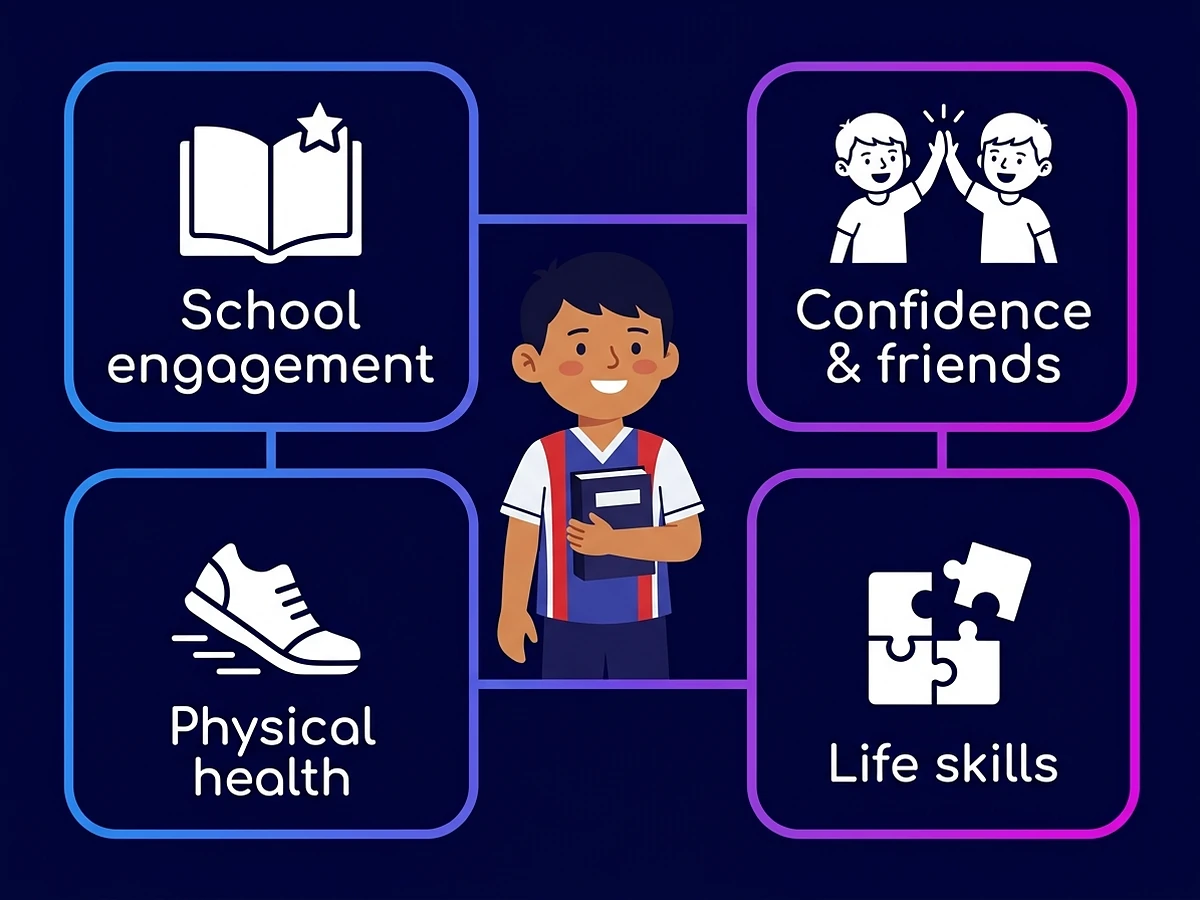
Students who take part in extracurricular activities tend to do better at school, feel better about themselves and get into less trouble. A major review of the research found these links again and again across academic, psychological and behavioural outcomes (Farb & Matjasko, 2012). Here is what the strongest studies show.
Better engagement and grades
In a US study of 13,130 secondary students, those who did more activities had higher maths scores, better grades and higher education goals, even after accounting for their earlier results (Fredricks, 2012).
Music shows one of the clearest patterns. A study of 112,916 students in British Columbia found that students who stuck with school music, especially an instrument, scored higher in maths, science and English exams (Guhn, Emerson & Gouzouasis, 2020). The most engaged instrumental students were, on average, about a year ahead of their peers.
Confidence, friendships and wellbeing
A systematic review of 30 studies found that sport was most often linked to higher self-esteem, better social skills and fewer symptoms of depression (Eime et al., 2013). Team sport showed stronger links than individual sport, probably because of the friendships built around it.
Activities also help children meet the World Health Organization’s target of an average of 60 minutes of moderate-to-vigorous activity a day for ages 5 to 17 (WHO, 2020). For most children, a school day alone won’t get them there.
Skills the classroom rarely teaches
In the Larson survey mentioned above, students reported more growth experiences in every type of organised activity than in their school classes (Larson, Hansen & Moneta, 2006). In sport, 61% said they had “learned to push myself”, compared with 36% in other activities (University of Illinois).
This is where children practise things like losing gracefully, turning up when they don’t feel like it, and leading people who aren’t their friends. Those are hard lessons to teach from a textbook.
What the research can and can’t prove
Most of these studies show a link, not proof that the activity caused the benefit. Children who already have supportive families, good grades or confidence are more likely to join activities in the first place. The better studies control for this, and the benefits mostly hold, but they shrink.
It also pays to be careful with claims that one activity “boosts” another subject. An OECD review found good evidence that music training strengthens some academic skills, but no clear causal effect from general arts classes (Winner, Goldstein & Vincent-Lancrin, 2013). The authors’ view is that the arts are worth doing for their own sake, and we agree. It is the same lesson we found in the research on brain training: practice mostly improves the skill you practise.
How many extracurricular activities should a child do?
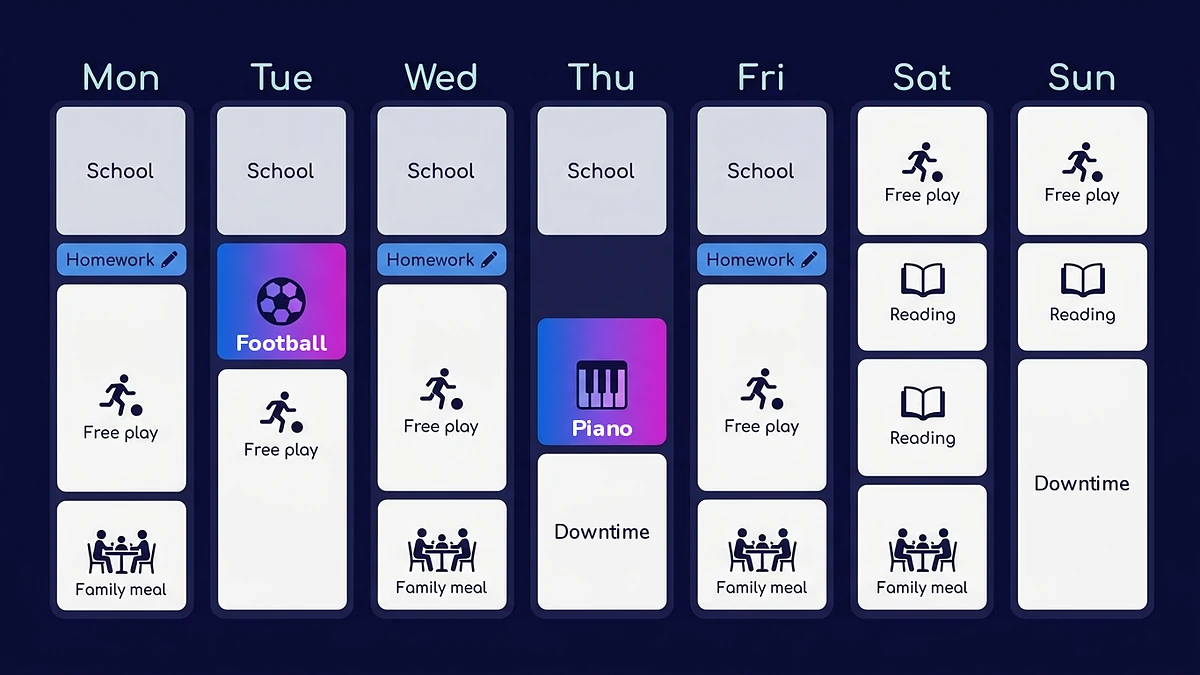
For most children, two or three activities, adding up to around five hours a week, is plenty. That is roughly what the average secondary student does (Fredricks, 2012).
The worry about “overscheduled” children turns out to be mostly overstated. A US study of thousands of families found very limited support for the overscheduling idea: only a small minority did 20 or more hours a week, and young people who did no activities fared worse than busy ones (Mahoney, Harris & Eccles, 2006).
There is a ceiling, though. The benefits level off and then dip at the very highest levels. In one study, educational attainment rose with each extra activity, but levelled off or fell once students reached five or more (Fredricks & Eccles, 2010).
The bigger risk is pressure, not hours
When researchers studied busy 13- and 14-year-olds in affluent communities, the number of hours in activities explained very little of their stress. What mattered far more was whether they felt their parents were critical of their achievements, and whether anyone was home after school (Luthar, Shoum & Brown, 2006).
Signs your child is doing too much
Instead of counting activities, watch for these signs that the balance is off:
- Your child regularly sleeps less than they need, or does homework late at night.
- They dread an activity most weeks, not just on the odd bad day.
- They have no unplanned time left to play, read or be bored.
- Grades are slipping and the timetable leaves no room to catch up.
- Family meals and downtime have disappeared from the week.
How do you choose the right extracurricular activity?
Start with what your child enjoys, then look for an activity that is well run. A meta-analysis of after-school programmes found that the ones that improved children’s confidence, behaviour and grades shared four features, summed up as SAFE (Durlak, Weissberg & Pachan, 2010):
- Sequenced: skills are taught step by step, building on last week.
- Active: children practise, rather than mostly watch or listen.
- Focused: time is set aside for building skills, not just supervision.
- Explicit: the coach or teacher says clearly which skill is being learned.
Programmes without those features showed little effect. That gives you four simple questions to ask any coach, teacher or club before you sign up.
Four more things to weigh up
- Mix the types. One physical activity plus one creative or thinking activity gives the most range. Students involved across several kinds of activity tend to do better than those in just one (Fredricks & Eccles, 2006).
- Give it a fair trial. Agree on a term before deciding whether to stop. The early weeks of any new skill are the least fun.
- Let your child own it. An activity chosen “for Mum and Dad” rarely lasts. Offer two or three options and let them pick.
- Check the logistics. A great club an hour’s drive away often loses to a good one near home, because it is the one you will keep going to.
What does this mean for your child?
Pick one or two activities your child enjoys, keep them going for at least a term, and protect their sleep and free time. That covers most of what the research says. You don’t need a packed timetable to raise a well-rounded child.
The same idea sits behind our five pillars at EyeQBoost. We believe children grow best when school results, emotional resilience, leadership and character develop together. Extracurricular activities are one of the best places for the last three to happen.
Sometimes the problem isn’t the activities at all. If homework takes your child three hours when it should take one, there is no time left for anything else. Weak focus or visual skills are a common reason, and our guide to attention span by age explains what’s normal. Our free assessment shows which skills are holding your child back, with a parent joining at the start and for the feedback chat at the end. In between, our free Brain Games give your child short, game-based focus practice at home.
Frequently asked questions
Co-curricular activities are organised by the school and linked to its programme. In Malaysian government schools they are compulsory and assessed through PAJSK, covering clubs, uniformed bodies and sports. Extracurricular activities are the extra ones a child chooses, inside or outside school, such as music lessons, a coding class or volunteering. Many activities can be either, depending on who runs them and whether they are required. For a side-by-side comparison, see our guide to co-curricular activities in Malaysian schools.
Usually, yes, but not on the first bad week. Agree on a fair trial, such as one term, before your child starts. If they still dislike it after that, ask why. A clash with a coach or friends can sometimes be fixed. If the activity itself isn’t right, let them stop and choose something new, so that quitting one thing doesn’t turn into quitting everything.
Start with small groups and a clear task, so your child has something to do besides talk. Art, music lessons, chess, coding, swimming and martial arts all work well. Avoid throwing them straight into a performance or a big team. Once they feel confident in the skill, they often grow into more social roles on their own, like helping newer members.
Yes. School clubs, community sports, libraries, places of worship and volunteering usually cost little or nothing. This matters because access is unequal: in the UK, children from the poorest homes were three times less likely to take part in any activity than those from the richest (Social Mobility Commission, 2019). A free school club run well beats an expensive one run badly.
They can. An online class counts if it is voluntary, runs regularly, has a teacher or coach and works towards a clear skill, such as coding, a language or chess. Watching videos alone usually doesn’t, because nobody guides the practice. Balance online activities with at least one that gets your child moving and mixing with others face to face.
Ask what they would enjoy, not what they should do. Some children are tired, anxious about new people or already stretched by schoolwork. Try a one-off taster session, invite a friend along, or let them sit and watch first. A child who loves cooking, building or drawing at home can often find a club for exactly that.
Invite students personally, because many don’t join simply because nobody asked. Run short taster weeks, hold clubs at times students can reach, and keep costs low. Give quieter students a role, such as timekeeper or designer, rather than expecting them to perform. Follow the SAFE features: a clear skill, active practice and steady progress keep students coming back.
Want to free up your child’s evenings for the things they love?
Book a free assessment and we’ll show you which skills to work on first.
References
- Bohnert, A., Fredricks, J. & Randall, E. (2010). Capturing unique dimensions of youth organized activity involvement. Review of Educational Research, 80(4), 576–610. doi.org/10.3102/0034654310364533
- Durlak, J. A., Weissberg, R. P. & Pachan, M. (2010). A meta-analysis of after-school programs that seek to promote personal and social skills in children and adolescents. American Journal of Community Psychology, 45, 294–309. doi.org/10.1007/s10464-010-9300-6
- Eime, R. M., Young, J. A., Harvey, J. T., Charity, M. J. & Payne, W. R. (2013). A systematic review of the psychological and social benefits of participation in sport for children and adolescents. International Journal of Behavioral Nutrition and Physical Activity, 10, 98. doi.org/10.1186/1479-5868-10-98
- Farb, A. F. & Matjasko, J. L. (2012). Recent advances in research on school-based extracurricular activities and adolescent development. Developmental Review, 32(1), 1–48. doi.org/10.1016/j.dr.2011.10.001
- Fredricks, J. A. (2012). Extracurricular participation and academic outcomes: Testing the over-scheduling hypothesis. Journal of Youth and Adolescence, 41(3), 295–306. doi.org/10.1007/s10964-011-9704-0
- Fredricks, J. A. & Eccles, J. S. (2006). Is extracurricular participation associated with beneficial outcomes? Developmental Psychology, 42(4), 698–713. doi.org/10.1037/0012-1649.42.4.698
- Fredricks, J. A. & Eccles, J. S. (2010). Breadth of extracurricular participation and adolescent adjustment among African-American and European-American youth. Journal of Research on Adolescence, 20(2), 307–333. doi.org/10.1111/j.1532-7795.2009.00627.x
- Guhn, M., Emerson, S. D. & Gouzouasis, P. (2020). A population-level analysis of associations between school music participation and academic achievement. Journal of Educational Psychology, 112(2), 308–328. doi.org/10.1037/edu0000376
- Larson, R. W., Hansen, D. M. & Moneta, G. (2006). Differing profiles of developmental experiences across types of organized youth activities. Developmental Psychology, 42(5), 849–863. doi.org/10.1037/0012-1649.42.5.849
- Luthar, S. S., Shoum, K. A. & Brown, P. J. (2006). Extracurricular involvement among affluent youth: A scapegoat for “ubiquitous achievement pressures”? Developmental Psychology, 42(3), 583–597. doi.org/10.1037/0012-1649.42.3.583
- Mahoney, J. L., Harris, A. L. & Eccles, J. S. (2006). Organized activity participation, positive youth development, and the over-scheduling hypothesis. Social Policy Report, 20(4), 3–30. Full text (University of Michigan)
- MyGOV Malaysia. School-Based Assessment (PBS) and PAJSK. malaysia.gov.my
- Social Mobility Commission (2019). An Unequal Playing Field: Extra-Curricular Activities, Soft Skills and Social Mobility. gov.uk
- University of Illinois (2006). Faith-based youth groups stand out in fostering teens’ growth experiences. EurekAlert!
- Vocabulary.com. Extracurricular. vocabulary.com
- WHO (2020). WHO Guidelines on Physical Activity and Sedentary Behaviour. NCBI Bookshelf
- Winner, E., Goldstein, T. R. & Vincent-Lancrin, S. (2013). Art for Art’s Sake? The Impact of Arts Education. OECD Publishing. doi.org/10.1787/9789264180789-en
About the author: Reuben Bykersma is the Catalyst and co-founder of EyeQBoost, a holistic education company helping children thrive in school and beyond, not just in exams. He has been teaching since the age of 15. He co-built a tutoring academy that taught more than 200 students over five years, and has taught English at a private school. Today he is building EyeQBoost to bring research-informed learning to more students, and to give parents and teachers honest, practical tools to support them. His aim is to make a lasting difference in education for students, teachers and parents alike. Connect on LinkedIn