Last reviewed: November 2026. We review this guide every year.
The short answer: Attention span is how long a child can stay focused on one task before their mind wanders. A common rule of thumb for attention span by age is 2 to 3 minutes per year of age on an adult-set task, so roughly 14 to 21 minutes at age 7. Sleep, movement, fewer distractions and short practice sessions that slowly grow all help it improve.
Key takeaways
- Attention span depends on the task. Children focus far longer on things they choose than on things they are asked to do.
- The “2 to 3 minutes per year of age” rule is a useful guide, not a test. Focus grows fastest between about ages 5 and 9.
- A short attention span on its own is not ADHD. Doctors look for a pattern that lasts at least six months and shows up at home and at school.
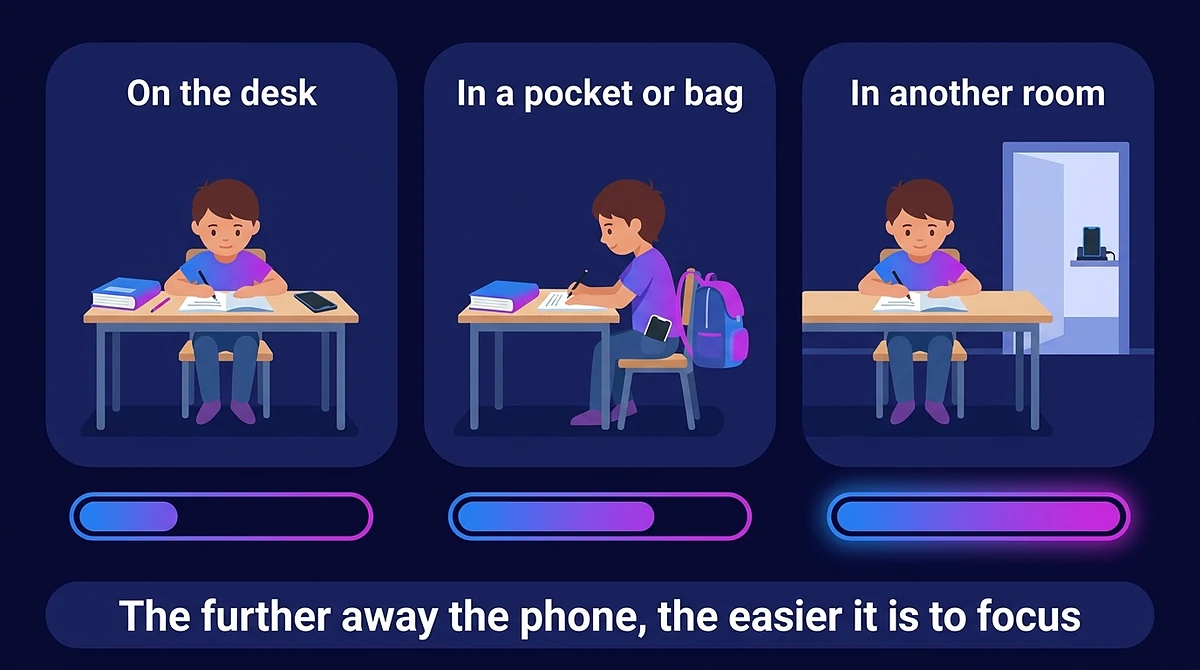
- Screens matter most when they are always within reach. A phone in another room helps more than a phone face down on the desk.
- Focus improves with practice. Start at your child’s current limit and add a minute or two at a time.
Every parent has seen it. Your child sits down to homework, and four minutes later they are sharpening a pencil, asking for a drink or staring out of the window. Yet the same child can build a block city for two hours without looking up.
So is their attention span short, or normal for their age?
What does attention span mean?
Attention span means the length of time a person can keep their focus on one task before they get distracted. In children, it usually means sustained attention: staying with homework, a story or an instruction until it is done.
By definition, a short attention span means a child’s focus regularly runs out sooner than you would expect for their age, across many kinds of tasks. The key word is regularly. Everyone’s focus drops when they are tired, hungry or bored.
There is more than one kind of attention
Psychologists usually separate attention into a few types:
- Sustained attention: keeping focus over time, such as finishing a page of sums.
- Selective attention: tuning out what does not matter, such as a sibling’s cartoon in the next room.
- Shifting attention: switching smoothly between steps, such as moving from reading a question to writing the answer.
A child can be strong in one and weaker in another. That is why “they just can’t focus” is rarely the full picture.
Why can my child focus on games for hours but not on homework?
Because attention depends on the task, not just the child. Games give a small reward every few seconds, so the brain barely has to work to stay engaged. Homework asks children to keep going without that instant payoff, and that is a skill the brain is still building.
Psychologists interviewed by the BBC in 2017 made the same point: an “average attention span” means little on its own, because focus changes with what the task demands. A child who plays for hours has not shown they can focus on anything. They have shown the game is very good at holding attention.
What is a normal attention span by age?
A widely used rule of thumb is that children can focus on an adult-set task for about 2 to 3 minutes per year of age. A 9-year-old in Standard 3, for example, might manage 18 to 27 minutes of homework before needing a short break.
| Age | School stage (Malaysia) | Focus on adult-set task (rule of thumb) |
|---|---|---|
| 5-6 | Preschool/kindergarten | 10-18 minutes |
| 7 | Standard 1 | 14-21 minutes |
| 8 | Standard 2 | 16-24 minutes |
| 9 | Standard 3 | 18-27 minutes |
| 10 | Standard 4 | 20-30 minutes |
| 11-12 | Standard 5-6 | 22-36 minutes |
| 13-15 | Form 1-3 | 26-45 minutes |
| 16-17 | Form 4-5 | 32-50 minutes |
Treat these numbers as guides, not targets. The rule comes from child development practitioners rather than from a single study, and children of the same age vary a lot.
The research does agree on the overall shape. A University of Melbourne study of 57 children aged 5 to 12 found that sustained attention developed quickly between ages 5–6 and 8–9, then largely levelled off by about age 10 (Betts et al., 2006). The parts of the brain that manage focus keep maturing through the teenage years, so secondary students still benefit from structure and breaks.
Is my child’s attention span short, or is something else going on?
Often it is something else. Before deciding your child has a short attention span, check the everyday causes that make any child’s focus drop.
Not enough sleep
A tired child cannot focus well, however hard they try. The American Academy of Sleep Medicine recommends 9 to 12 hours a night for children aged 6 to 12, and 8 to 10 hours for teenagers. Its expert panel found that regularly sleeping less than this is linked to attention, behaviour and learning problems. A late bedtime on school nights is one of the most common reasons focus collapses by mid-afternoon.
The task is too hard, or too easy
Children lose focus on work that feels impossible, and on work that feels pointless. Watch where they stall. If it is always at the same kind of question, the problem may be a gap in the skill, not their attention.
Worry or low mood
Worry takes up attention that would otherwise go to schoolwork. An anxious child can look distracted because part of their attention is already busy with the worry. If focus dropped suddenly, think about what else changed: a new class, a friendship problem or something at home.
Trouble seeing or hearing
A child who cannot see or hear clearly will look inattentive, even when they are trying. This is why doctors include hearing and vision tests when they assess attention (CDC). Squinting, sitting very close to screens or often saying “what?” are worth a check.
When is a short attention span a sign of ADHD?
Only when it is part of a lasting pattern. Under the American Psychiatric Association’s diagnostic manual (DSM-5), children need six or more signs of inattention or hyperactivity. These must have lasted at least six months, started before age 12, and show up in two or more settings, such as home and school.
Signs worth writing down include a child who often:
- loses focus partway through tasks or play, even ones they chose
- does not seem to listen when spoken to directly
- loses things they need for school, such as books, pencils or homework
- avoids tasks that need steady mental effort
- fidgets, leaves their seat or interrupts much more than classmates of the same age
If several of these sound familiar, keep a two-week note of when focus breaks down and ask the class teacher what they see. Then talk to your child’s doctor or a paediatrician, because only a qualified clinician can diagnose ADHD. Plenty of children with short attention spans do not have it, and many children with ADHD can focus for hours on things they love.
Is screen time shortening my child’s attention span?
Screens can make focus harder, especially fast-paced content and phones within easy reach. But the research mostly shows links, not proof that screens permanently shorten attention.
Fast-paced shows have an immediate effect
In a 2011 study in Pediatrics, 60 four-year-olds either watched a fast-paced cartoon, watched a slower educational cartoon or drew for 9 minutes (Lillard & Peterson). Those who watched the fast-paced cartoon did significantly worse on tasks measuring self-control and working memory straight afterwards. The study measured the short-term effect only, but it is a good reason to avoid fast cartoons right before homework.
Heavy use is linked to attention problems in teenagers
A 2018 study in JAMA followed 2,587 teenagers for two years (Ra et al.). Among those with no frequent digital media use at the start, 4.6% later reported ADHD symptoms, compared with 9.5% of those who did seven activities frequently. The authors were clear that this is a link, not proof of cause. Teens who already find focus hard may simply reach for their phones more.
A phone nearby still pulls at attention
In experiments with nearly 800 adults, people did better on focus tests when their phone was in another room than when it sat face down on the desk, even with the sound off (Ward et al., 2017). Students show the same pattern at home. When researchers observed 263 students studying for 15 minutes, they averaged under 6 minutes on task before switching, most often to texting or social media (Rosen et al., 2013).
In Malaysia, the national dietary guidelines for children and adolescents recommend under two hours of screen time a day, as researchers at Universiti Putra Malaysia note (Raj et al., 2022). For focus, where and when screens are used matters as much as the total.
Is the attention span of Gen Z really shorter than a goldfish’s?
No. The claim that people now have an 8-second attention span, shorter than a goldfish, spread from a 2015 Microsoft Canada marketing report. The BBC traced the figure to a website that could not show where it came from, and fish experts pointed out that goldfish actually learn and remember well.
What has changed is how often we switch. Research by Gloria Mark at UC Irvine tracked how long adults stay on one screen before switching. The average fell from about two and a half minutes in 2004 to 47 seconds by 2020. That measures habits on devices, not a fixed limit of the brain, and habits can be changed.
How can I increase my child’s attention span and focus?
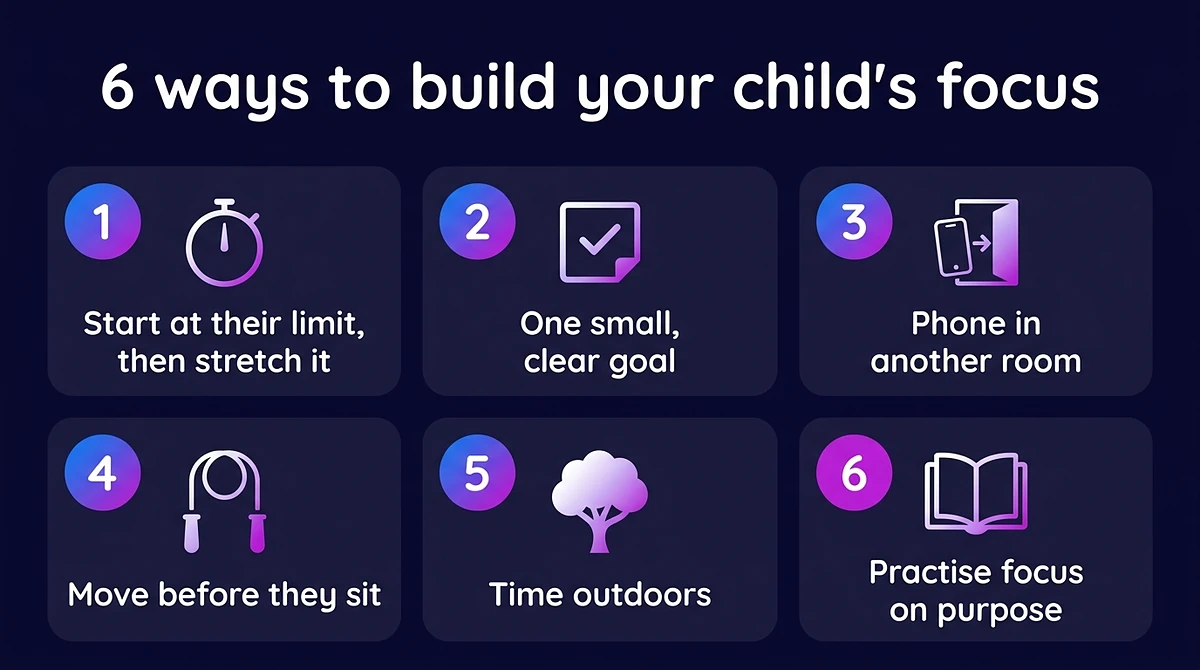
Attention span grows with age, but you can help it grow faster with practice and the right conditions. These six steps have the best support.
1. Start at their current limit, then stretch it
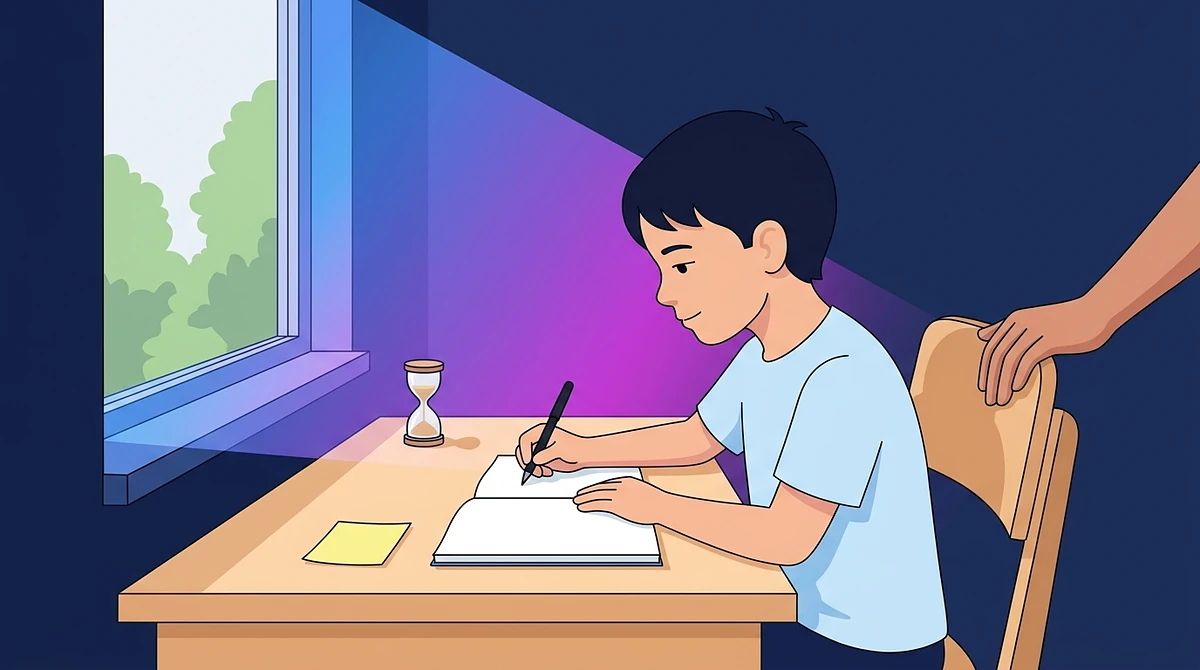
Time how long your child stays on a typical homework task before drifting. Set a timer for just under that, followed by a 3 to 5 minute movement break. Each week, add a minute or two, because success at a slightly shorter session builds more focus than failure at a long one.
2. Turn big tasks into small, clear goals
“Do your homework” is hard to focus on. “Answer questions 1 to 5” is not. Gloria Mark describes attention as goal-directed, so a clear, visible goal keeps focus on track. Write it on a sticky note where your child can see it.
3. Put the phone in another room
Not face down, not on silent, but out of the room. The phone-distance research above found this made the biggest difference. Agree on a place where devices “sleep” during homework, and do the same with your own phone if you sit with them.
4. Move before they sit
A 2018 review of studies in children aged 6 to 12 found that a single session of physical activity had a moderate positive effect on attention (de Greeff et al.). Ten minutes of skipping, star jumps or a quick game of catch before homework is an easy way to use this.
5. Spend time outdoors
In a small study of 17 children with ADHD aged 7 to 12, children concentrated better after a 20-minute walk in a park than after the same walk downtown or through a housing area (Faber Taylor & Kuo, 2009). The study was small, but a walk in the taman before homework costs nothing to try.
6. Practise focus on purpose
Focus is a skill, so it improves when children use it on purpose. Reading a chapter book aloud together, jigsaws, building kits and listening games (all good brain-building activities) ask children to hold attention a little longer than is comfortable. So do extracurricular activities such as music lessons or chess, where practice builds week by week. Our free focus games, Bubble Pop, Star Runner and Asteroid Watch, give children short, timed focus practice.
Be clear about what games do, though. Practice improves the skill being practised, and the research on brain training shows it rarely carries over to school results on its own. Use games as a warm-up, not a replacement for real reading and homework.
What does this mean for your child?
If focus is still a struggle, it helps to know which skill is weak: sustained attention, tuning out distractions, or the visual skills that make reading and copying from the board tiring. That is what our free assessment looks at. A parent joins at the start and for the feedback chat at the end, so you see where your child is now and what would help. We train specific skills alongside real schoolwork through our Academic Excellence programmes, and we do not promise more than the research supports.
Frequently asked questions
Does a short attention span affect reading?
Yes, often more than parents expect. Reading asks children to hold one line of thought across many sentences, so when focus slips they lose the thread and have to reread. Short passages with a few questions build reading stamina without overloading attention. Our free reading comprehension worksheets are graded by level for this, and our guide to improving English reading skills covers the rest.
Why does my child focus at school but not at home?
School gives structure that home often lacks: a set time, a teacher nearby and classmates all doing the same task. At home, homework competes with toys, siblings and screens, and it comes after a long day when focus is already low. Copy the school setup with a fixed homework time, one clear workspace and an adult close by for the first few minutes.
Does sugar make children lose focus?
Probably not, despite what many parents believe. A 1995 review of 23 studies in JAMA found sugar did not affect children’s behaviour or thinking, though it could not rule out a small effect in some children (Wolraich et al.). Parents’ expectations seem to play a part. A proper snack before homework still helps, mainly because hungry children find it hard to settle.
Can video games improve attention span?
Some can sharpen certain kinds of attention. A 2018 review of action video game studies found gains in skills such as spotting and tracking things on screen (Bediou et al.). But most studies used young adults and shooter games, which are not suitable for children. Fast, rewarded attention is also different from the slow, steady focus that homework needs.
How can teachers help students with short attention spans in class?
Break lessons into short chunks with one clear goal each, and change activity more often with younger classes. Build in quick movement breaks, give instructions one step at a time, and seat easily distracted students away from doors and windows. A visible timer helps students see that the effort has an end, which makes it easier to keep going.
Can teenagers and adults increase their attention span too?
Yes. Attention responds to habits at any age, so the six steps above work for teenagers and parents too. One extra tip for older students is to notice self-interruptions. Gloria Mark’s research found that about half the time, people interrupt themselves rather than being interrupted. Catching that urge is the first step to resisting it.
Want to know which focus skills your child actually needs to work on?
References
- Bediou, B., Adams, D. M., Mayer, R. E., Tipton, E., Green, C. S., & Bavelier, D. (2018). Meta-analysis of action video game impact on perceptual, attentional, and cognitive skills. Psychological Bulletin, 144(1), 77–110. doi.org/10.1037/bul0000130
- Betts, J., McKay, J., Maruff, P., & Anderson, V. (2006). The development of sustained attention in children: The effect of age and task load. Child Neuropsychology, 12(3), 205–221. doi.org/10.1080/09297040500488522
- Centers for Disease Control and Prevention. Diagnosing ADHD. cdc.gov/adhd/diagnosis
- de Greeff, J. W., Bosker, R. J., Oosterlaan, J., Visscher, C., & Hartman, E. (2018). Effects of physical activity on executive functions, attention and academic performance in preadolescent children: A meta-analysis. Journal of Science and Medicine in Sport, 21(5), 501–507. doi.org/10.1016/j.jsams.2017.09.595
- Faber Taylor, A., & Kuo, F. E. (2009). Children with attention deficits concentrate better after walk in the park. Journal of Attention Disorders, 12(5), 402–409. doi.org/10.1177/1087054708323000
- Lillard, A. S., & Peterson, J. (2011). The immediate impact of different types of television on young children’s executive function. Pediatrics, 128(4), 644–649. doi.org/10.1542/peds.2010-1919
- Maybin, S. (2017). Busting the attention span myth. BBC News. bbc.com/news/health-38896790
- Paruthi, S., et al. (2016). Recommended amount of sleep for pediatric populations: A consensus statement of the American Academy of Sleep Medicine. Journal of Clinical Sleep Medicine, 12(6), 785–786. doi.org/10.5664/jcsm.5866
- Ra, C. K., Cho, J., Stone, M. D., et al. (2018). Association of digital media use with subsequent symptoms of attention-deficit/hyperactivity disorder among adolescents. JAMA, 320(3), 255–263. doi.org/10.1001/jama.2018.8931
- Raj, D., Mohd Zulkefli, N., Mohd Shariff, Z., & Ahmad, N. (2022). Determinants of excessive screen time among children under five years old in Selangor, Malaysia. International Journal of Environmental Research and Public Health, 19(6), 3560. doi.org/10.3390/ijerph19063560
- Rosen, L. D., Carrier, L. M., & Cheever, N. A. (2013). Facebook and texting made me do it: Media-induced task-switching while studying. Computers in Human Behavior, 29(3), 948–958. doi.org/10.1016/j.chb.2012.12.001
- Schelenz, R. (2024). How to sharpen your attention and meet your goals [Interview with Gloria Mark]. University of California. universityofcalifornia.edu
- Ward, A. F., Duke, K., Gneezy, A., & Bos, M. W. (2017). Brain drain: The mere presence of one’s own smartphone reduces available cognitive capacity. Journal of the Association for Consumer Research, 2(2), 140–154. doi.org/10.1086/691462
- Wolraich, M. L., Wilson, D. B., & White, J. W. (1995). The effect of sugar on behavior or cognition in children: A meta-analysis. JAMA, 274(20), 1617–1621. doi.org/10.1001/jama.1995.03530200053037
About the author: Reuben Bykersma is the Catalyst and co-founder of EyeQBoost, a holistic education company helping children thrive in school and beyond, not just in exams. He has been teaching since the age of 15. He co-built a tutoring academy that taught more than 200 students over five years, and has taught English at a private school. Today he is building EyeQBoost to bring research-informed learning to more students, and to give parents and teachers honest, practical tools to support them. His aim is to make a lasting difference in education for students, teachers and parents alike. Connect on LinkedIn