Last reviewed: November 2026. We review this guide and its data every year.
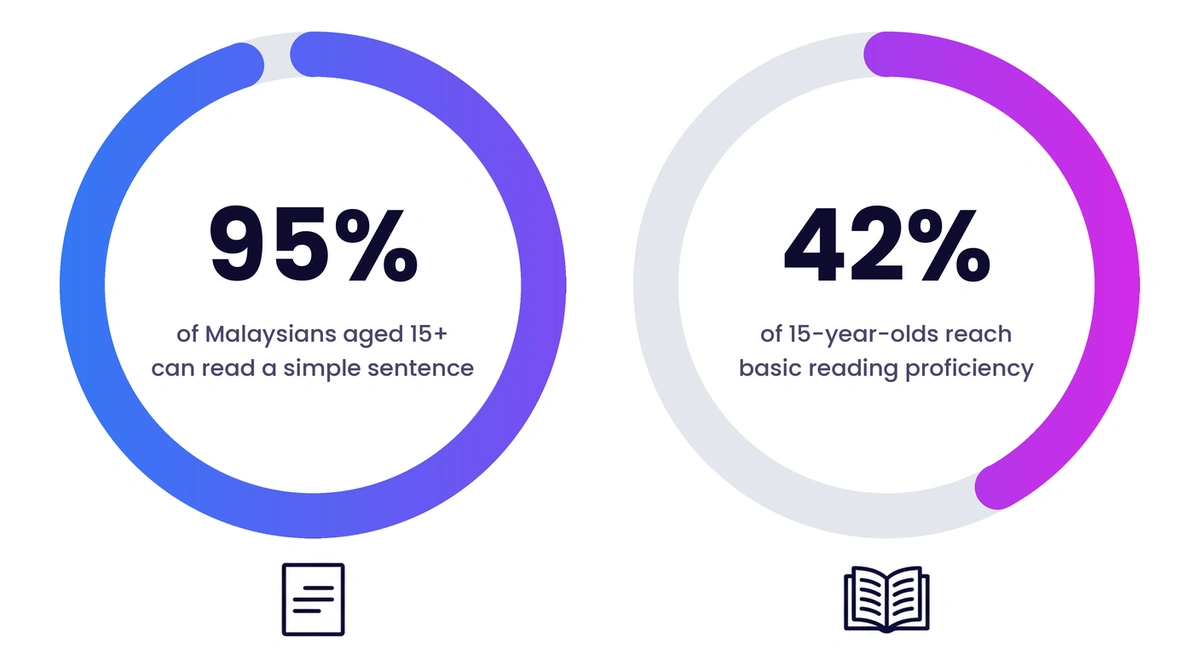
The short answer: On paper, literacy in Malaysia is high: about 95% of adults can read and write a simple sentence. Reading to learn is a different story. In PISA 2022, only 42% of Malaysian 15-year-olds reached basic reading proficiency, against 74% across OECD countries. The gap starts early, and what happens at home is one of the levers that helps close it.
Key takeaways
- In 2024, about 1 in 4 Standard 1 pupils hadn’t yet reached minimum literacy three months into school. The Ministry treats this as normal at that stage.
- By Standard 5, Malaysian pupils read above the Southeast Asian average, yet about 3 in 10 still miss the end-of-primary benchmark.
- Reading scores at 15 fell 27 points between 2018 and 2022, one of the steepest drops of any country.
- About 1 in 4 Malaysian students rarely or never read for pleasure, and they’re more likely to be the ones with weaker grades.
- Reading together helps most when you talk about the book, not just read it aloud.
What is the literacy rate in Malaysia?
Malaysia’s literacy rate is about 95%. The UNESCO figure the National Library cites is 94.64% of people aged 15 and over (NST).
That number measures a low bar. UNESCO counts someone as literate if they can read and write, with understanding, a short simple statement about everyday life (UNESCO via Index Mundi). It tells you almost nobody is shut out of reading altogether. It doesn’t tell you whether a child can read a textbook chapter, follow an argument or spot a misleading claim. Researchers call that reading literacy, and it’s where Malaysia’s picture changes. For the wider definitions, see What Is Literacy?
How well do children read in Malaysia?
Better than most of our neighbours, but well behind the countries Malaysia compares itself with. Each stage of school has its own measure. The table shows the share of children who fall below each one, so you can see where they start to slip.
| Stage | Benchmark | Below it in Malaysia | For comparison |
|---|---|---|---|
| Standard 1, three months in (2024) | Minimum literacy, in the Ministry’s screening | About 24% (108,393 of 448,113) | The Ministry treats this as normal so early in school |
| Age 10 (2019) | Can read and understand a simple text (the World Bank’s learning poverty measure) | 42% | 3–4% in Japan, Singapore and Korea |
| Standard 5 (2024) | Minimum end-of-primary reading level (SEA-PLM Band 5) | About 31% | Malaysia’s average score of 314 is above the regional 300 |
| Age 15 (2022) | Basic reading proficiency (PISA Level 2) | 58% | 26% across OECD countries |
Sources: Ministry of Education screening via Sinar Harian (the 24% adds pupils behind in literacy alone to those behind in both literacy and numeracy); World Bank and World Bank press release; The Star; OECD.
The pattern is what matters. Most Malaysian children learn to decode words, and by Standard 5 they compare well across the region, where Malaysia also posted the top writing scores (The Star). The trouble shows at 15, when PISA asks students to use what they read: find the main idea in a longer text, or locate information against a set of conditions. That’s where more than half fall short.
Who is falling behind?
Boys and children from lower-income homes. In PISA 2022, Malaysian girls outscored boys in reading by 31 points (Newswav). At Standard 5 the gender gap is smaller and narrowing, from 9 points in 2019 to 7 in 2024, but the gap between low- and high-income pupils remains significant (The Star). Region-wide, children who don’t speak the school’s language at home also score lower (UNICEF).
What I see as a teacher
[Check this matches your experience, or replace it with your own example.] The children who worry me most aren’t the ones who can’t sound out a word. They’re the ones who read a paragraph aloud perfectly, then can’t tell me what happened in it. Teachers sometimes call this barking at print. It hides well in the early years, because fluent reading aloud sounds like success. It’s also very fixable once someone spots it.
Why have reading scores in Malaysia fallen?
Lost school time is the biggest single reason. Malaysia’s PISA reading score fell from 415 in 2018 to 388 in 2022 (NST), and Malaysia was among the five countries with the largest declines in all three subjects (ISIS Malaysia). The Ministry links the fall to learning lost during the pandemic’s home-based teaching. The Standard 5 cohort tested in 2024 went through that same disruption, and its score dipped 5 points from 2019.
Two slower trends sit underneath:
- Fewer children arrive ready. Malaysia’s pre-primary enrolment fell from 97% in 2016 to 87% in 2021 (World Bank), and the Ministry has named missed preschool as one reason Standard 1 pupils start behind (Utusan).
- Less reading outside school. Screens now fill the time that leisure reading used to, which the Education Minister has called a “scrolling generation” (Malay Mail). If focus is part of the problem, our guide to attention span by age can help. The next section looks at reading habits.
Do Malaysian children read for fun?
Many do, but a sizeable minority don’t, and it shows in their grades. A 2025 survey of 1,168 Malaysian primary and secondary students found that 25% rarely or never read as a hobby (FINCO). Among students with A to D grades, about 90% read frequently. Among those with F grades, only 40% did. Children from lower-income homes were twice as likely to read rarely, and 30% of students had fewer than 10 books at home.
Adults set the tone. The National Library’s reading survey puts Malaysians at an average of 24 books a year, up from 15 in 2014 (Utusan Malaysia), with a national target of 40 by 2030 (Bernama).
Why does reading for pleasure matter so much? The OECD found that 15-year-olds who read for enjoyment every day scored the equivalent of about a year and a half of school ahead of those who didn’t, and it mattered more whether they read daily than for how long (OECD). That’s a correlation, not proof that pleasure reading alone causes the gain, but the link held in every country PISA measured in 2018 (OECD). Our post on the benefits of reading for kids covers the rest.
Does learning to read in two or three languages hold children back?
No. Reading skills built in one language carry over to the next. A 2025 review of 156 studies and more than 23,000 children found that the sound, spelling and word-part awareness children develop in their first language predicts the same skills in their second (Li, Zhang & Ke, 2025). For a child reading Bahasa Melayu at school, English at tuition and Mandarin or Tamil at home, that’s good news: each language supports the others.
Malaysian students already read across languages. In the 2025 survey, 44% mostly read Malay books and 44% English (FINCO). What helps most is a strong first language plus plenty of reading and talk in the school’s language. If English is the weaker one, our guide to improving your child’s English reading skills goes further.
What is the government doing about literacy in Malaysia?
It’s moving the focus earlier. The main changes parents will notice:
- Standard 1 screening. Since 2024, pupils are checked for reading, writing and arithmetic in their first three months, and those behind get focused intervention (Berita Harian).
- A new curriculum from 2027. Under the 2027 School Curriculum, Standard 1 and 2 focus on literacy and numeracy, with early intervention before children move up (The Sun).
- Standard 1 at age six. From 2027, parents can choose to start Standard 1 at six instead of seven (The Star).
- A National Reading Index. Due in early 2027, it will track reading habits under the National Reading Decade, which aims to make Malaysia a reading nation by 2030 (The Star).
These help, but school alone can’t build the habit. That part happens at home.
How can parents help their child read better at home?
Small, daily habits beat big one-off efforts. Here’s what I’d suggest, in order of impact:
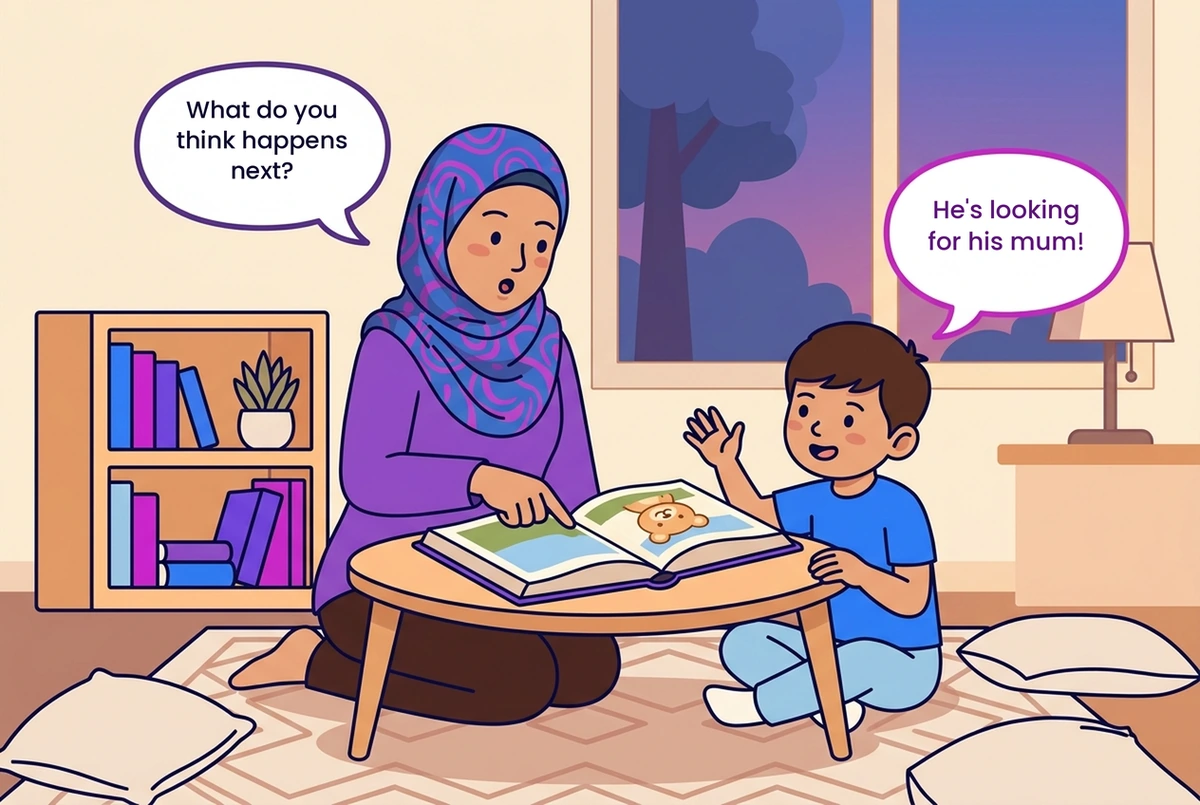
- Talk about the book while you read. Simply reading aloud has a smaller effect than many studies once claimed (Noble et al., 2019). The method with consistent results is dialogic reading: pause to ask “What do you think happens next?” or “Why did she do that?”, and let your child retell the story (Barone et al., 2020).
- Read to younger children most days. Primary pupils who were read to more than four times a week had the strongest reading habits in the Malaysian survey.
- Fill the house with books they choose. Their picks, in any language, including comics. Use the library, and our free graded reading comprehension PDFs for practice.
- Check understanding, not just fluency. After a chapter, ask your child to tell you what happened in their own words. If they can’t, read our guide to improving reading comprehension.
- Let them see you read. A parent with a book in hand sends a stronger message than any reminder to read.
Frequently asked questions
At what age should my child be able to read?
Most children learn to decode simple text in Standard 1 and 2, and should be reading to learn by about age 10. Under the 2027 School Curriculum, those first two years focus on literacy and numeracy. The World Bank’s benchmark is that every child can read and understand a simple text by age 10, roughly Standard 4. Children get there at different speeds, so steady progress matters more than the exact month.
My child is in Standard 1 and still can’t read. Should I worry?
Not yet. The Ministry says it’s normal for new Standard 1 pupils not to have mastered reading, writing and arithmetic, and screens every pupil in their first three months. Ask the class teacher whether your child is in the intervention group, and check their classroom assessment (PBD) report, which parents can view online. Seek advice if there’s little progress over a full term despite that support.
Should my child learn to read in Bahasa Melayu or English first?
Start with the language your child speaks best, or the one their school teaches in. Reading skills transfer between languages, so a strong first language makes the second easier. Bahasa Melayu is also very regular: each letter almost always makes the same sound, which makes it a gentle place to learn decoding. Don’t drop the home language to make room for English.
Is reading on a tablet as good as reading a book?
For stories, mostly yes. For schoolwork, paper is better. Research comparing the two finds no real difference for narrative texts, but better understanding of informational texts on paper, especially when readers are short of time. So e-books and reading apps are fine at bedtime. For revision and textbook chapters, print it or use the physical book.
Do comics and graphic novels count as real reading?
Yes, as a way in. OECD data links reading fiction to the strongest reading scores, while frequent comic reading is tied to lower scores, probably because weaker readers find comics easier to start with. Comics and graphic novels were the most popular genre in the 2025 Malaysian student survey. Let them read comics, and offer a chapter book on a similar theme next.
How do I know if my child has dyslexia or is just behind?
Watch for difficulties that persist despite good teaching. Signs include trouble linking letters to sounds, guessing words from the first letter, very slow reading, and spelling the same word differently each time. A family history of reading difficulty adds weight. Talk to the class teacher first. Only a qualified psychologist can diagnose dyslexia. A school screening, or our free reading test for kids, is a starting point, not a diagnosis.
How can teachers help struggling readers in a mixed-ability class?
Short, regular small-group phonics sessions, led by a trained adult. The Education Endowment Foundation rates phonics as one of the best-evidenced approaches in its Toolkit, adding about five months’ progress on average. Pair it with daily read-alouds that model questioning. Send books home with a note on how to read them together, since parents often don’t know dialogic reading.
Not sure whether your child is reading to learn, or just reading aloud?
Our free assessment looks at the skills behind reading, such as decoding, comprehension, attention and visual processing, and shows you what to work on next. You can also read about our Academic Excellence programme.
References
- Barone, C., Chambuleyron, E., Vonnak, R., & Assirelli, G. (2020). Home-based shared book reading interventions and children’s language skills: A meta-analysis of randomised controlled trials. Educational Research and Evaluation, 25(5–6), 270–298. https://doi.org/10.1080/13803611.2020.1814820
- Bernama. (2025, 22 September). Kelantan’s reading habit rate lags behind national average.
- Berita Harian. (2024, December). 122,062 murid dikenal pasti belum kuasai kemahiran asas 3M.
- Delgado, P., Vargas, C., Ackerman, R., & Salmerón, L. (2018). Don’t throw away your printed books: A meta-analysis on the effects of reading media on reading comprehension. Educational Research Review, 25, 23–38. https://doi.org/10.1016/j.edurev.2018.09.003
- Education Endowment Foundation. (n.d.). Phonics: Teaching and Learning Toolkit.
- FINCO. (2025). Beyond Books: Reading culture amongst Malaysian students.
- ISIS Malaysia. (2024). Understanding Malaysia’s decline in PISA scores.
- Li, X., Zhang, D., & Ke, S. E. (2025). Transfer facilitation of metalinguistic awareness in word reading among dual language learners of English: A meta-analytic structural equation modeling study. Review of Educational Research. https://doi.org/10.3102/00346543251390490
- Malay Mail. (2026, 4 November). Fadhlina warns of ‘scrolling generation’ as gadgets erode reading habits among youth.
- New Straits Times. (2017). M’sia’s literacy rate is almost 95%, not 55%: National Library.
- New Straits Times. (2023, December). Covid-19 learning loss contributes to Malaysia’s weaker performance in PISA.
- Newswav. (2023). PISA 2022: Malaysian girls do better than boys at mathematics, reading.
- Noble, C., Sala, G., Peter, M., Lingwood, J., Rowland, C., Gobet, F., & Pine, J. (2019). The impact of shared book reading on children’s language skills: A meta-analysis. Educational Research Review, 28, 100290. https://doi.org/10.1016/j.edurev.2019.100290
- OECD. (2011). Do students today read for pleasure? PISA in Focus 8.
- OECD. (2011). What kinds of reading are associated with being a good reader? In PISA 2009 at a Glance. OECD Publishing.
- OECD. (2023). PISA 2022 results, country notes: Malaysia.
- OECD. (n.d.). Reading literacy.
- Sinar Harian. (2024). Seramai 122,062 murid Tahun 1 ikuti program intervensi.
- The Star. (2025, 9 December). M’sian students top charts.
- The Star. (2026, 20 January). Kids to begin Year One at six from 2027 onwards, says PM.
- The Star. (2026, 19 April). M’sian pupils are tops in South-East Asia.
- The Star. (2026, 31 October). National Reading Index to be finalised by early 2027, says Aaron.
- The Sun. (2026). Ministry adopting fresh approach for 2027 school curriculum.
- UNESCO Institute for Statistics, via Index Mundi. (n.d.). Malaysia: Literacy rate.
- UNICEF. (2025, 4 December). 1 in 2 children in Southeast Asia still lagging behind in reading.
- Utusan Malaysia. (2024, October). 22 juta rakyat Malaysia suka membaca.
- Utusan Malaysia. (2024, October). Tempoh 3 tahun sekolah rendah masa kuasai 3M.
- World Bank. (2023). Improving learning outcomes key to achieving development aspirations in middle-income East Asia and Pacific countries.
- World Bank. (2025). Human Capital Complementary Indicators: Malaysia.
About the author: Reuben Bykersma is the Catalyst and co-founder of EyeQBoost, a holistic education company helping children thrive in school and beyond, not just in exams. He has been teaching since the age of 15. He co-built a tutoring academy that taught more than 200 students over five years, and has taught English at a private school. Today he is building EyeQBoost to bring research-informed learning to more students, and to give parents and teachers honest, practical tools to support them. His aim is to make a lasting difference in education for students, teachers and parents alike. Connect on LinkedIn