Last reviewed: November 2026. We review this guide every year.
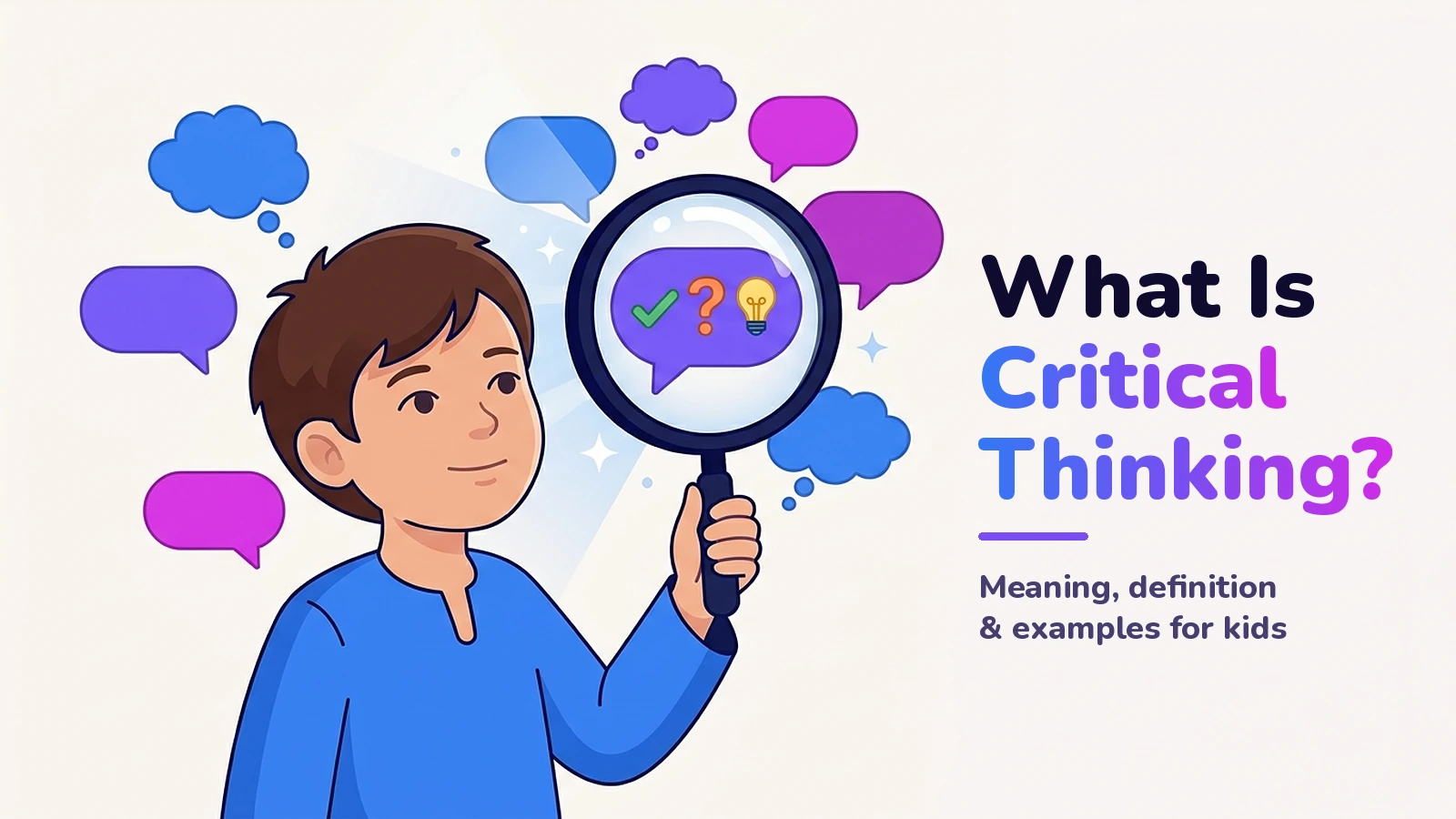
The short answer: Critical thinking is reasonable, reflective thinking focused on deciding what to believe or do. In everyday terms, it means asking what the evidence is, weighing other explanations and being willing to change your mind. Children show early signs of it before they start school, and it grows with knowledge and practice.
Key takeaways
- “Critical” means “able to judge”, not negative. Good thinkers also recognise when an idea is strong.
- It has two halves: thinking skills, such as analysing and evaluating, and thinking habits, such as curiosity and open-mindedness.
- Even 3- and 4-year-olds show the first signs of it, but how well a child thinks about a topic depends heavily on how much they already know about it.
- Research shows critical thinking can be taught. Discussion, real problems and an adult who coaches work best when they are combined.
- At home, the easiest place to start is one warm, curious question, asked often: “How do you know?”
Ask a room of parents what they want most for their children, and “to think for themselves” comes up again and again. Ask the same parents what critical thinking actually is, and the answers become much less certain. Teachers are not always clearer: the phrase appears in almost every curriculum, yet it is rarely defined.
What is the meaning of critical thinking?
The definition of critical thinking most widely used in education comes from philosopher Robert Ennis: critical thinking is reasonable, reflective thinking focused on deciding what to believe or do (Ennis, 2011). It covers both beliefs (“Is this true?”) and actions (“Is this the right thing to do?”).
In 1990, the American Philosophical Association asked a panel of 46 experts to agree a definition. Their consensus, known as the Delphi Report, described critical thinking as purposeful, self-regulatory judgement (Facione, 1990). Put simply, it is thinking with a goal while keeping an eye on your own reasoning as you go.
The key word in both definitions is reflective. Critical thinking is not the first thought that comes to mind. It is the second look.
A definition children can understand
Academic wording does not work well at the dinner table. The version I use with students is this: critical thinking is checking a thought before you trust it. Younger children can remember it as three questions:
- What is being said?
- How do we know?
- What else could be true?
A child who can ask these about a story, an advert or a playground rumour is already thinking critically.
Critical thinking is not the same as criticising
The word critical puts many parents off. It comes from the Greek kritikos, meaning “able to judge”. Judging well includes recognising when an idea is good, not only finding fault with it.
| Critical thinking is… | Critical thinking is not… |
|---|---|
| Asking for reasons and evidence | Rejecting everything by default |
| Changing your mind when the evidence is better | Winning every argument |
| Judging a claim on its merits | Believing a claim because of who said it, or how loudly |
| Saying “I’m not sure yet” | Having an instant opinion on everything |
| Questioning ideas, including your own | Doubting other people but never yourself |
What does critical thinking involve?
Critical thinking combines a set of thinking skills with a set of thinking habits. Skills without habits sit unused. Habits without skills lead to confident but shaky conclusions.
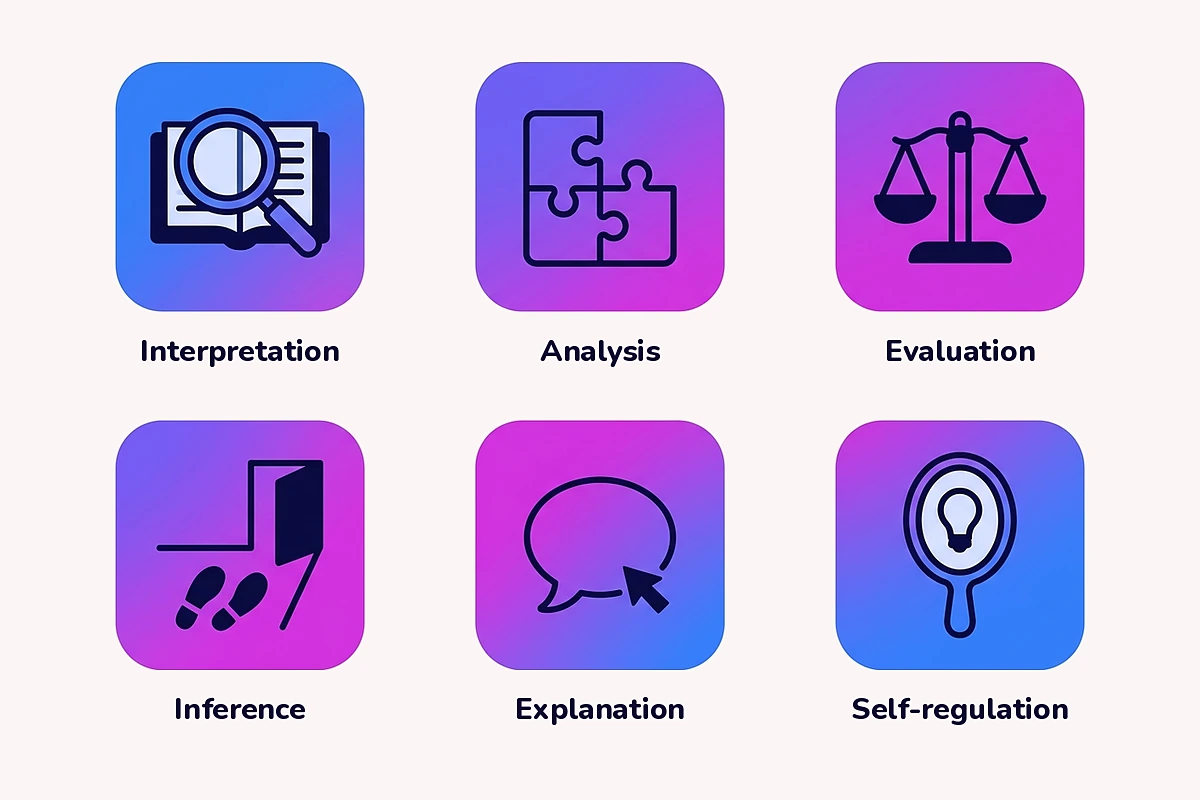
The Delphi panel identified six core skills (Facione, 1990). Here they are in plain language, with the question each one helps a child ask:
| Skill | What it means | The question a child asks |
|---|---|---|
| Interpretation | Working out what something means | “What is this really saying?” |
| Analysis | Breaking an argument into its reasons and conclusion | “Why do they think that?” |
| Evaluation | Judging how strong or trustworthy a claim is | “Is this source reliable?” |
| Inference | Drawing a sensible conclusion from the evidence | “What follows from this, and what’s missing?” |
| Explanation | Setting out your reasoning clearly | “Can I show why I think this?” |
| Self-regulation | Checking and correcting your own thinking | “Could I be wrong?” |
Why the habits matter as much as the skills
The same experts stressed that a good thinker has certain dispositions: curiosity, open-mindedness, a wish to be well informed and the honesty to face their own biases (Facione, 1990). In a classroom, these show up in the student who says “Wait, that doesn’t add up” or “I used to think that, but now…”.
This is where parents have real influence. Children copy the thinking habits they see. A parent who says “I’m not sure, let’s check” teaches more than any worksheet.
What are some critical thinking examples for kids?
Critical thinking happens any time a child decides what to believe or do, so the examples are all around them. Here is what critical thinking skills look like at different stages of school.
Standard 1 to 3 (ages 7 to 9)
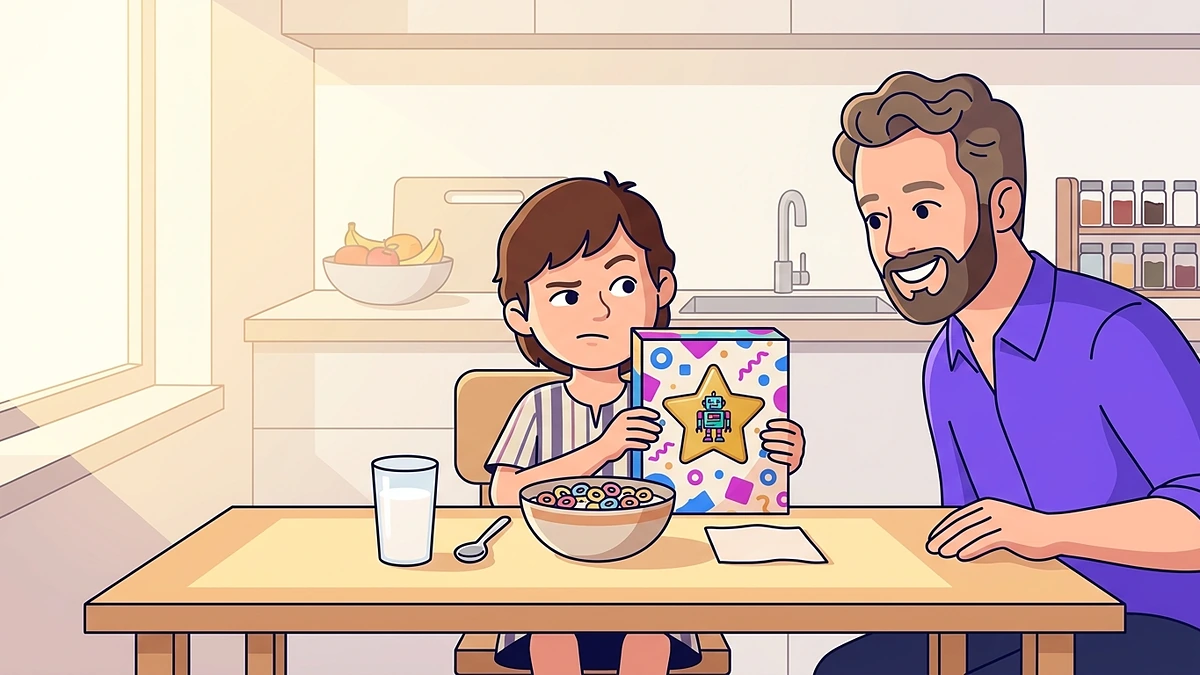
- The cereal-box toy: the box promises a “free” toy. Your child asks, “Is it really free if we have to buy the cereal?”
- The pizza argument: two siblings share a pizza, and one notices the slices are different sizes and suggests a fair way to cut it.
- The story clue: halfway through a book, your child predicts the ending and points to a picture that gave it away.
Standard 4 to 6 (ages 10 to 12)
- The word problem: before calculating, your child estimates whether the answer should be large or small, then uses the estimate to check their working.
- The plant experiment: your child wonders whether plants grow faster with music, and suggests testing two plants where only one thing is different.
- The playground rumour: a classmate says school is closed next week. Your child asks who said so and whether a teacher has confirmed it.
Form 1 to 5 (ages 13 to 17)
- The viral video: a clip claims a drink “cures” stress. Your teenager checks who made it, whether they are selling something and what health experts say.
- The essay: in a history essay, your teenager sets out the strongest argument against their own view, then answers it.
- The chatbot answer: an AI tool gives a confident homework answer. Your teenager checks it against the textbook and finds a date is wrong.
None of these examples needs a high IQ. What they share is a pause: the moment a child stops to question the first answer instead of simply accepting it.
At what age do children start thinking critically?
Earlier than most parents expect. In studies by researchers Melissa Koenig and Paul Harris, 3- and 4-year-olds preferred to learn new words from a person who had named things correctly before, and became wary of someone who had made obvious mistakes (Koenig & Harris, 2005). In a follow-up study, preschoolers still preferred the accurate person a week later (Corriveau & Harris, 2009).
That is the seed of evaluating a source. Cognitive scientist Daniel Willingham makes the point from the other side: critical thinking is something 3-year-olds can manage, and something trained scientists can fail at (Willingham, 2007).
Why knowledge comes first
Willingham’s central argument is that thinking skills are tied to knowledge. A child who knows a lot about dinosaurs can spot a mistake in a dinosaur book, yet accept nonsense about volcanoes. Nobody can judge a claim about something they know nothing about.
For parents, this is encouraging. Every book your child reads and every topic they explore gives their thinking more to work with. Our free reading comprehension PDFs are one easy way to build that knowledge while practising inference and evaluation.
Why does critical thinking matter so much today?
Children now meet a steady stream of claims online, and many are designed to persuade rather than inform. When the Stanford History Education Group tested students across 12 US states, 82% of middle school students could not tell a news story from an advert labelled “sponsored content” (Wineburg et al., 2016). Being comfortable with technology is not the same as judging it well.
AI tools make this more urgent, because they give confident answers in seconds, right or wrong.
Employers are asking for the same thing. In the World Economic Forum’s Future of Jobs Report 2025, around seven in ten employers named analytical thinking as a core skill, the top of the list (World Economic Forum, 2025). It’s also the foundation of good leadership.
Where critical thinking fits in Malaysian schools
In Malaysia, critical thinking is part of KBAT (Kemahiran Berfikir Aras Tinggi), or higher-order thinking skills, which became part of the school system in 2013. KBAT questions ask pupils to apply, analyse, evaluate or create, rather than recall facts.
What does a KBAT question look like? The easiest way to see the difference is side by side. Each pair below is on the same topic:
| Recall question | KBAT-style question |
|---|---|
| English: Who is the main character in the story? | The main character told the truth, even though it got him into trouble. Did he make the right choice? Give two reasons from the story. |
| Maths: What is 25% of RM80? | A shop offers “25% off everything” or “Buy 3, pay for 2”. Which is the better deal for six items at RM20 each? Show how you know. |
| Science: What does the sun give us? | Two cups of water are left in the sun, one black and one white. Predict which will warm up faster, and explain how you could test your prediction fairly. |
Notice what changes. The KBAT version cannot be answered from memory alone: your child has to apply what they know, weigh up the options and justify an answer. You can practise this at home by turning any recall question into a “Which is better, and why?” or “How could we check?” question.
The need is clear. Malaysia’s average score across the three PISA subjects fell from 431 in 2018 to 404 in 2022, and the Penang Institute has called for the curriculum to put more weight on critical thinking and problem solving (Penang Institute, 2024).
Can critical thinking be taught?
Yes, though not by lecture alone. One of the largest reviews on the question, a meta-analysis by Philip Abrami and colleagues covering 341 study results, found that teaching critical thinking produces a small but real improvement on average (Abrami et al., 2015).
The more useful finding is what worked. Three ingredients stood out:
- Dialogue: discussing and debating questions, not just listening to answers.
- Authentic problems: real situations where the answer actually matters.
- Mentoring: an adult who models good thinking, coaches and gives feedback.
Combined, the three produced almost double the average effect (Abrami et al., 2015). Children learn to think best when there is something real to think about and someone to think it through with. Like other thinking skills, it strengthens with regular use (how the brain changes with practice).
What about Philosophy for Children?
Philosophy for Children (P4C), where classes discuss big questions such as “What is fair?”, is one of the best-known programmes. A first UK trial found pupils made about two months’ extra progress in reading and maths (Gorard et al., 2015). However, a much larger follow-up trial in nearly 200 schools found no extra progress overall (Education Endowment Foundation, 2021).
The honest lesson is that good discussion is valuable and costs nothing, but no single programme works like a switch. Steady everyday practice matters more than the brand name.
What does this mean for your child?
Critical thinking isn’t an extra subject to squeeze into a busy week. It’s a core part of an all-round education, and a way of handling the stories, schoolwork and screens your child already meets. Three small habits make a good start:
- Ask “How do you know?” with curiosity, not suspicion. A curious tone invites thinking, while a testing tone shuts it down.
- Think aloud. Let your child hear you weigh up a real decision, such as which of two products to buy and why.
- Welcome disagreement that comes with a reason. When your child disagrees with you and explains why, the skill is working.
For more ideas, every reading comprehension PDF in our free Resources library ends with critical thinking questions you can talk through together.
Logic games make a fun warm-up too. In our free Code Cracker, children deduce a hidden pattern from clues, and Robot Route builds step-by-step planning. As the research on brain training shows, games mainly improve the skill being practised, so use them alongside real conversations rather than instead of them.
If you would like a clearer picture of how your child reasons, our free assessment looks at the thinking and learning skills behind schoolwork. A parent joins at the start and for the feedback chat at the end. We build these skills alongside real schoolwork through our Academic Excellence programmes, and we only promise what the research supports.
Frequently asked questions
Is critical thinking the same as problem solving?
No, but they work together. Problem solving is about getting from a problem to a solution. Critical thinking is about judging ideas: whether a claim is true, whether a plan makes sense and whether a solution actually worked. A strong problem solver uses critical thinking to choose between possible solutions and to check the result before moving on.
My child argues about everything. Is that critical thinking?
Sometimes. Arguing becomes critical thinking when your child gives reasons, listens to yours and can change their mind. If they only repeat “But why?” or refuse to budge, it is closer to resistance. Try replying, “Give me your best reason,” and genuinely consider it. Your child learns that good reasons, not volume, win an argument.
Can AI tools like ChatGPT harm my child’s critical thinking?
They can if they replace thinking rather than support it. In a 2025 study of 666 people, heavier AI users scored lower on critical thinking, largely because they handed the thinking over to the tool. The youngest group, aged 17 to 25, relied on AI most (Gerlich, 2025). The study shows a link, not proof of cause. A good rule: your child answers first, then uses AI to check, then checks the AI.
Does critical thinking improve school results?
It can. Marks in reading comprehension, essays and science increasingly depend on explaining and justifying answers, not just recalling facts. In Malaysian schools, that’s exactly what KBAT (higher-order thinking) questions test: applying, analysing and evaluating. A child who regularly practises giving reasons at home is better prepared for these questions, especially when they also know the topic well.
How can teachers build critical thinking into ordinary lessons?
Use questions with more than one defensible answer and ask students to back up their answers with evidence. Give a short discussion before writing, compare two sources on the same topic, and ask “What would change your mind?” These routines fit inside existing lessons, need no special programme and match the approaches with the strongest research behind them. We also run these routines with partner schools.
What are the signs a child is thinking critically?
Look for a child who asks ‘why’ or ‘how do you know’, gives reasons without being prompted, notices when something doesn’t add up, compares two explanations, and can say ‘I was wrong’ without getting upset. These show up in everyday talk long before they show up in exam answers.
Curious how your child thinks through problems?
Book a free assessment and we’ll show you where their strengths are.
References
- Abrami, P. C., Bernard, R. M., Borokhovski, E., Waddington, D. I., Wade, C. A., & Persson, T. (2015). Strategies for teaching students to think critically: A meta-analysis. Review of Educational Research, 85(2), 275–314. https://doi.org/10.3102/0034654314551063
- Corriveau, K., & Harris, P. L. (2009). Preschoolers continue to trust a more accurate informant 1 week after exposure to accuracy information. Developmental Science, 12(1), 188–193. Boston University PDF
- Education Endowment Foundation. (2021). Philosophy for Children: Effectiveness trial. EEF project page
- Ennis, R. H. (2011). The nature of critical thinking: An outline of critical thinking dispositions and abilities. University of Illinois. University of Illinois PDF
- Facione, P. A. (1990). Critical thinking: A statement of expert consensus for purposes of educational assessment and instruction (The Delphi Report). American Philosophical Association. ERIC ED315423. PhilArchive
- Gerlich, M. (2025). AI tools in society: Impacts on cognitive offloading and the future of critical thinking. Societies, 15(1), 6. https://doi.org/10.3390/soc15010006
- Gorard, S., Siddiqui, N., & See, B. H. (2015). Philosophy for Children: Evaluation report and executive summary. Education Endowment Foundation. EEF project page
- Koenig, M. A., & Harris, P. L. (2005). Preschoolers mistrust ignorant and inaccurate speakers. Child Development, 76(6), 1261–1277. University of Lincoln repository
- Penang Institute. (2024). Raising the alarm: Urgent reforms needed to address PISA and propel STEM education. Penang Institute
- Willingham, D. T. (2007). Critical thinking: Why is it so hard to teach? American Educator, 31(2), 8–19. American Federation of Teachers PDF
- Wineburg, S., McGrew, S., Breakstone, J., & Ortega, T. (2016). Evaluating information: The cornerstone of civic online reasoning. Stanford History Education Group. Stanford Graduate School of Education
- World Economic Forum. (2025). The Future of Jobs Report 2025. World Economic Forum
About the author: Reuben Bykersma is the Catalyst and co-founder of EyeQBoost, a holistic education company helping children thrive in school and beyond, not just in exams. He has been teaching since the age of 15. He co-built a tutoring academy that taught more than 200 students over five years, and has taught English at a private school. Today he is building EyeQBoost to bring research-informed learning to more students, and to give parents and teachers honest, practical tools to support them. His aim is to make a lasting difference in education for students, teachers and parents alike. Connect on LinkedIn